IP Student Handbook 2025/26
| Site: | QMplus - The Online Learning Environment of Queen Mary University of London |
| Module: | School of Law Postgraduate Home Page |
| Book: | IP Student Handbook 2025/26 |
| Printed by: | Guest user |
| Date: | Sunday, 16 August 2026, 5:30 PM |
Table of contents
- 1. Front Cover
- 2. Queen Mary's Mission Statement
- 3. Welcome
- 4. Departmental Location and Contact Details
- 5. Use of Queen Mary ID Card
- 6. Contacts: PG Law Office
- 7. Academic Contacts
- 8. Teaching Delivery
- 9. Student Engagement
- 9.1. Markers of Student Engagement
- 9.2. Student Engagement Monitoring Procedure
- 9.3. What will my student engagement data be used for?
- 9.4. What will happen if my student engagement data shows a lack of engagement?
- 9.5. Who will have access to my student engagement data?
- 9.6. Authorised Absence and Short Term Absence
- 10. Key Dates
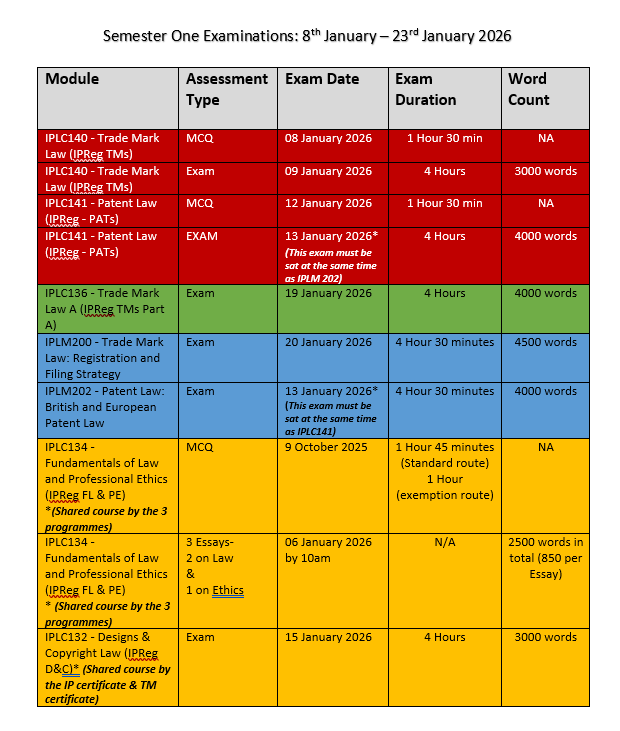
- 10.1. Exams Dates & Related Details: Semester One Examinations: 06 January - 23 January 2026
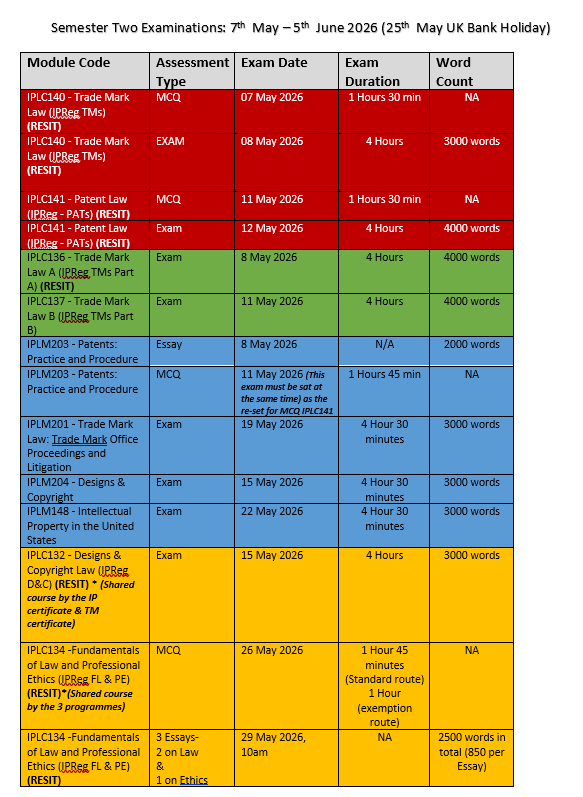
- 10.2. Exams Dates & Related Details: Semester Two Examinations: 7 May – 5 June 2026 (25 May UK Bank Holiday)
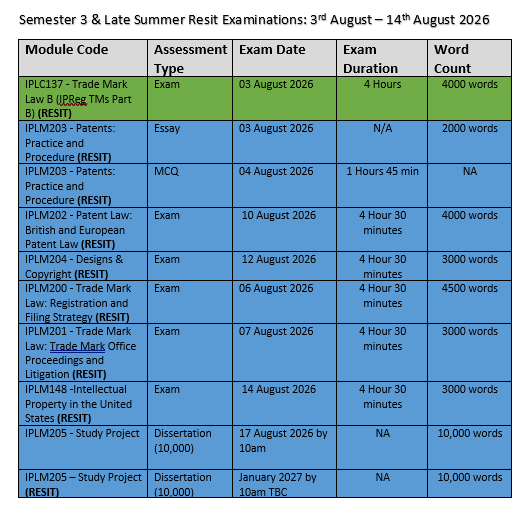
- 10.3. Exams Dates & Related Details: Semester 3 & Late Summer Resit Examinations: 3 August - 14 August 2026
- 11. Assessment (Updated 12 November 2025)
- 11.1. Module Assessment Types
- 11.2. Submission of Assessments (Course Essay/FAE/Online Exam/Dissertation)
- 11.3. Notification of Exam Dates
- 11.4. Examination Access Arrangements
- 11.5. Religious Observance and Study
- 11.6. Re-sit regulations
- 11.7. Resit Procedures
- 11.8. Course Essay
- 11.9. Final Assessment Exercise and Online Examination
- 11.10. Dissertation
- 12. Feedback
- 13. Viewing your Results
- 14. Critical Thinking and Writing
- 15. Plagiarism and Referencing
- 16. Extenuating Circumstances
- 17. College Policies
- 18. Student Voices
- 19. Marking Criteria
- 20. Award Postgraduate Taught Programmes
- 21. Graduation and Alumni
- 22. Departmental Prizes
- 23. Appeals and Complaints -
- 24. Student Services
- 24.1. Faith at QMUL
- 24.2. AskQM Frontline Enquiry Team
- 24.3. Bursaries, Grants and Scholarships
- 24.4. I.T. Services
- 24.5. Communications IT services and support LIF
- 24.6. QMplus Online Support for Modules and Noticeboards (FOR ALL)
- 24.7. QMplus Support for Module Teaching
- 24.8. QMplus Access/Logins
- 24.9. PG Law Noticeboard
- 24.10. QMplus Helpdesk and help with access
- 24.11. CCLS QMplus Helpdesk
- 24.12. Libraries
- 24.13. Institute of Advance Legal Studies (IALS)
- 24.14. Accommodation
- 24.15. Student Health Service
- 24.16. QM Advice and Counselling
- 24.17. Disability and Dyslexia Service
- 25. Careers & Employability at CCLS
- 26. Safety and Emergencies
- 27. Other useful contacts at Queen Mary
- 28. Appendix I
- 29. Appendix III: Programme: Semester Dates & Module Descriptions
- 30. Appendix II: Dissertation
- 31. Back Cover
1. Front Cover
2. Queen Mary's Mission Statement
Queen Mary’s Mission Statement
The mission of Queen Mary, University of London is:
To create a truly inclusive environment, building on our cherished cultural diversity, where students and staff flourish, reach their full potential and are proud to be part of the University. Dedicated to the public good, we will generate new knowledge, challenge existing knowledge, and engage locally, nationally and internationally to create a better world.
QMUL Charter
The QMUL Charter contains a list of expectations for both staff and students to help create a community which is mutually supportive and works to further knowledge creation and dissemination. Click here to read the Queen Mary Charter
About the School of Law
Queen Mary, part of the prestigious University of London, is one of the top UK research universities and a member of the Russell Group of leading UK universities.
In 2025 we will celebrate 60 years of law at Queen Mary University of London.
The School of Law has as its central focus the role of law and its institutions in contemporary international society and it is divided into two organisational units: the Department of Law and the Centre for Commercial Law Studies (CCLS).
The Department of Law covers the full spectrum of legal studies and is based at the University's Mile End campus.
The Centre for Commercial Law Studies (CCLS) specialises in the knowledge and skills in commercial law that can be placed at the service of government, public bodies, overseas institutions, the legal profession, industry and commerce. CCLS is based in the postgraduate law centre at the Lincoln's Inn Fields campus.
In 2024, we were ranked 7th best university in the UK and 38th in the world for Law by QS World University Rankings by Subject 2024.
Postgraduate Study at the Centre for Commercial Law Studies (CCLS)
Queen Mary, part of the prestigious University of London, is one of the top 15 UK research universities for law and a member of the Russell Group of leading UK universities.
The School of Law is comprised of the Centre for Commercial Law Studies (CCLS) and the Department of Law. The School has more than 90 faculty members, either teaching at postgraduate level or offering PhD supervision, whom are leading experts in almost all areas of law and advise and act as consultants to national and international governments, the United Nations, the World Bank, the European Commission, NGOs, legal regulatory authorities and businesses. Our staff have a long established reputation for providing high-quality teaching and internationally renowned research, with invaluable contributions from respected practitioners and industry experts.
Programmes
The Centre for Commercial Law Studies offers a wide range of postgraduate programmes including:
Certificate in Trade Mark Law and Practice, MSc Management of Intellectual Property, Diploma (General), Diploma in International Dispute Resolution (arbitration and mediation), LLM in Law and Economics, MSc Law and Finance, LLM/MSc Regulation and Compliance and the LLM in Paris. As well as distance learning options including Certificate, Diploma and LLM in Technology, Media and Telecommunications Law and Diploma in International Dispute Resolution Arbitration or Mediation.
The London-based PGT programmes is jointly offered by CCLS and the Department of Law and is the largest in the UK, with a wide range of modules, offering students a broad and liberal learning experience. Our diverse student body comes from more than 90 jurisdictions, which creates a lively, supportive and intellectually stimulating environment in which to study and research.
PhD in Law programme is offered jointly by the CCLS and Department of Law. Global - Distance Learning and Studying in Paris
If you are unable to attend classes in London, the Centre for Commercial Law Studies offers distance learning courses Technology, Media and Telecommunications Law and Arbitration and Mediation. In addition, you have the option to follow one of our CCLS led LLM programmes in Paris, providing in-depth immersion in commercial law from both comparative and international perspectives, within a common law framework.
Offered in block teaching and evening modes, the course is taught at the University of London Institute in Paris (ULIP) in central Paris, led by CCLS staff, with the generous support of leading practitioners and academics based in France.
3. Welcome
Welcome message from the Programme Director:
As the Programme Director of the Specialist Intellectual Property Programmes, I would like to extend a warm welcome to all students on all 3 specialist Programmes. CCLS offers an unprecedented range of innovative programmes at graduate level, embracing diverse disciplines while providing its students with a rich mix of opportunities that makes studying at our Centre an exciting and stimulating experience. During you studies you will benefit from the experience of leading scholars and practitioners in the field of Intellectual Property and from being part of a large, diverse and international student community.
The Specialist Intellectual Property Programmes are designed to be exciting, engaging and also challenging. That said, being at CCLS is not all about what you will learn in the classroom, our courses will give you access to a diverse range of activities to stretch and develop your knowledge, thinking and skills. Your CCLS experience will equip you for success in the future and we are certain
you will have a fantastic time here.
Within CCLS we are committed to providing a student experience of the highest standard and making sure you have the support you need along the way. This handbook will give you information to help you make the most of your time with us. I look forward to seeing you all thrive whilst you are here with us at CCLS.

Dr Jasem Tarawneh
Programme Director
Specialist Intellectual Property Programme
3.1. Your Handbook
This handbook should be read alongside:
- The Academic Regulations – covering progression, award, and classification requirements.
- The Queen Mary Student Handbook – providing information relevant to all students across the university.
Please note: Nothing in this handbook overrides the Academic Regulations, which always take precedence.
Where to Find the Regulations
- Academic Regulations: Queen Mary Policies and Regulations
- Student Handbook: QMUL Student Handbook
Accessibility
This handbook is available in large-print format. If you require a large-print copy or other accessible versions, please contact the Student Support Team, PG Law Office (LIF 3.5, Holborn) pglaw-support@qmul.ac.uk
Disclaimer
The information in this handbook is accurate as of September 2025. If significant changes are made during the academic year, you will be notified via:
- The IP Specialist Programme Noticeboard 2025/26 - Announcements
Please note: Queen Mary cannot accept responsibility for the accuracy of information found in external websites or third-party publications referenced here.
4. Departmental Location and Contact Details
Departmental Location and Contact Details
Centre for Commercial Law Studies (CCLS)
School of Law, Queen Mary University of London
67–69 Lincoln’s Inn Fields
London WC2A 3JB
+44 (0)20 7882 8100
www.qmul.ac.uk/ccls
Administration
All postgraduate Law programmes are administered from the Lincoln’s Inn Fields (LIF) building. The Teaching and Learning Team is available to support you with any questions or issues during your time at Queen Mary.
Facilities at LIF
- Building Access & Opening Hours
- Monday–Friday: 08:30 – 21:00
- Please note: PG Law Office staff are only available until 16:00.
- Always carry your Queen Mary ID card when on campus.
- Academic Staff Office Hours
- Most staff hold regular office hours in addition to teaching.
- These may be scheduled weekly or arranged by appointment.
- Contact details are available on the website Centre for Commercial Law Studies and your QMplus course pages.
- Academic staff offices are located either at LIF or at the Mile End campus (Department of Law).
- Student Study Area
- Lower Ground Floor, open 08:30 – 21:00 (Monday–Friday).
- Equipped with Wi-Fi, computers, printers, and photocopying facilities.
- Student Common Room
- Room LG.3 (Lower Ground Floor).
- Multi-Faith Room
- Located on the Lower Ground Floor of LIF.
- Reception can also provide details of local multi-faith prayer facilities.
5. Use of Queen Mary ID Card
All new students will be issued a Queen Mary
photo-identity (ID) card once they have completed full or temporary
enrolment.
Guidance on where and when to collect your card: Student
ID Card Information
Why Your ID Card Is Important
- Provides access to certain buildings and facilities (e.g. printers, photocopiers, computer rooms).
- Must be carried at all times on campus.
- Used for examinations – you must place it on your desk during all face-to-face exams and copy your student number onto your script.
- Functions as your library card.
- May be required to confirm your attendance (e.g. scanning into lecture theatres).
Rules and Misuse
- If you cannot produce your card when asked, or if staff cannot verify it belongs to you, you may be removed from the building.
- Misuse of your card (e.g. lending it to others) will normally be investigated under the Code of Student Discipline: Student Misconduct Policy.
Lost or Stolen Cards
- If your card is lost or stolen, you must obtain a replacement from the Student Enquiry Centre: How to get a new ID card.
- A replacement fee will be charged (unless your card was stolen and you can provide a crime reference number).
5.1. Communications
Queen Mary communicates with students in several ways. It is essential that you check your university email account daily during term time to ensure you do not miss important updates.
Formal Communications
- Official correspondence will be sent to you electronically.
- Keep your personal details up to date via MySIS: Update My Record.
- You will be assigned a QMUL email account at enrolment.
- All official communication will be sent to this address only. Personal email accounts cannot be used for university correspondence.
- You may redirect your QMUL email to a personal account, but the responsibility for checking remains with you.
- Access your email: QMUL Webmail.
- For login issues, contact IT Services:
its-helpdesk@qmul.ac.uk | +44 (0)20 7882 8888
Queen Mary cannot take responsibility if you miss important information because you did not check your QMUL account.
Best Practice for Email Etiquette
When emailing staff, please follow these guidelines:
- Use your QMUL email address only.
- Always include:
- Your full name
- Your student ID number
- Your programme of study
- Check your email every working day during term time.
- Write in a polite, professional register (avoid slang and text-style abbreviations).
- Always complete the subject line.
- Address the recipient appropriately (e.g. “Dear Dr…”) and close with a polite sign-off.
- Do not send blank emails.
- Only copy in others if directly relevant. Place the person responsible for action in the “To” field, and use “CC” for information only.
Email Signature
Adding a standard signature helps staff process your query more quickly. Include:
- Name
- Student ID
- Programme of study
Guidance on creating a signature: How to add an Outlook signature
After Graduation
Your email account will close approximately two months after graduation. Please ensure you back up any important messages or files in advance. For details: IT Services FAQs
6. Contacts: PG Law Office
Contacts: PG Law Office
The Teaching and Learning Services team is based in the Postgraduate Law Office (LIF 3.5, Holborn campus). Staff are available to help with general enquiries:
Opening Hours: Monday–Friday, 10:00–16:00 (excluding bank holidays)
Drop-in: PG Law Office, LIF 3.5
To avoid disappointment, please email ahead if you wish to meet a specific member of staff.
Team Contacts by Area
Student Support - pglaw-support@qmul.ac.uk
- General enquiries and induction events
- Pastoral support, welfare, and safeguarding
- Extenuating circumstances, scholarships, changes of programme, interruptions, withdrawals, deregistrations
- Student handbook queries
- Module evaluation, course reps, and Student Voice Committees
- Student communications, events, and activities
- Student Engagement
Quality And Student Services Online enquiries: AskQM
- Change of Programme, Interruptions, Withdrawals, and De-registrations
- Module Selection Queries
- London Programmes – Module Diet SetupTeaching Timetable Management
- Student Tutorial Allocations
- Dissertation Supervisor Allocation
- Module and Programme Description Book
- Syllabus Collection
Assessments - Online enquiries: AskQM
- Exam and assessment queries
- Submission deadlines
- Dissertation supervision and allocation
- Extenuating circumstances and academic regulations
- Academic misconduct, appeals, and complaints
- Assessment submission - pglaw-submissions@qmul.ac.uk
Partnerships and Distance Learning - pglaw-global@qmul.ac.uk
- LLM programmes in Paris and Distance Learning
- Online learning programmes and short courses
- European Intellectual Property Institutes (EIPIN) and Pan-European Seal Programme
- Associate and visiting students
- Partnership programme queries
Digital Learning (QMplus) - Online enquiries: AskQM
- Access and setup of QMplus module pages
- Online classes, lecture recordings, and troubleshooting
- Coursework/exam submission issues
- Support with Turnitin self-similarity reports
7. Academic Contacts
Academic Support Contacts
General Academic Advice
All students are encouraged to seek informal advice from academic staff throughout their studies.
Programme Director
Dr Jasem Tarawneh
j.tarawneh@qmul.ac.uk
4th Floor, Lincoln’s Inn Fields (LIF)
The Programme Director provides academic leadership for your programme, including:
- Overseeing programme content and structure
- Implementing improvements based on student feedback
- Offering guidance on overall academic progress
If you have concerns that cannot be resolved by your Module Convenor, or if your query relates to your overall programme, please contact the Programme Director. They are available during term time and can offer general academic advice and support.
Academic staff may also refer students to the Programme Director if they believe a student is struggling. In some cases, issues may be escalated to the School of Law’s Director of Teaching and Learning or a relevant committee.
Module Convenors
Your first point of contact for any questions or concerns about a specific module.
- Each module has a designated Module Convenor, typically a member of the CCLS academic staff.
- In some cases, teaching may be delivered by Academic Leads (affiliated or external academics), who work closely with the Module Convenor.
How They Support You
- Provide guidance on teaching, assessment, and module content
- Address special requirements or academic concerns
- Offer feedback and support after assessments
- Refer you to additional support services if needed
Module Convenors hold regular office hours during term time. Check your module page or contact them via email to arrange a meeting.
For most module-related queries, your Module Convenor should be your first point of contact.
For programme-wide concerns, contact your Programme Director.
If the matter remains unresolved, it may be referred to the Director of Teaching and Learning.
Full staff list and contact details: School of Law
7.1. CCLS ACADAMICS
Name and Responsibilities:
|
Name |
|
Responsibilities |
|
Jasem Tarawneh |
Programmes Director Module Convenor: IPLC132 Designs & Copyright Law (Cert TM & Cert IP) IPLC136 Trade Mark Law A (IPReg TMs Part A) IPLC137 Trade Mark Law B (IPReg TMs Part B) IPLC138 Fundamentals of Law and Professional Ethics (Exemption Route) IPLC140 Trade Mark Law (IPReg TMs) IPLC141 Patent Law (IPReg - PATs) IPLM202 Patent Law: British & European Patent Law IPLM203 Patents: Practice and Procedure (MSc IP) IPLM205 Study Project (MSc IP) Lecturer: IPLC134 Fundamentals of Law and Professional Ethics (IPReg FL & PE) IPLC136 Trade Mark Law A (IPReg TMs Part A) IPC 137 Trade Mark Law B (IPReg TMs Part B) |
|
|
Guan Tang |
IPLC137 Trade Mark Law B (IPReg TMs Part B) |
|
|
Guido Westkamp |
Module Convenor: IPLM131 Competition Law Overview (MSc IP) IPLM148 Intellectual Property in the United States (MSc IP) IPLM204 Designs & Copyright (MSc IP) |
|
|
Gail Evans |
|
Module Convenor: IPLM200 Trade Mark Law: Registration and Filing Strategy (MSc IP) IPLM201 Trade Mark Law: Trade Mark Office Proceedings and Litigation (MSc IP) |
|
Theodora Christou |
Module convenor: IPLC134 Fundamentals of Law and Professional Ethics (Cert IP, Cert TM & MSc IP) Lecturer on: IPLC134 Fundamentals of Law and Professional Ethics (Cert IP, Cert TM & MSc IP) IPLC138 Fundamentals of Law and Professional Ethics (Exemption Route) |
|
|
Phillip Johnson |
Academic Lead: IPLC141 Patent Law(Cert IP) IPLM202 Patent Law: British & European Patent Law(MSc IP) IPLM205 Study Project (MSc IP) Lecturer on: IPLC136 Trade Mark Law A (IPReg TMs Part A) IPLC137 Trade Mark Law B (Cert TM) |
|
|
Darren Smyth (External) |
Lecturer: IPLC132 Designs & Copyright Law (Cert TM & Cert IP) IPLC134 Fundamentals of Law and Professional Ethics (Cert IP, Cert TM & MSc IP) IPLC138 Fundamentals of Law and Professional Ethics (Exemption Route) |
|
|
Brian Chun Lok Leung |
Lecturer: IPLC134 Fundamentals of Law and Professional Ethics |
|
|
David Stone |
Lecturer: IPLC132 Designs & Copyright Law (Cert TM & Cert IP) IPLC137 Trade Mark Law B (IPReg TMs Part B) |
|
|
Alexander von Mühlendahl |
Lecturer: IPLC136 Trade Mark Law A (Cert TM) IPLC137 Trade Mark Law B (Cert TM) |
|
|
Catherine Wolf (External) |
Lecturer: IPLC136 Trade Mark Law A (Cert TM) |
|
|
John Hull |
Lecturer: IPLC136 Trade Mark Law A (Cert TM) |
|
|
Marijan Hucke (External) |
IPLC137 Trade Mark Law B (IPReg TMs Part B) |
|
|
Anthony Yerasimou (External) |
Lecturer: IPLC136 Trade Mark Law A (IPReg TMs Part A) |
|
|
Emily Scott (External) |
Lecturer: IPLC136 Trade Mark Law A (Cert TM) |
|
|
Nina O’Sullivan |
Lecturer: IPLC132 Designs & Copyright Law (Cert TM & Cert IP) |
|
|
Susan Payne |
Lecturer: IPLC137 Trade Mark Law B (Cert TM) |
|
|
Tom Priem |
Lecturer: IPLC137 Trade Mark Law B (Cert TM) |
|
|
Ashley Roughton |
Module convenor: IPLM203 Patents: Procedure and Practice Lecturer: IPLC137 Trade Mark Law B (IPReg TMs Part B) |
7.2. Teaching Assistants
Teaching Assistants help with:
- Uploading teaching materials to QMplus
- Supporting MSc students with research and critical writing
- Induction week “bridging lecture”
Contact:
- Brian Chun Lok Leung: b.c.l.leung@qmul.ac.uk
- Myriam Christmann: myriam.christmann@qmul.ac.uk
- Miguel Angel Perez Espinosa: m.angelperezespinosa@qmul.ac.uk
- Jude Okwuchukwu Mbonu: j.o.mbonu@qmul.ac.uk
8. Teaching Delivery
All courses in our three programmes are delivered face-to-face, and in-person attendance is required. However, in certain circumstances—such as public health concerns or unforeseen staff absences—teaching may temporarily move online. If this happens, CCLS will always act in your best interests and take reasonable steps to minimise any disruption to your learning and assessment.
You will be notified promptly of any significant changes to teaching delivery. Please check your QMUL email and QMplus course pages regularly for the latest updates.
All your courses are supported by QMplus, our interactive online platform. Here, you’ll find course materials, announcements, and lecture recordings. Most in-person lectures and tutorials are recorded and made available on QMplus as soon as possible. If you have trouble accessing recordings, please contact the Teaching and Learning Services Office or your Module Convenor for help.
Your Module Convenors and Programme Director are available to answer questions about teaching and assessment—by email, online meetings, or in-person appointments, as needed. Don’t hesitate to reach out if you need support.
9. Student Engagement
Student engagement with their studies is monitored for welfare and support purposes only.
Why We Monitor Engagement
Engagement data helps us to:
- Identify students who may need additional support or are at risk
- Provide tailored advice to help students access support services and improve academic outcomes
This process is designed to ensure that every student has the opportunity to thrive during their studies.
If you have any questions after reading this section, please contact the PG Law Student Support Team at:
pglaw-support@qmul.ac.uk
Further Information
You can read the full College Policy on Student Engagement, Retention and Success here:
Student Learning Engagement Policy
9.1. Markers of Student Engagement
For the timely and effective administration of support, the School will use the following markers of student engagement. This is to ensure that students are well supported and given every opportunity to progress with their studies and to achieve to their fullest potential whilst here.
Lecture attendance: It is the student’s responsibility to ensure that they are actively engaging with their programme. Students are required to attend all timetabled teaching especially lectures and and in-class assessments. Students are expected to attend tutorials associated with the modules they are registered on.
To request a leave of absence please see: Authorised Absence and Short Term Absence
Other markers of student engagement are:
On campus courses, full time
|
Faculty-level Engagement Indicators |
|
Attendance at small and/or large format teaching activities |
|
Submission of assessments |
|
QMPlus log in activity |
|
School-specific Engagement Indicators |
|
Access to Induction QMplus page (first two weeks of Semester 1) |
|
Access to module QMplus pages |
|
Lecture attendance (3 per week) |
|
Assessment submissions (Assessment periods: Sem 1 (Jan), 2 (May/June) & 3 (August) |
|
Dissertation (if applicable) supervision meetings – March, June/July |
9.2. Student Engagement Monitoring Procedure
Queen Mary monitors student engagement both online and in person to ensure academic progress and identify students who may need support.
Online Engagement
Your activity on QMPlus—such as accessing module pages and submitting assignments—helps demonstrate your engagement with your studies.
Lecture Attendance Monitoring
To monitor attendance effectively, students must:
- Enter the attendance code provided during each lecture into the QMUL app using the ‘Record Attendance’ tile.
- The code is a six-digit format:
XX-XX-XX.
Do not share attendance codes. Doing so may prevent the School from identifying students who need support or are at risk.
Attendance Checkpoints
Attendance is reviewed at four key points during each 10-week teaching block:
- End of Week 3
- End of Week 5
- End of Week 8
- End of Week 10
If You Cannot Record Your Attendance
If the app doesn’t work, try the following:
- Use the web version: QMUL App Web Access
- Log out and back in on the app or web version to refresh settings
- If issues persist, ask your module convenor/lecturer to manually record your attendance
- Manual entry is only possible for classes held within the last 4 weeks
Need Help?
If you experience ongoing issues or cannot see the attendance tile:
Contact the PG Law Student Support Team: pglaw-support@qmul.ac.uk
9.3. What will my student engagement data be used for?
Student engagement data—both online and in-person—is monitored to help identify students who may need additional support and to encourage active participation in their studies.
Purpose of Monitoring
- The primary aim is to support students in engaging or re-engaging with their programme.
- Once a student is admitted, the School has a duty of care, and students have a responsibility to make use of the support available.
- Any outreach from the School will be tailored to the individual’s needs, with the goal of helping them succeed.
When Engagement Falls Below Expectations
If a student is identified as approaching or falling below the minimum engagement requirements set by their School:
- They will be contacted and informed of their engagement status.
- The communication will include support options to help address any underlying issues affecting their participation.
9.4. What will happen if my student engagement data shows a lack of engagement?
If your engagement data indicates that you may be struggling to keep up with your studies, the School will take steps to support you.
Support Process
- You will be invited to a meeting with your Student Support Officer to discuss any issues affecting your engagement.
- The meeting is intended to offer encouragement, advice, and, if needed, referral to Queen Mary support services.
- In exceptional circumstances, a senior member of the School team may also be involved in the support process.
Risk of Deregistration
Students who consistently fail to engage with their studies may be deregistered from their programme in accordance with the Academic Regulations.
Your Responsibility
The School is committed to helping students overcome challenges—but we can only do so if we are informed. If you are experiencing difficulties that affect your ability to engage:
- Speak to an appropriate member of staff as early as possible.
- Early communication gives us the opportunity to intervene and provide tailored support.
9.5. Who will have access to my student engagement data?
We understand the importance of protecting your personal data. Your student engagement data is used solely for welfare and support purposes, helping the University provide tailored assistance when needed.
Who Can See Your Data?
Only two groups of people have access to your engagement data:
-
Support and Academic Staff
- This includes PG Law Student Support Officers and academic staff directly involved in your programme.
- Access is limited to staff who work directly with you—not across the entire University.
-
Technical and System Support Staff
- This includes Queen Mary IT staff and, where applicable, external software providers who maintain the engagement monitoring systems.
- These individuals access data only for system maintenance and development purposes.
All staff accessing your data must comply with strict data protection regulations.
How Your Data Is Used
- Your data may be anonymised and aggregated with other students’ data to identify trends and improve support services.
- When used in this way, it is not possible to identify you personally.
What Your Data Will Not Be Used For
- It will not be shared with third parties (e.g. employers).
- It will not affect your module marks or student record.
- It will never be used for the Prevent scheme.
- It is processed in accordance with Queen Mary’s Data Protection Policy and Student Privacy Notice.
9.6. Authorised Absence and Short Term Absence
Term Time
Term-time is the period between your official course start date and end date (check in MySIS) - only the Christmas and Easter holidays are vacations (examination periods are part of term-time). The period between the end of final assessments for Semester 3 and your course end date is not a vacation. You use this time to complete a project or dissertation, or prepare and sit exams. You are still known as a student until your course completion date stated in MySiS.
Please check the 'Key Date' section in the Student Handbook.
Short-Term Absence and Authorised Absence
Short-Term Absence
|
Authorised Absence |
|---|---|
|
If you are unable to engage in your studies due to a short-term absence such as sickness or for other reasons that are less than 7 consecutive days, then it is not necessary to inform the PG Law Student Support and Engagement team or the class academic/teaching assistant. Please ensure you make the necessary arrangements to catch up with any teaching activities you may have missed.
If your short-term absence continues more than 7 days, you should notify the PG Law Student Support & Engagement Team via email pglaw-support@qmul.ac.uk.
|
Students can request up to 14 consecutive days of leave during term-time (including weekends). In exceptional cases, it may be possible to request more than 14 consecutive days of leave during term-time (including weekends), but students will need to complete the Authorised Absence Request Form and provide evidence. Please note that a period of continued absence for more than two consecutive weeks will not normally be permitted; however, this should be for unavoidable reasons only. In both cases above, you MUST inform the PG Law Student Support & Engagement Team at least 7 working days in prior to your leaving date by emailing to pglaw-support@qmul.ac.uk. This will be noted as ‘Authorised Absence’ and we will provide a letter confirming this for you.
|
10. Key Dates
The dates in this table are for all full time and part time programmes.
Other key Queen Mary dates are available on the ARCS homepage (www.arcs.qmul.ac.uk) and here: http://www.qmul.ac.uk/about/calendar/
Semester Dates
In addition to the general key dates listed below, please see Section - Appendix III: Programme: Semester Dates & Module Description:
- Managment in Intellectual Property MSc
- Intellectual Property Law Certificate
- Trademark Law and Practice Certificate
Semester Dates 2025 – 26
|
Semester 1 (A25) Term Dates |
08 September – 12 December 2025 |
|
Semester 2 (B25) Term Dates |
26 January – 10 April 2026 |
|
Semester 3 (C25) Term Dates |
No teaching – dissertation and assessment only
|
Semester 1 (A25)
|
08 September 2025 |
Semester 1 (A25) Teaching Begins |
|
17 October 2025 |
Deadline for Religious Holiday form for Semester 1 (A25) |
|
03 November 2025 |
Academic Integrity, QM+ module deadline |
|
28 November 2025 |
Deadline for all September start PG students to transfer from full time to part time/variable mode status |
|
26 November 2025, 10:00am (GMT) |
Dissertation Title and Proposal Submission |
|
28 November 2025 |
Deadline for the submission Exam Access |
|
xx December 2025, 16:00 - 19:00 (TBC) |
Semester 1: End of term party (Shields Cafe, Charterhouse Square) |
|
12 December 2025 |
Semester 1(A25) Teaching Period Ends |
|
15 December 2025 – 02 January 2026 |
Study Week |
|
25 December 2025 – 02 January 2026 |
University Closure |
Semester 2 (B25)
|
07 January 2026 |
Deadline for students to apply for interruption of study/withdrawal from study prior to SEM 2 (B25) examinations |
|
08 – 23 January 2026 |
Semester 1 (A25) Online Examination period |
|
Check Exams Dates & Related Details: Semester 1 (A25) Examinations |
Semester 1 (A25): Essay Submission |
|
26 January 2026 |
Semester 2 (B25) Teaching Begins |
|
30 January 2026,10:00am (GMT) |
Semester 1 (A25) Extenuating Circumstances claim deadline |
|
13 February 2026 |
Deadline for Religious Holiday Notification form for Semester 2 (B25) |
|
27 February 2026 |
Subject Examination Board |
|
09 February – 07 May 2026 |
Study Project Module - Introduction Lecture Study Project Module - Mentor Meetings (Meeting dates will be confirmed by mentors) |
|
02 March 2026 |
Publication of provisional results for Semester 1 (A25) MYSIS |
|
03 - 07 March 2026 |
Study Week |
|
18 March 2026 |
PGT Degree Examination Board (ONLY applicable to Intellectual Property Law Certificate students) |
|
24 March 2026 |
Official publication of results MySiS: PGT students Semester 1 (A25) |
|
28 March 2026 |
Deadline for the submission Exam Access |
|
02 April 2026 |
Deadline for the submission Exam Access |
|
10 April 2026 |
Semester 2 (B25) Teaching Ends (Law modules) |
|
06 May 2026 |
Deadline for taught students to apply for interruption of study/withdrawal from study prior to Semester 2 (B25)/Year |
|
07 May – 05 June 2026 |
Semester 2 (B25) Online Examination period and Semester 1 (A25) resit period |
| Check Exams Dates & Related Details: Semester 2 (B25) Examinations |
Semester 2 (B25): Essay Submission |
|
14 July 2026 |
Official publication of results via MySiS: PGT students |
Semester 3 (C25)
|
12 June 2026, 10:00am (BST) |
Semester 2 (B25) Extenuating Circumstances claim deadline |
|
30 June 2026 |
Deadline for PG students to interrupt their studies to retain examination marks but to defer the Project/Dissertation to a future year |
|
17 August 2026, 10:00am (BST) |
Semester 3 (C25): Dissertation submission (IPLM205) |
|
26 August 2026, 10:00am (BST) |
Semester 3 (C25) Extenuating Circumstances claim deadline |
|
Check Exams Dates & Related Details: Semester 3 (C25) Examinations |
Semester 3 (C25): Essay Submission |
|
Official Result Release |
22 October 2026 |
|
HEAR Publication Date |
05 November 2026 |
Study Skill Sessions (Dates maybe subject to Change)
| 15 October, 13:00 - 14:00 | Dissertation overview session |
| 29 October, 12:00 - 13:00 | Citation Needed! OSCOLA Referencing Workshop |
| TBC | Themed Dissertation session: Programme of Study |
| 12 November, 12:00 - 13:00 | Approaching your Final Assessment Exercise or Examinations |
| 19 November, 12:00 - 13:00 | Dissertation Title Proposal Guidance session |
| 19 November, 13:00 - 14:30 | Effective Postgraduate Law Essay Writing (for NON-CTW students) |
|
3 December, 13:00 - 14:00 |
Extenuating Circumstances Guidance |
|
3 December, 13:00 - 14:00 |
Assessment Submission QMplus Guidance |
Student Voice Committee (dates to be confirmed)
|
Semester 1 (A25) |
30 October 2025, 12-2pm |
|
Semester 2 (B25) |
5 February 2026, 12-2pm |
10.1. Exams Dates & Related Details: Semester One Examinations: 06 January - 23 January 2026
Colours Key:
Intellectual Property Law PG Certificate Exams- Red
Trade Mark Law & Practice PG Certificate Exams-Green
MSc in Management of Intellectual Property Law-Blue
Shared courses- Yellow
10.2. Exams Dates & Related Details: Semester Two Examinations: 7 May – 5 June 2026 (25 May UK Bank Holiday)
Colours Key:
Intellectual Property Law PG Certificate Exams- Red
Trade Mark Law & Practice PG Certificate Exams-Green
MSc in Management of Intellectual Property Law-Blue
Shared courses- Yellow
10.3. Exams Dates & Related Details: Semester 3 & Late Summer Resit Examinations: 3 August - 14 August 2026
Colours Key:
Intellectual Property Law PG Certificate Exams- Red
Trade Mark Law & Practice PG Certificate Exams-Green
MSc in Management of Intellectual Property Law-Blue
Shared courses- Yellow
11. Assessment (Updated 12 November 2025)
Each module in the PG Law programme has its own assessment method. When choosing your modules and planning your year, please consider how each module is assessed and what suits your learning style.
Assessment methods may include:
- Online examinations
- On-campus examinations
- Essays
- Final Assessment Exercise (FAE)
- Presentations or in-class activities
- Or a combination of these
For modules assessed by FAE, online, or on-campus exams, you’ll answer a set of questions covering the topics taught during the module.
Exam dates are set centrally and published on your Examination Timetable in the MySIS portal before each exam period. Please note: the PG Law Office and Module Convenors receive the final timetable at the same time as students, so we cannot confirm exam dates before they are officially released.
11.1. Module Assessment Types
Each module has its own assessment method. When planning your studies, please check how each module is assessed and choose those that best suit your strengths and preferences.
Assessment Types
-
Online Examinations:
You’ll answer a set of questions covering topics taught in the module.- Exam dates and durations are published in your Semester Examination Timetable (see MySIS).
- Submissions up to 10 minutes late are accepted with a 10% penalty. After that, the portal closes and non-submissions receive a mark of 0-FL.
-
Course Essays:
Some modules are assessed partly or fully by essays linked to your taught modules.- Essays are overseen by one of your module’s teaching staff.
- Essays submitted up to 7 calendar days late are accepted with a late penalty.
- Extensions of up to one week may be granted for valid extenuating circumstances.
-
Multiple Choice Quizzes (MCQs):
MCQs cover topics taught in the module.- You have a 24-hour window to start the quiz, but once started, you have 2 hours to complete it.
- You cannot pause once you begin.
- Late submissions are not permitted.
-
Presentations / Oral Assessments:
Some modules include a class presentation or oral component.- Dates for presentations are treated as exam dates; attendance is required (in person or online, as specified).
- Your Module Convenor will provide details.
- If you cannot attend due to extenuating circumstances, please refer to the relevant section for guidance.
-
Other Assessment Elements:
Some modules may include additional in-class or practical elements. Details are provided in your module outline.
For full details on how each module is assessed, see Appendix III: Programme Structure and Overview.
Academic Regulations:
For the full regulations governing assessment, see the Academic Regulations 2025–26.
11.2. Submission of Assessments (Course Essay/FAE/Online Exam/Dissertation)
Saving Your Work
Students are strongly advised to save all work to QMUL OneDrive, the university’s secure cloud storage service. This ensures your files are backed up and accessible from any device.
Refer to the OneDrive Guide for instructions on how to access and use the service.
Draft Submission (Turnitin Similarity Check)
Submitting Assignments via QMplus (Turnitin)
For all assignments (essays, FAEs, dissertations, and online exams):
- Submit your work to the relevant QMplus module page by the specified deadline (UK time).
- When you submit, your work is automatically checked for plagiarism using Turnitin.
See the Turnitin section for more details on how this process works.
Draft Submission (Turnitin Similarity Check)
- You can upload a draft version of your work to the Draft Submission Page to check your Turnitin similarity score before final submission.
- Draft submissions are not stored in the Turnitin student database and do not count as your final submission.
- You can submit drafts as many times as you wish to help reduce your similarity score.
- Important: Draft submissions are not linked to your module. You must submit your final version to the correct module submission point for it to be marked.
- Generating a similarity report may take time, especially during busy periods – do not expect an instant report.
Do not use other online plagiarism checking services.
Final Submission
- A specific submission point will be available on your QMplus module page before the deadline.
- You can only submit your assessment once. Resubmissions are not permitted, so please ensure you upload the correct and final version of your assessment to the submission portal. You will receive a Turnitin and QMplus receipt upon correct submission.
- Submit at least 30 minutes before the deadline to avoid last-minute technical issues.
- Essays or dissertations submitted up to 7 days late will be accepted but will incur a late penalty (see the Late Submission Policy in this handbook).
- Submissions for online exams and FAEs made within 10 minutes after the scheduled deadline will be accepted, but subject to a 10% penalty.
If you have technical issues submitting before the deadline:
Email your work as a single file (.pdf or .doc[x]) to pglaw-submissions@qmul.ac.uk and it will be uploaded on your behalf. This email is for submissions only.
Late Submissions and Penalties
- Online Exams and FAEs: Submissions up to 10 minutes after the deadline are accepted but incur a 10% penalty. After that, the portal closes and non-submissions receive a mark of 0-FL.
- Essays/Dissertations: Late submissions are accepted up to 7 days with a penalty; see the Late Submission Policy for details.
Extenuating Circumstances
If you are experiencing difficulties meeting a submission deadline, please refer to the Extenuating Circumstances section for guidance and support.
11.3. Notification of Exam Dates
All examinations are governed by the QMUL Exams Office. The majority of CCLS exams will be held online, although some modules will require on-campus, in-person exams.
Exam Scheduling
- Exams may be scheduled in either the morning or afternoon.
- You will have only one exam per 24-hour period.
- The examination period is part of the official term dates, and you are expected to be in the UK during this time.
If you plan to take your exams outside the UK, you must refer to the Student Engagement section of this handbook and submit a Short-Term Leave and Authorised Absence Request.
All exam times are listed in UK time.
Exam Timetables
- Individual module exam dates are set by the University and will be published on your MySIS portal.
- You can also view the full University exam timetable here:
Exam Timetable/Information – QMUL
Please refer to the Key Dates section of this handbook for the specific examination period.
Past Exam Papers
If you have any questions about the exam paper format prior to sitting them, you should refer them to either the teaching academic concerned or to your Module Convenor
Important Notes
- Exam dates cannot be changed for any reason. You must be available for the entire duration of the assessment period.
- The PG Law Office does not receive advance notice of exam dates and cannot assist with individual queries regarding scheduling.
- You are responsible for submitting your exam on the allocated date.
Extenuating Circumstances
If you are unable to submit your exam due to unforeseen circumstances, you may be eligible to apply under the Extenuating Circumstances Policy. Please refer to the relevant guidance for more information.
11.4. Examination Access Arrangements
Students with disabilities, specific learning differences (such as dyslexia), or short-term conditions (e.g. broken limbs or pregnancy) may be eligible for Examination Access Arrangements (EAAs). These arrangements are managed by the Disability and Dyslexia Service (DDS).
The DDS works with students to determine appropriate adjustments, in line with Queen Mary University of London’s legal duty to provide reasonable adjustments under the Equality Act (2010).
Evidence Requirements
To apply for EAAs, students must submit supporting documentation:
- For disabilities or short-term conditions: Medical evidence dated within the last two years.
- For specific learning differences (e.g. dyslexia): A diagnostic report completed after the student’s 16th birthday.
All documentation must be in English.
How to Apply
Students should complete the EAA application form available via MySIS, by the deadline published on the EAA website. This deadline is the final date by which DDS can guarantee arrangements will be in place for end-of-teaching or year-end exams.
Late applications may still be considered, but arrangements might not be implemented until the following academic year.
For full details and deadlines, please visit the Examination Access Arrangements.
11.5. Religious Observance and Study
For guidance on religious observance, please refer to the following link: Religious Observance
Students are reminded to check their QM email accounts for an important announcement regarding the submission of the online Notification of Religious Holidays form. Please refer to the Key Dates section for the submission deadline.
11.6. Re-sit regulations
Failed Assessments, Non-Attendance, and Non-Submission
Students are permitted a maximum of two attempts for each assessment element:
- First attempt
- One resit opportunity
If you fail, do not attend, or do not submit an assessment, you may resit it at the next available opportunity.
Important Rules About Resits
- You cannot resit an assessment element if you have already passed the module overall, even if you failed or missed an individual component.
- All eligible students are automatically enrolled for required resits.
- Deferrals of first attempts or resits are not permitted unless supported by extenuating circumstances.
- Resits are free of charge and will take place at the next available opportunity.
- If you do not complete a scheduled resit or first attempt, it will still count as one of your two permitted attempts.
Capped Resit Marks
- If you resit an assessment, your overall module mark will be capped at 50 (the minimum pass mark).
- If you fail all attempts, the highest mark achieved (‘best fail’) will be recorded.
Condonable Marks
- For information on condonable marks, please refer to the Award Postgraduate Taught Programmes section.
- You may choose to opt out of a resit and accept a condonable mark.
This means forfeiting any remaining attempts to pass that module.
Resit Dates and Deadlines
- Please check the Appendix III: Programme: Semester Dates & Module Descriptions section for resit information related to any failed or missed assessments.
Note for MSc in Management of Intellectual Property Students
If you are resitting an exam or essay, this may coincide with work on your Dissertation.
It is important to plan ahead, as resits are not considered valid extenuating circumstances for missing your dissertation or other assessments.
11.7. Resit Procedures
Course Essays
Students who fail to submit or do not pass their required essays for modules in Semester 1 or Semester 2 should refer to the Key Dates section for the next available opportunity to resubmit.
Resit Oral Components
Resit dates for oral assessments will be communicated directly to affected students closer to the time.
Resit Dissertations
(Applicable to MSc Management of Intellectual Property only)
Students who do not submit or fail their Dissertation must resubmit at the next available opportunity, as outlined in the Key Dates section.
Further details about the resubmission process will be provided to relevant students nearer the time.
If you are resubmitting a Dissertation in the following academic year, please note:
- No additional supervisory meetings will normally be provided.
- Limited guidance via email may be available from your original supervisor, if possible.
- If your original supervisor is unavailable (e.g. on sabbatical), a new first marker will be appointed and you will be informed.
Need Support?
If you are experiencing difficulties due to extenuating circumstances, please contact: pglaw-support@qmul.ac.uk for further guidance and support.
11.8. Course Essay
Word Count Guidelines for Course Essays
Essay word counts may vary depending on the module. You are allowed a 10% margin above or below the stated word limit without penalty.
However, please note that markers will not read or assess any content beyond the 10% upper limit.
What Counts Towards the Word Limit?
All words are counted except for the bibliography.
The following are examples of content that do count towards your word total:
- Table of contents
- Appendices
- Footnotes and endnotes
- Wording under diagrams
- Abstracts
- Words within graphs, tables, and diagrams
This list is not exhaustive. As a general rule: if it’s written, it counts — so use your words wisely.
Meeting the Word Count
While it’s understood that hitting the exact word count can be challenging, you should aim to get as close as possible without exceeding the maximum.
At Master’s level, students are expected to be able to edit and refine their work to meet word count requirements.
There is no minimum word count, but essays that fall significantly short may fail to fully address the topic and will be marked accordingly.
Title Page Requirements
Your submitted essay must include a title page (or top sheet) with the following information:
- Module number (e.g. SOLMxxx)
- Module title
- Final word count
- Student ID number (not your username — check MySIS or your student ID card)
- Do not include your name anywhere on the essay
You may use colour or graphics on the title page if you wish, but this is optional.
Formatting Recommendations
There is no official style guide, but we recommend the following:
- Font: 12-point, in a standard readable style (e.g. Times New Roman, Arial)
- Line spacing: Double-spaced
- Margins: At least 2 cm
- Citations: Required — either inline or in footnotes
- Footnotes: No smaller than 10-point font, ideally matching the main text font
11.9. Final Assessment Exercise and Online Examination
There is no official style guide for formatting your Final Assessment Exercise or Online Examination submission. However, to ensure clarity and consistency, we recommend the following:
General Formatting
- Font: Use a standard, readable font such as Times New Roman, Arial, or Calibri
- Font size: 12-point for the main text
- Line spacing: Double-spaced
- Margins: Minimum of 2 cm on all sides
- Citations: Required for all assessments. You may use either:
- Inline citations, or
- Footnotes (no smaller than 10-point font, ideally in the same font as the main text)
Title Page Requirements
Your submission must include a top sheet (title page) containing the following information only:
- Module number (e.g. SOLM001)
- Module title
- Final word count
- Student ID number (not your username — check MySIS or your student ID card)
- Your name must not appear anywhere on the assessment.
You may include colour or graphics on the title page if you wish, but this is optional and not required.
11.10. Dissertation
Word Count
You are permitted a 10% margin above or below the stated word limit without penalty.
However, please note that markers will not assess any content beyond the 10% upper limit.
All words are counted except for the bibliography.
The following elements are included in the word count:
- Table of contents
- Appendices
- Footnotes and endnotes
- Abstract
- Wording under diagrams
- Words within graphs, tables, and diagrams
This list is not exhaustive. As a general rule: if it’s written, it counts — so use your words wisely.
While it may be difficult to meet the word count exactly, you should aim to get as close as possible without exceeding the maximum.
At Master’s level, students are expected to be able to edit and refine their work to meet word count requirements.
There is no minimum word count, but dissertations that are significantly shorter than the maximum may fail to fully address the topic and will be marked accordingly.
Title Page Requirements
Your submitted dissertation must include a top sheet (title page) with the following information only:
- Module number (e.g. IPLMxxx)
- Module title
- Final word count
- Student ID number (not your username — check MySIS or your student ID card)
- Your name must not appear anywhere on the dissertation.
You may include colour or graphics on the title page if you wish, but this is optional.
Formatting Recommendations
There is no official style guide for dissertations. However, we recommend the following formatting for clarity and consistency:
- Font: Use a standard, readable font such as Times New Roman, Arial, or Calibri
- Font size: 12-point for the main text
- Line spacing: Double-spaced
- Margins: Minimum of 2 cm on all sides
- Footnotes: No smaller than 10-point font, ideally in the same font as the main text
12. Feedback
Accessing Feedback
- Feedback for your assessments will be available via QMplus, where you submitted your work.
- Feedback may be provided in various formats, depending on the structure of the module.
Types of Feedback
Feedback may be delivered through:
-
Lecture and revision sessions:
- Whole-class feedback
- Group feedback
- Individual feedback on tasks or mock answers
-
Tutorials:
- Feedback on individual or group responses to specific topics
Student Responsibilities
- You are expected to actively participate in feedback sessions, whether individually or in groups.
- You should reflect on both class-wide and individual feedback to improve your academic performance.
- If you require additional feedback, you are encouraged to contact the module convenor directly.
13. Viewing your Results
You can view your assessment marks by logging into MySIS using your usual credentials. Your marks will be listed under your academic record.
Important Notes
- Marks shown on MySIS are provisional until they are confirmed by the Degree Examination Board (DEB).
- MySIS will clearly indicate whether your results are provisional or confirmed (official).
For step-by-step guidance on checking your results, visit: Receiving Your Results – Registry Services
14. Critical Thinking and Writing
Critical Thinking and Writing in Law (CTWL)
The Queen Mary Critical Thinking and Writing in Law (CTWL) programme is a specialised series of classes designed to enhance the accuracy, clarity, and effectiveness of postgraduate Law students’ academic writing and research. CTWL also supports more confident participation in seminars and helps students prepare for exams and dissertations with greater assurance and skill.
A Pathway to Success for PG Law Students
Academic writing at postgraduate level is a discipline-specific skill that takes time to develop. Since assessment is primarily through essays, exams, and dissertations, the Language Centre, in collaboration with the Postgraduate School of Law, has created two tailored modules and a series of supplementary sessions to support students in:
- Strengthening research and writing skills
- Building confidence in academic communication
- Enhancing overall performance across assessments
Programme Objectives
The CTWL programme is designed to achieve three key goals:
- Support conditional offer holders in meeting their language requirements (see Section 1 for details)
- Deepen understanding of effective learning strategies for postgraduate study
- Guide students through the writing process for essays and dissertations, from planning to final submission
Programme Structure
To meet these objectives, CTWL offers:
- Two 10-week modules focused on academic writing and critical thinking
- One-off sessions to support:
- Dissertation proposal writing
- Exam preparation and strategy
14.1. Students with In-Sessional Language Conditions
The Critical Thinking and Writing in Law (CTWL) module in Semester 1 is designed specifically for students who join Queen Mary University of London (QMUL) with a conditional offer. It introduces key academic skills expected at postgraduate level within the context of UK higher education.
Students will engage with a range of legal texts—including statutes, cases, and academic journals—from a linguistic and structural perspective, with a focus on developing clarity, argumentation, and academic style in English. The module also introduces legal research methodology and related skills that support success throughout the programme.
Important: Understanding Your Offer Conditions
Please ensure you carefully read all conditions outlined in your offer letter, available via the student web portal.
Claims of being unaware of the requirement to attend the In-sessional programme will not be accepted. It is your responsibility to understand your status and comply with the conditions of your offer.
Who Must Attend CTWL Semester 1
- Students who completed the Pre-Sessional English Programme at QMUL before joining a PG Law programme are automatically subject to an In-sessional condition.
- Students accepted with an In-sessional condition only must complete Semester 1 (A25) of the CTWL module.
- This condition is met by attending at least 80% of the classes in Teaching Period One. - Students who did not meet the IELTS 7.0 writing requirement are also expected to attend CTWL.
- Attendance and participation are closely monitored by the School of Languages, Linguistics and Film
Programme Information and Monitoring
-
The CTWL handbook is available on the QMplus Noticeboard, where you’ll find:
- Registration details
- Module dates
- Weekly topics and session outlines
-
This compulsory 10-week module helps students meet their language requirements and develop essential academic skills.
- Data shows a strong correlation between regular CTWL attendance and high LLM attainment. -
Attendance is monitored closely, and non-attendance will be reported to the PG Law Office.
At the end of each teaching period, students will receive a short individual report detailing:- Attendance record
- Class performance
- Participation
14.2. Course Content
CTWL for All PG Law Students
While CTWL is mandatory for students with a language condition attached to their offer, the programme is open to all PG Law students, regardless of entry status. This includes native English speakers, many of whom have found the programme beneficial and have attended regularly over the years.
Semester 1 – EAL4791: CTW Literacy Development
This 10-week module focuses on building foundational academic skills for postgraduate study in Law. Key areas include:
- Locating authoritative legal sources early in the module
- Reading strategies for engaging with statutes, cases, and academic journals
- Understanding structure and organisation of legal texts
- Efficient and critical reading to identify relevant material with confidence
- Exam writing techniques and
- Preparing a research proposal for the 10,000-word dissertation
Students will complete weekly writing tasks, receive individual feedback, and engage in online exercises to reinforce language and writing skills covered in class.
Semester 1 – Dissertation Proposal Writing (Supplementary Session)
As PG Law students are required to submit their dissertation proposals by late November/early December, the Language Centre offers a dedicated session to support this process.
This session covers:
- Structure and components of a QMUL dissertation proposal
- Academic style and tone
- Planning and approach
Exact dates and times will be published on the CTWL section of the QMplus Dissertation Support Noticeboard.
Semester 2 – EAL4792: CTWL Dissertation Writing
Although titled “Dissertation Writing,” this module is open to all PG Law students, whether or not they are writing a dissertation. Many students take both Semester 1 and Semester 2 modules to strengthen their academic writing across essays and longer research papers.
This 10-week module (February–April) focuses on:
- Planning and structuring dissertations and coursework essays
- Applying academic writing skills developed in Semester 1
- Addressing common challenges in legal writing at postgraduate level
- Improving clarity, accuracy, and formality in written work
Students attend one 2-hour class per week, with opportunities for feedback and practical application of skills.
CTWL Registration
Semester 1 Registration
- Opens: Late September 2025
- Classes begin: Week commencing 29 September 2025
- Register via: MySIS – In-sessional Course Bookings
- Class listings (EAL4791) with times and locations will be available on MySIS
- Class sizes are limited (20–25 students) and allocated on a first-come, first-served basis
Semester 2 Registration
- Opens: Late December 2025
- Classes resume: Late January/Early February 2026, following the exam period
14.3. Contact: School Of Languages, Linguistics And Film (SLLF)
This module is not administered or delivered by the School of Law. All queries should be directed to the School of the Arts (STA).
Contact Information
Administrative Queries
Email: sta-education@qmul.ac.uk
Academic Queries
Nicholas Lloyd
Module Convenor – Critical Thinking & Writing in Law
Tel: 020 7882 2840
Email: n.h.lloyd@qmul.ac.uk
15. Plagiarism and Referencing
Queen Mary University of London expects all students to uphold the highest standards of academic integrity and ethical conduct in their studies. Engaging in academic misconduct undermines the value of your work and the integrity of the institution.
What Is Academic Misconduct?
Academic misconduct refers to any action that compromises the fairness or validity of an assessment. This includes, but is not limited to:
- Plagiarism, including self-plagiarism
- Falsification or fraudulent reporting of sources or data
- Collusion (unauthorised collaboration)
- Use of third parties, including ghost-writing services
- Impersonation or use of impersonators in assessments
Definition of Plagiarism
Queen Mary defines plagiarism as:
“Presenting someone else’s work as your own, irrespective of intention. This includes close paraphrasing, copying from another person (including another student), or using someone else’s ideas without proper acknowledgement. Self-plagiarism includes reusing work you have previously submitted—at Queen Mary or another institution—without appropriate citation.”
Definition of Collusion
Collusion is unauthorised collaboration between students in the preparation or production of submitted work.
Unless explicitly permitted, all work submitted for individual assessment must be entirely your own.
Study groups and legitimate academic discussions are not considered collusion.
Use of Generative Artificial Intelligence (AI)
Unless otherwise stated in your module guidance:
- You may use generative AI tools (e.g. ChatGPT) only as a research aid, similar to using search engines.
- You must not include AI-generated text in your assessments unless explicitly permitted.
- If permitted, you must:
- Reference the AI-generated content appropriately
- Save and retain your original prompts and the AI output
- Be prepared to submit these to your module convenor upon request
Unpermitted use of AI-generated content will be treated as an assessment offence, equivalent to using a ghost-writing service.
Consequences of Academic Misconduct
Academic misconduct is a serious offence. If suspected, you will be subject to formal investigation.
Possible penalties include:
- Formal reprimand
- Failing the module
- Capping the module mark at the minimum pass mark
- Suspension or expulsion from the programme
For full details, refer to the Academic Integrity & Misconduct Policy.
Avoiding Plagiarism: Best Practices
To maintain academic integrity, follow these key recommendations:
- Record your sources when taking notes and cite them accurately when used
- Be cautious when copying and pasting between documents—ensure references are not lost
- Use quotations and paraphrasing carefully and always provide appropriate citations
- Reference all sources in-text and in your bibliography
- Use Turnitin and other tools to check for potential plagiarism
- When in doubt, ask your module convenor or the Programme Director for guidance
Academic Integrity Course
All PG Law students are required to complete the Academic Integrity course by 3 November.
This course is designed to help you understand and avoid plagiarism and other forms of misconduct.
For further information on the policy click here: Academic Misconduct 2025-26
15.1. How Turnitin works
Turnitin is an online tool used at Queen Mary to support academic integrity by checking submitted work for potential plagiarism.
Submitting Your Work
A Turnitin assignment is set up by a member of staff, typically via QMplus. You will access the assignment online and upload your work before the deadline.
Once submitted, Turnitin analyses your work by comparing it against:
- Current and archived web content
- Previously submitted student papers
- Published books, journals, and academic articles
Turnitin Reports
For each submission, Turnitin generates two key outputs:
-
Similarity Index
- This is a percentage score indicating how much of your work matches other sources.
-
Originality Report
- This provides a detailed breakdown of matched text, showing the source of each match and highlighting areas that may require attention.
15.2. How Turnitin is used within the school
Turnitin is used for the majority of postgraduate assignments that contribute to your final grade. It plays a key role in maintaining academic integrity by checking submissions for originality and proper referencing.
Assignments Typically Submitted to Turnitin
Turnitin is normally used for:
- Essays
- Research papers
- Dissertations
- Other substantial written assignments
Assignments Not Usually Submitted to Turnitin
Turnitin is not typically used for the following types of work:
- formative assignments
- on campus exams
- Short assignments (under 500 words)
- Contributions to online discussion forums
- Paper-based exercises
- Computer programs or coding assignments
Submission Process
For assignments where Turnitin is used:
- All student submissions for that assignment will be uploaded to Turnitin via QMplus.
- Turnitin will automatically generate a similarity index and an originality report for each submission.
15.3. How we use the information provided by Turnitin
Turnitin is a tool that supports academic integrity by identifying potential issues in submitted work. However, only academic staff are responsible for determining whether plagiarism has occurred.
Key Points on Interpretation
- Turnitin provides a similarity index and an originality report, but it does not make judgments about plagiarism.
- Academic staff will review the originality report in detail to assess whether any matches indicate misconduct.
- There is no fixed percentage threshold that automatically indicates plagiarism. Even a high similarity score may be acceptable depending on the nature of the matches.
Understanding Similarity Scores
Turnitin may highlight matches that are not indicative of plagiarism, such as:
- References and bibliographies
- Commonly used phrases
- Quotations
- Data tables
- Standard legal terminology
These matches are typically discounted during academic review, so the initial percentage score alone is not a reliable indicator of plagiarism.
Suspected Plagiarism
If plagiarism is suspected:
- The originality report may be referred to the Head of School/Institute.
- In serious cases, it may be escalated to an Academic Misconduct Panel for formal investigation.
15.4. How you can use the information provided by Turnitin
Before Turnitin is used on your assessed work, you will have the opportunity to view a Turnitin report on a draft version of your submission. This is available via the Draft Submission QMplus.
Key Points
- You will be able to access and review your own originality report before final submission.
- No other student will be able to view your report or submission.
- This process is designed to help you understand how Turnitin works and how to improve your academic writing and referencing.
Support and Guidance
To help you interpret your Turnitin report:
-
Please refer to the guidance provided by the E-Learning Unit:
Course: Turnitin Guidance for Students | MyQMUL -
If you have questions that are not answered by the guidance materials, please rasie an enquiry: AskQM
15.5. Other things you should know
Storage of Submitted Work
-
Turnitin stores a copy of most submitted work in its secure repository.
This does not affect ownership or copyright of your original work. -
For draft submissions, staff may configure Turnitin so that your work is not stored in the repository.
-
Staff will ensure that commercially sensitive or confidential documents are not stored in Turnitin’s database.
Opting Out and Deletion Requests
-
You cannot opt out of having your work scanned by Turnitin.
-
If you believe your work should be deleted after scanning, please contact: pglaw-submissions@qmul.ac.uk
16. Extenuating Circumstances
Queen Mary University of London defines extenuating circumstances as:
“Circumstances that are outside a student’s control and which may have a negative impact on a student’s ability to undertake or complete any assessment so as to cast doubt on the likely validity of the assessment as a measure of the student’s achievement.”
When to Consider an EC Claim
If you experience circumstances that may affect your ability to complete or perform in an assessment, you should consider submitting an Extenuating Circumstances (EC) claim.
Common valid reasons include:
- Personal or family emergencies
- Physical health issues
- Mental health or emotional wellbeing challenges
Note: The following are not considered valid extenuating circumstances:
- Technical or computer problems
- Misreading your exam timetable
- Planned holidays or social events
- Local transport delays
Further Guidance
For detailed information on what qualifies as valid extenuating circumstances and how to submit a claim, please refer to:
Extenuating Circumstances: A Guide for Students
Reminders and additional guidance will be sent to students throughout the academic year, particularly around examination periods.
16.1. Fit to Sit Policy
Queen Mary University of London operates a ‘fit to sit’ policy, which applies to all assessments, including coursework, essays, exams, final assessment exercise (FAE) and dissertations.
Key Principle
If you submit coursework or sit an exam, you are declaring yourself fit to do so.
Once submitted or attended, an Extenuating Circumstances (EC) claim will not normally be accepted for that assessment.
If You Are Unwell or Affected by Personal Circumstances
If you feel that illness or personal issues may negatively affect your performance:
- Do not submit your coursework or attend the exam.
- Instead, submit an Extenuating Circumstances claim for non-submission or non-attendance.
You must:
- Attend a medical consultation within three days of the missed exam or submission deadline.
- If you become ill during an exam and have to leave, you must also attend a medical consultation within three days.
Important Reminder
If you are experiencing difficulties that may impact your performance, the rule is simple:
Do not submit or attend. Submit an EC claim instead.
For further guidance, please refer to: Extenuating Circumstances Guidance
16.2. Process
Step 1: Seek Advice Before Submitting
Before submitting an EC claim, it is strongly recommended that you speak with the PG Law Student Support to discuss your situation.
To request an appointment, email: pglaw-support@qmul.ac.uk
Step 2: Submit Your EC Claim
To submit an EC request:
- Log your claim via the Extenuating Circumstances task in MySIS
- Follow the instructions provided on the platform
- It is your responsibility to ensure your claim is submitted correctly and on time
Make sure your submission complies with the Postgraduate School of Law guidelines and deadlines.
Step 3: Confirmation and Confidentiality
- Once submitted, you will receive a formal acknowledgement — keep this for your records.
- All EC claims are treated confidentially and are only reviewed by the EC Sub-Board of the School of Law (or the School of Economics and Finance for joint programme students).
- EC claims are not normally discussed at full examination board meetings.
Step 4: Deadlines
- EC claims must be submitted by the published deadline for the relevant semester.
- Claims must be received no later than three working days before the EC Sub-Board meeting.
- EC deadlines are listed in the Key Dates section of this handbook.
You cannot submit a retrospective EC claim once you know your results. Late claims will not be considered.
Step 5: Outcome
- The School aims to provide an outcome within 5 working days of submission.
- You may be asked to provide additional evidence or information to support your claim.
16.3. Standard EC claim
Supporting Evidence Requirements
A standard EC claim must be supported by relevant documentation. Examples of acceptable evidence include:
- Medical certificate or doctor’s note
- Death certificate
- Police report and crime reference number
- Written evidence from a person in authority (e.g. counsellor, solicitor, employer)
While documentation can be submitted after the initial claim, claims without any supporting evidence cannot be considered.
It is in your best interest to provide comprehensive and clear documentation to support your claim.
Language Requirements for Evidence
All supporting evidence must be provided in English.
If your documentation is in another language, it is your responsibility to obtain a certified translation.
Dissertations and EC Claims
Please note: Dissertations can only be considered under standard EC claims (not under late or retrospective claims).
Further Guidance
For more information on what constitutes valid evidence and how to submit a claim, please refer to: Extenuating Circumstances: A Guide for Students
16.4. Self-certification
What Is Self-Certification?
Self-certification allows students to submit an Extenuating Circumstances (EC) claim without documentary evidence, based on personal circumstances that have affected their ability to complete assessments.
Key Rules and Limitations
- You may submit up to two self-certified EC claims per academic year, and only one during any examination period.
- Each self-certification can cover a maximum of seven calendar days.
- You cannot submit consecutive self-certification claims (i.e. two back-to-back seven-day periods).
- You cannot normally use self-certification more than once for the same assessment.
- A single self-certification claim may cover multiple assignments, provided all deadlines fall within the same seven-day period.
Important Notes
- Self-certification does not guarantee approval. Each claim is reviewed by the School to ensure it meets the criteria outlined in Queen Mary’s Extenuating CircumstancesPolicy.
- Any claims beyond the permitted self-certifications must be submitted as a standard EC claim, with supporting evidence (see Section 14.1).
Further Guidance
For more information on self-certification and EC claims, please refer to:
Extenuating Circumstances: A Guide for Students
16.5. Non-attendance or non-submission EC claim
If you do not submit an assessment by the deadline, or miss an exam or in-class test, this is normally recorded as a fail. However, if you have valid extenuating circumstances, you may submit an EC claim to explain your non-attendance or non-submission.
Submitting Your Claim
When submitting your EC claim via MySIS, please follow these instructions:
-
Select ‘Non-Attendance’ for:
- Exams
- Final Assessment Exercises (FAEs)
- In-class tests
- Presentations
-
Select ‘Non-Submission’ for:
- Essays
- Dissertations
-
Leave the Late Date field blank.
Impact on Assessment Attempts
If Your EC Claim Is Accepted for a First Attempt:
- You will be granted a new uncapped first attempt at the next available opportunity.
- You will still be entitled to a resit attempt if needed.
- You may also submit a further EC claim if circumstances persist.
If Your EC Claim Is Accepted for a Resit Attempt:
- You will be granted a new capped resit attempt at the next available opportunity.
- You may also submit a further EC claim if needed.
Important Note for Resits in the Following Academic Year
Students who are required to resit assessments in the next academic year due to accepted EC claims:
- Are not entitled to attend lectures or classes.
- Will retain access to QMplus materials via the QMplus Archive.
16.6. Extensions and Late Submission Policy
Key Points to Note
-
Essays and dissertations may be submitted up to 7 calendar days after the deadline.
However, they will be recorded as late, and a penalty of 5 marks per day will be applied (see Mark Deduction section below). -
Students may request a 7-day extension for essays and dissertations.
This must be submitted before the original deadline.
No late submissions are permitted for:
- Online exams
- Final Assessment Exercises (FAEs)
A 10-minute grace period is allowed for these assessments. Submissions within this window will incur a 10-mark penalty. After 10 minutes, the submission portal closes and a non-submission (fail) is recorded.
Extension EC Claim (Essays and Dissertations Only)
To request an extension:
- Submit an EC claim via MySIS before the deadline.
- Select ‘Extension Needed’ as the EC Impact.
- Enter your new proposed deadline in the Extension Date field.
Late Submission EC Claim (Essays and Dissertations Only)
If you submit your work late due to extenuating circumstances:
- Submit your work within 7 calendar days of the deadline.
- Then submit an EC claim via MySIS before the EC deadline.
- Select ‘Late Submission’ as the EC Impact.
- Enter the actual submission date in the Late Date field.
Do not submit your EC claim before submitting your work. Claims submitted prematurely will be declined. You may resubmit your claim once your work has been uploaded.
Mark Deduction for Late Submission
- A 5% deduction (i.e. 5 marks out of 100) is applied for every 24-hour period or part thereof that the work is late.
- A late penalty may be revoked if a valid EC claim is submitted with supporting evidence.
Impact on Module Outcome
- A student may submit work of passing standard but still fail the module due to the late penalty.
- If eligible for a resit, the student will not need to resubmit the assessment. Instead, the minimum pass mark (50) will be awarded for the resit.
- If not eligible for a resit, this provision does not apply.
Non-Submission After 7 Days
- If work is not submitted within 7 days of the deadline, a mark of 0-NS (Non-Submission) will be recorded.
- The student must resit at the next available opportunity.
- If extenuating circumstances apply, refer to the Non-Submission EC Claim guidance.
Feedback-Sensitive Assessments
In some cases, assessments may cease to be valid once feedback has been provided to the class. If feedback is given before the 7-day cut-off, any submission made after feedback will receive a mark of 0FL (Fail due to Late Submission).
Schools must inform students in advance where this variant policy applies. Otherwise, the general late submission policy will be used.
17. College Policies
The following are the College Policies at CCLS.
17.1. Interruption & Withdrawal of Studies
Thinking About Interrupting or Withdrawing?
If you are considering interrupting or withdrawing from your programme of study, you should first contact the PG Law Student Support Team for advice and guidance.
Email: pglaw-support@qmul.ac.uk
Useful Resources
For detailed information and access to the relevant forms, please refer to the following links:
Important Deadlines
- Please refer to the Key Dates section of this handbook for Registry deadlines.
- Forms must be signed off and submitted before the published deadlines.
- If forms are submitted after the deadline, you will remain registered for the upcoming January or May examination periods.
- Failure to attend these exams may result in a mark of 0 being recorded.
- These marks may be used in determining progression and award outcomes.
17.2. Deregistration
Deregistration from Programme of Study
You may be deregistered from your programme if you fail to meet essential requirements, such as:
- Attendance
- Coursework submission
Before deregistration occurs:
- You will receive formal warnings
- You will have the right to present your case to the School or Institute
Click here for more information on De-registration
18.2 Deregistration Due to Tuition Fee Non-Payment
When you enrol or re-enrol each academic year, you agree to Queen Mary’s Tuition Fee Regulations: Tuition Fee Regulations
Failure to pay your tuition fees by the specified deadlines may result in deregistration under College Ordinance C3: College Ordinance C3
Important Note on Deadlines
Please refer to the Key Dates section for Registry deadlines related to:
Forms submitted after these deadlines may result in continued registration for the January or May examination periods. Failure to attend scheduled exams may result in a mark of 0, which could affect progression and award outcomes.
17.3. Updating personal details
Personal Information and Data Protection
When you apply to Queen Mary and during (re-)enrolment, you provide personal information such as contact details and background information. This data is stored in systems like MySIS, and it’s essential that you keep it accurate and up to date.
Throughout your studies—and even after graduation—you may provide or we may collect additional personal data. This includes work submitted for assessment. Occasionally, tutors may use anonymised student essays (or excerpts) for teaching purposes. While we hope you’ll support fellow students by allowing this, you may opt out by contacting the PG Law Office.
We also monitor other markers of engagement to support students. If you engage with support services through the PG Law Office, notes may be recorded and shared with relevant staff. You may also use Queen Mary’s Report and Support Tool, or be identified by another user, which could result in the processing of personal data—including special category data or data related to criminal offences. Please refer to the Privacy Notice for full details.
Data Security and Disclosure
All personal data is held securely and will not be disclosed to third parties without your consent, unless required by law. For example, we submit an annual student record to the Higher Education Statistics Agency (HESA), which includes data on ethnicity and disabilities to monitor national equal opportunities policies. This information is kept confidential and helps us provide tailored support and services.
During online enrolment or re-enrolment, you will be asked to read a Privacy Notice outlining how your data is used and to whom it may be disclosed. You must read this carefully.
All personal data is managed in accordance with data protection legislation. For more information, visit www.qmul.ac.uk/privacy or contact Queen Mary’s Data Protection Officer at: data-protection@qmul.ac.uk
17.4. Representation
Your Voice Matters at CCLS and Queen Mary
We value your feedback and ideas for improvement. There are several ways you can share your views and help shape your experience—and that of future students.
One key opportunity is to become a Course Representative, elected by fellow students. Course Reps speak on behalf of the student body at School, Faculty, and University-wide levels through various committees, groups, and meetings.
For more information, visit: Course Representatives
Ways to Share Your Feedback
-
Student-Staff Liaison Committees (SSLCs)
A forum where students and staff discuss issues affecting the student experience. -
Module Experience Survey
End-of-module surveys to provide feedback on teaching and content. -
Course Representatives
Elected students who represent peers and raise concerns or suggestions. -
Personal Feedback to Tutors
Direct conversations or emails to share thoughts on your learning experience. -
Postgraduate Taught Experience Survey (PTES)
An annual national survey facilitated by Advance HE, giving you the chance to reflect on your experience and suggest improvements. -
Student Ambassadors (optional)
Represent Queen Mary at open days and other events.
Postgraduate Taught Experience Survey (PTES)
The PTES is conducted annually and gives postgraduate taught students the opportunity to share what they value about their time at Queen Mary—and what could be improved. Your feedback is invaluable and helps us enhance the student experience for future cohorts.
We strongly encourage you to complete the survey when invited.
Take the PTES Survey
17.5. Code of Conduct
Code of Student Discipline
The Code of Student Discipline applies to all forms of misconduct, whether they occur on or off Queen Mary premises. It also covers misconduct carried out electronically, including (but not limited to) actions via:
- Internet platforms
- Social media
- Chat rooms
- Text messages
Please refer to the full Code here: Code of Student Discipline
Report + Support: Tackling Harassment, Gender-Based Violence, and Hate Crime
Queen Mary is committed to fostering a respectful and inclusive environment for all staff and students. We do not tolerate bullying, harassment, or hate in any form.
We understand these behaviours can take many shapes. Any allegation of harassment, hate crime, bullying, or victimisation will be taken seriously—regardless of the seniority of those involved. Disciplinary action may be taken in line with Queen Mary’s policies.
Using Report + Support
Report + Support is a secure online platform where anyone at Queen Mary can:
- Report incidents of harassment, gender-based violence, or hate crime
- Access information about support options
If you have experienced or witnessed any form of bullying, harassment, violence, or hate crime, please visit: QMUL Report and Support
Our Collective Responsibility
All members of the Queen Mary community share a responsibility to:
- Promote a culture of dignity and respect
- Treat others fairly, with courtesy and consideration
- Challenge inappropriate behaviour when it is safe to do so
Learn more about our commitment here: Our Commitment
17.6. Student conduct in lectures and classes
Aim:
To significantly reduce—ideally eliminate—disruptive behaviour during teaching sessions.
Minimum Standards of Behaviour
While instruction is in progress, students must not:
- Speak without being recognised by the instructor
- Use mobile phones
- Use laptops for non-academic purposes
- Arrive late to the lecture room
These four rules represent the minimum standard for acceptable conduct and must be enforced across all courses.
Instructor Authority and Additional Disruptions
Disruptive behaviour may take other forms beyond those listed above. This policy is intended to support instructors’ authority, not limit their professional judgement. Instructors are encouraged to address any behaviour that negatively affects the learning environment.
Further Guidance
For more information, please refer to:
18. Student Voices
Student Voice and Representation
Your feedback is highly valued by the School of Law and Queen Mary University of London (QMUL). There are multiple ways for you to share your views and contribute to improving the student experience.
Ways to Get Involved
You can share feedback and ideas through:
- Student Voice Committees (SVC)
- Course Representatives
- Module Experience Surveys
- Postgraduate Taught Experience Survey (PTES)
- Personal feedback to academic tutors
- Student Ambassadors (e.g., for open days)
- Staff-Student Liaison Committees
- Health and Safety Committee
More information: Your Voice – QMUL
Course Representatives – PG Law
During the first weeks of the programme, we will invite volunteers from each PG Law programme to act as Course Representatives. We aim to have representation from each area we teach.
Each PG Law programme has one or more student reps who work closely with:
- The Student Support Team
- The Professional Development (PD) Team
Together, they help organise events and initiatives that enhance the educational, social, and professional experience of their cohort.
Focus Areas
- Social activities
- Charitable initiatives
- Career-related events
The PD Team also collaborates with reps to deliver programme-specific career events and, where possible, secure exclusive work experience and mentoring opportunities with leading legal professionals. Additionally, the PG Law Careers Team runs weekend workshops on key professional skills such as:
- Effective negotiation
- Accounting for lawyers
- Time management
Training and Recognition
All student reps receive full training from the Students’ Union, in collaboration with the School of Law, before the first SVC meeting. This training prepares reps to:
- Represent their peers effectively
- Liaise with staff and committees
From the pool of volunteers, two main Course Representatives will be nominated and confirmed.
Recognition
Course Reps who complete their training and attend at least one SVC meeting will be invited to the Education Awards Ceremony at the end of the year and receive a certificate. Additional awards are available for those who go above and beyond in their role.
Reps also gain access to additional training sessions that support skill development in areas such as:
- Personal Development Planning
- Communication
- Chairing Meetings
- Negotiation Skills
These sessions contribute to the QM Skills Award, recognising the valuable skills reps develop during their time in the role.
Meetings and Responsibilities
- Reps are expected to attend SVC meetings at LIF once per term, where they can raise concerns directly with programme directors and key staff.
- The two main Course Reps may also be invited to attend QMUL-wide committee meetings (usually no more than two per year).
- Reps should introduce themselves to classmates during lectures and remain approachable for peer feedback.
A list of Course Reps and their QMUL email contacts will be posted on the QMplus Noticeboard.
Look out for email invitations to volunteer for this rewarding opportunity!
18.1. Module Experience Surveys
What are Module Experience surveys?
Module Experience surveys allow you to give your experiences directly to your teacher who is normally the Module Organiser. You complete a survey for each module you take once you’ve finished it, normally at the end of the semester.
The surveys are completed on a platform called Evasys and you can access all the surveys open to you using your Queen Mary login details. Once the survey window is closed your Module Organiser is expected to respond to your feedback by email within fifteen working days.
Access the Evasys dashboard.
Your responses are confidential. Members of staff who receive your feedback will not be able to identify you. More information on confidentiality of these surveys and where that may not apply can be found on MyQMUL.
Why should you complete the surveys?
Module Organisers receive the results and comments from surveys as soon as they close. This feedback can help them make changes to how the module is taught next time. If something was amazing or didn’t work so well your voice helps improve it for other students on your course. Your teachers care about doing a good job so honest, constructive feedback helps them understand what worked and what could be better.
How you should give your feedback?
Please provide feedback in line with Queen Mary’s values of inclusivity, integrity and accountability.
Remember: This feedback will go directly to your Module Organiser, so you should use constructive language when giving feedback. Focus on:
- what worked
- how could things improve.
When giving feedback, reference specific experiences or examples, this helps staff understand the context and take meaningful action.
Where does your feedback go?
Your Module Organiser will receive your classes’ responses in the first instance and you will be sent their feedback via email.
Your Module Organiser then discusses your feedback with your course/programme director before your School/Institute reviews the results of all the modules running that semester. Around the same time your Student Voice Committee should also be able to discuss results with staff in your School/Institute.
18.2. Postgraduate Taught Experience Survey (PTES)
The Postgraduate Taught Experience Survey (PTES) is conducted every year. It is facilitated by Advance HE, the national body that champions teaching excellence. The PTES gives you, as a postgraduate taught student, an opportunity to give your opinions on what you like about your time at Queen Mary, as well as those aspects that you feel could be improved. Please do consider completing the survey; your feedback really is invaluable and will help us make a difference for future generations of Queen Mary students.
http://my.qmul.ac.uk/your-voice/feedback/postgraduate-taught-experience-survey/
For all enquiries and to contact please e-mail: pglaw-support@qmul.ac.uk
19. Marking Criteria
Assessment Marking Criteria
These guidelines cover the criteria for the assessment of taught modules through examination, as well as extended written work. The criteria build upon and supplement the Queen Mary Assessment Handbook, which is available in the Assessment Handbook (2025-26).
The marking criteria below are designed to apply to all forms of assessment, as appropriate. Assessments are evaluated on six areas:
- the accuracy and relevance of the submission
- evidence of independent or original analysis;
- the quality of the logic and analysis of the submission;
- the use and scope of relevant sources;
- the organisation and structure of the submission;
- accurate, appropriate and consistent referencing and citation of sources; and the English language level of the written text
The following is broken down into the levels of award that can be achieved under:
- Distinction (70 and above)
- Merit (60-69)
- Pass (50-59)
- Fail (0-49)
19.1. Distinction
Distinction (70 and above)
A submission in the Distinction mark range shows mastery over the subject, is well structured and displays a clear and logical argument. It includes analysis informed by wider reading of relevant materials and a good grasp of detail. The submission should be complete, with few, if any, errors or omissions.
Indications of a Distinction-level submission include the following:
- A well-scoped and coherent topic
- Focused coverage of the issues, which are accurately and fully discussed
- Original thinking about the topic
- Sophisticated critical analysis
- Depth of insight into theoretical issues
- Integration of a range of materials, including, where relevant, class and reading list materials
- Clarity of argument and expression, with a conclusion that follows logically from the analysis
- Complete, accurate and consistent citation
- Excellent use of written English with few, if any, grammatical or other errors
In addition to the above, Distinction answers to problem questions will also satisfy the following criteria:
- All relevant issues have been identified
- The analysis, the exposition, and application of any relevant rules or principles are clear, accurate and comprehensive
- The application of any relevant legal rules and principles is insightful (e.g., the candidate demonstrates that s/he can both distinguish cases on their facts and argue by analogy)
- There is a conclusion that follows logically from the preceding analysis
To obtain a mark above the normal Distinction range (i.e., a mark of 80 or above), the submission should demonstrate exceptional qualities of originality, critical analysis and clarity of writing. In the case of an essay or dissertation, the writing and analysis should be at a level that generally would be found in an article accepted for publication with minor revisions.
19.2. Merit
Merit (60 to 69)
A Merit-level submission generally shows a sound understanding of the relevant legal and other issues, supported by analysis presented in a coherent and logical fashion. The submission should be well presented and structured and contain no major errors or omissions, but it need not necessarily be excellent in any area.
Indications of a Merit-level submission include the following:
- Accurate and well-informed coverage of the issues or questions
- Reasonably comprehensive discussion, but with some arguments not fully developed or containing some material which is not relevant to the issue or question
- Evidence of insight, reflection and analysis
- Evaluation of the relevant material, though the evaluation may be derivative
- Evidence of a sound grasp of the relevant principles
- Evidence of a good understanding of the relevant material
- Succinct and cogent arguments
- Good organisation and structure
- Generally accurate and consistent citation
- A reasonable standard of written English, although it may contain some grammatical and other errors
In addition to the above, Merit answers to problem questions will also satisfy the following criteria:
- Most of the issues raised by the question have been identified, and the application of the relevant legal rules and principles is generally accurate and competent
- There is a conclusion that summarises the argument
19.3. Pass
Pass (50 to 59)
A submission in the Pass range represents the minimum acceptable standard for the award of a degree. It demonstrates a basic understanding of the main issues, which, however, are not well presented. It will be weak in various ways.
Indications of a Pass-level submission include the following:
Coverage of basic material and issues, with some errors, omissions or irrelevances
- Little evidence of wider reading and, where relevant, little reference to class and reading list materials
- Overly descriptive discussion
- Indirect consideration of the issue or question
- Failure to address key points or facts
- Brief coverage of material and issues
- Assertions not sufficiently supported by authority or evidence
- An inability to follow an argument through
- Poor or disorganised structure
- Limited references and/or inconsistent citation
- Poor written English
In addition to the above, a Pass answer to a problem question is one that:
- Misses relevant issues
- Fails to apply or otherwise address relevant legal rules and principles
- Fails to make proper use of the relevant legal rules and principles
19.4. Fail
Fail (0 to 49)
- A submission in the Fail range does not meet the minimum requirements of the assessment criteria. A submission in the Fail range typically contains one or more of the following:
- Evidence of a lack of basic understanding of the issue or question
- Many errors or omissions
- Evidence of a lack of familiarity and engagement with the relevant literature and/or class and reading list materials
- Disorganised presentation
- Few or no citations or consistently incomplete or inaccurate citations
- Very poor written English, including poor grammar and spelling and incoherent statements In addition to the above, in a problem question, the answer:
- Fails to identify several important issues
- Fails to apply relevant legal rules and principles
- Fails to make appropriate use of the relevant legal rules and principles
- Fails to answer the question posed, e.g., it answers a different question from that set by the module convenor
Failure in the condonable Fail range (i.e., 40-49) should be limited to submissions that almost meet the minimum requirements of the assessment criteria.
A non-condonable Fail mark (i.e., 0-39) is appropriate for a submission which indicates no understanding of the issue or significantly misinterprets the question.
There will be little or no mention of any relevant law, with no analysis or application of value. The quality of the written English may be so poor as to be unintelligible.
Such a mark may also be appropriate where the submission is of just a few lines, commonly where a student has run out of time before being able to answer the question properly.
20. Award Postgraduate Taught Programmes
Postgraduate Certificate (PgCert) Awards
To be eligible for a PgCert, a student must meet all of the following requirements:
-
Credit Requirements
- Complete 60 credits, including a minimum of 45 credits at Level 7.
- Any credits below Level 7 must be at Level 5 or 6.
-
Pass Requirements
- Either:
a. Pass all 60 credits, or
b. Pass a minimum of 45 credits and meet the criteria for condoned failure in the remaining credits.
- Either:
-
Classification Mark
- Achieve a Classification Mark of 50.0 or higher.
Condoned Failure (PgCert)
Failure may be condoned in up to 15 credits if all of the following conditions are met:
- Each failed module has a mark of 45.0 or higher.
- The credit-weighted average across all modules (including failed ones) is 50.0 or higher.
- The failed module is not designated as ‘core’ in the programme regulations.
MSc in Management of Intellectual Property
To be eligible for the MSc award, a student must meet all of the following requirements:
-
Credit Requirements
- Complete 180 credits, including a minimum of 150 credits at Level 7.
- Any credits below Level 7 must be at Level 5 or 6, with a maximum of 15 credits at Level 5.
-
Pass Requirements
- Either:
a. Pass all 180 credits, or
b. Pass a minimum of 150 credits and meet the criteria for condoned failure in the remaining credits.
- Either:
-
Classification Mark
- Achieve a Classification Mark of 50.0 or higher.
Condoned Failure (MSc)
Failure may be condoned in up to 30 credits if all of the following conditions are met:
- Each failed module has a mark of 40.0 or higher.
- The credit-weighted average across all modules (including failed ones) is 50.0 or higher.
- The failed module is not designated as ‘core’ in the programme regulations.
Special Regulations: PgCert in Intellectual Property Law
This programme consists of 80 credits. To qualify for the award, a student must:
- Pass all 80 credits, or
- Pass a minimum of 65 credits and meet the criteria for condoned failure in the remaining credits.
Condoned Failure (PgCert IP Law)
Up to 15 credits may be condoned if all of the following conditions are met:
- Each failed module has a mark of 45.0 or higher.
- The credit-weighted average across all modules (including failed ones) is 50.0 or higher.
- The failed module is not designated as ‘core’ in the programme regulations.
Refer to the full Academic Regulations: Academic Regulations 2025-26
20.1. Overall Classification
Overall Classification
Postgraduate awards are classified based on the Classification Mark, which is the mean average mark across the full programme of study.
| Classification Mark | Award Classification |
|---|---|
| 70.0 – 100.0 | Distinction |
| 60.0 – 69.9 | Merit |
| 50.0 – 59.9 | Pass |
20.2. Borderline Policy
Borderline Policy:
Examination Boards may apply the borderline classification policy to recommend a higher award classification than that indicated by a student’s Classification Mark, where specific criteria are met. This decision must reflect collective academic judgement and be based on the belief that the higher classification better represents the student’s overall performance.
Zone of Consideration
A student is considered within the zone of consideration if their Classification Mark falls within 1.5% of a classification boundary, except at the pass/fail border.
Criteria for Awarding a Higher Classification
A student within the zone of consideration may be awarded the higher classification if:
- At least 50% of their final year credits (or 50% of all credits for postgraduate taught awards) have marks at or above the level of the higher classification.
- For part-time students, the modules equivalent to the full-time final year will be used to assess eligibility under this policy.
For further details, please refer to the relevant Academic Regulations 2025-26 or contact your programme office.
20.3. Exit Award and Condoned Failure
Exit Awards
Students who do not achieve their intended award may still qualify for an exit award, provided they:
- Have passed a sufficient number of credits, and
- Have achieved the required Classification Mark.
The exit award will be automatically applied if a student does not pass at their final attempt but meets the credit requirements.
For full details, please refer to the Academic Regulations 2025–26.
Condoned Failure
Condoned failure allows a student to progress or qualify for an award despite failing a limited number of credits, provided specific conditions are met.
MSc Awards
Failure may be condoned in up to 30 credits if all of the following conditions are met:
- The module mark for each failed module is 40.0 or higher
- The credit-weighted average across all modules (including failed ones) is 50.0 or higher
- The failed module is not designated as ‘core’ in the programme regulations
PgCert in Intellectual Property Law and Trade Mark Law and Practice
Failure may be condoned in up to 15 credits if all of the following conditions are met:
- The module mark for each failed module is 45.0 or higher
- The credit-weighted average across all modules (including failed ones) is 50.0 or higher
- The failed module is not designated as ‘core’ in the programme regulations
20.4. Examination Boards and Results
Your Results
Subject Examination Boards (SEB)
Once all assessments have been completed, your results will be reviewed by a Subject Examination Board (SEB). The SEB considers:
- Provisional results for all modules
- Recommendations from the Extenuating Circumstances Sub-Board
- Any relevant decisions from previous SEBs
The SEB applies collective academic judgement to ensure fair and consistent outcomes for all students.
Degree Examination Board (DEB)
Following the review of provisional results by the Subject Examination Board (SEB), the Degree Examination Board (DEB) is responsible for confirming the official final results.
Results Publication
Final results will be made available to both graduating and continuing students via MySIS, shortly after the DEB has taken place. These boards are typically held at the end of:
- March
- July
- October (only applicable to Management in Intellectual Property Law)
Transcripts for Graduating Students
Graduating students will receive an official transcript of results by post, sent to the address listed on MySIS.
Please ensure your MySIS address is accurate and up to date.
Note: Due to the high volume of transcripts being processed, there may be a slight delay in their delivery.
Important: Students with outstanding debts to the College will not be permitted to receive their results until the debt is cleared.
Subject Examination Board (SEB) Timeline
The first SEB typically meets in June to consider:
- Results from Semester 1 (A25) and Semester 2 (B25)
- All coursework and exam marks
- Recommendations from the Extenuating Circumstances Board (EC)
These recommendations are then passed to the DEB for final confirmation.
Transcript Access via HEAR
You can access your official digital transcript of marks through the Higher Education Achievement Report (HEAR) system.
How to Access Your HEAR
- You will receive an email at your QM email address from GradIntelligence with instructions on how to register and access your transcript.
- Once registered, you can view and share your verified academic record digitally.
For full details, visit: HEAR – Your Digital Transcript – Registry Services
HEAR Publication Schedule
HEARs are typically issued in:
- April
- August
- November
They include verified information about your academic results up to the point of publication.
For specific dates, visit: HEAR Publication Dates – Registry Services
20.5. Degree Certificate
Degree Certificate
Once you have successfully completed your programme and been awarded your degree, your official degree certificate will be produced.
Delivery of Your Certificate
- If you attend your Graduation Ceremony, you will receive your certificate in person.
- If you are unable to attend, your certificate will be posted to your registered home address as listed on MySIS.
Please ensure your address on MySIS is accurate and up to date to avoid delays or delivery issues.
Certificate Details
Your degree certificate will include the full name of your programme, for example:
“Certificate in Intellectual Property Law”
21. Graduation and Alumni
Your Alumni Network
As a future alumnus of Queen Mary University of London, there are many ways to stay connected with your peers and the wider alumni community—both during your studies and after graduation.
Get Involved
-
Alumni Chapters
Queen Mary has 28 Chapters—social and professional networking groups—mostly organised by geographical region. These help students and alumni connect locally and participate in events.
There are also two Distance Learning Chapters.
Find out more and join a Chapter -
LinkedIn Groups
Join the CCLS Alumni LinkedIn Group to stay updated on community news, upcoming conferences, seminars, and events.
Join CCLS Alumni LinkedIn -
CCLS Alumni Web Pages
Explore opportunities to get involved, read alumni news, and learn about upcoming activities.
Visit the CCLS Alumni Pages
Share Your Story
We’re always looking for student and graduate testimonials to inspire future students.
View current testimonials
Interested in sharing yours? Let us know!
Stay Connected
Look out for the Alumni Team at events throughout the year, including pop-up stands in the CCLS Reception.
You’ll also receive a leaflet during Induction outlining the benefits of being part of the CCLS community.
Interested in alumni engagement? Contact the Alumni Team: alumni@qmul.ac.uk
Graduation
Queen Mary holds two graduation ceremonies each year:
- Summer Ceremony
- Winter Ceremony (usually mid-December)
The Ceremonies Office will contact you a few months before your graduation with booking details for you and your guests.
You may need to book your place before your results are confirmed—this is standard practice due to event timelines. If you do not pass, you can withdraw from the ceremony.
For full details, visit the Graduation
22. Departmental Prizes
Departmental Prizes
Prizes are awarded to students who achieve the highest overall marks in specific modules or combinations of modules across the following programmes:
Intellectual Property Law (Certificate)
-
GSK Prize
Awarded for the highest mark in IPLC141 -
Trade Mark Law Director Prize
Awarded for the highest mark in IPLC140 -
Burrell Prize for Excellence
Awarded for the highest mark in IPLC132
Intellectual Property Law (MSc)
-
GSK Prize
Awarded for the highest average mark across IPLM202 and IPLM203 -
Burrell Prize for Excellence
Awarded for the highest average mark in IPLM204
Trade Mark Law and Practice
- Programme Prize
Awarded for the highest average mark across IPLC136 and IPLC137
23. Appeals and Complaints -
Academic Appeals
An academic appeal is the formal process by which a student can request a review of a decision made by an academic body. This may relate to:
- Progression
- Assessment outcomes
- Award decisions
- Other decisions under Queen Mary policies
Before Submitting an Appeal
- Speak to your School or Institute first. Many concerns can be resolved informally without initiating a formal appeal.
- Your School/Institute can provide feedback on marks or degree classification and help clarify any queries.
- Note: Appeals cannot be used to request feedback on academic work.
Grounds for Appeal
Appeals based on academic judgement (e.g. believing a mark is too low) are not eligible.
There are two valid grounds for an academic appeal:
-
Procedural Error
Queen Mary’s processes were not followed correctly, and the error significantly affected the decision. -
Exceptional Circumstances
You experienced serious adverse circumstances that impacted your ability to study, and you had a valid reason for not disclosing them earlier.
Appeals must be submitted within 15 working days of receiving your results or decision. Late submissions require a valid reason and supporting evidence.
Submit your appeal via AskQM: AskQM Portal
More information: Appeals, Complaints and Conduct Office – Governance and Legal Services
Final Review
If you are dissatisfied with the outcome of a Formal Appeal, you may request a Final Review, provided you have received an outcome letter stating this option.
Student Complaints
Students may raise complaints about academic or non-academic matters under the Student Complaints Policy.
Complaint Process
-
Informal Resolution
Speak with a member of staff in your School or Institute. Most issues can be resolved informally. -
Formal Complaint
If unresolved, submit a Formal Complaint via the AskQM portal for investigation under the Student Complaints Policy. -
Complaint Review
If dissatisfied with the outcome of the Formal Complaint, you may request a Complaint Review via AskQM.
Office of the Independent Adjudicator (OIA)
If you remain dissatisfied after the Complaint Review, you may submit a complaint to the OIA.
- You’ll receive a Completion of Procedures Letter from Queen Mary, which includes guidance on submitting to the OIA.
- More information: www.oiahe.org.uk
Independent Advice
For confidential advice, contact:
Annie Mitchell (Please note Annie is a QMSU staff member, not a student officer.)
Advocacy and Representation Manager, Queen Mary Students’ Union
24. Student Services
Following sections is information about Student Support Services within Queen Mary, University of London.
24.1. Faith at QMUL
Queen Mary welcomes over 30,000 staff and students on its campuses in London and is committed to encouraging religious understanding, freedom of speech and open social interaction.
Queen Mary is proud of its diverse multicultural population. With a variety of faiths among staff and students, our facilities are designed to be places where people of all faiths are welcome to use the spaces for contemplation, reflection, meditation and worship.
Please, visit Faith at QMUL for further information, including facilities and services, policies and guidelines and other useful information.
24.2. AskQM Frontline Enquiry Team
The AskQM Frontline Enquiry Team is the first line of support for students at Queen Mary University of London. As well as supporting students online via the new student enquiry management system, AskQM, we also provide an in-person and telephone service for our students.
Where to find us
AskQM Lincoln's Inn Fields is located on the Lincoln's Inn Fields Campus in East London. We are located in room 3.5, third floor of the Centre for Commercial Law Studies (CCLS) (building 1 on the campus map).
The nearest station on the London Underground is Holborn on the Central and Piccadilly lines. There are also several bus routes that stop nearby. You can plan your journey using the Transport for London website.
In-person opening hours
- Monday - Friday: 10:00 - 16:00
- Saturday - Sunday: Closed
24.3. Bursaries, Grants and Scholarships
Student Loans
If you have applied for funding through Student Finance, your first instalment will be released after you have fully enrolled for the academic year.
If your payment is delayed and you are unable to resolve the issue directly with Student Finance, please contact the Student Enquiry Centre for assistance: AskQM Team
Queen Mary Bursaries
Queen Mary Bursaries are assessed using household income information provided by Student Finance.
If you do not wish to take out a student loan but would still like to be considered for a bursary, you must request a household income assessment.
Full details: QMUL Bursary Information
This page includes:
- Eligibility criteria
- Award amounts
- Payment schedules
Queen Mary Financial Assistance Fund
If you are experiencing exceptional or unforeseen financial hardship, you may be eligible for support through the Financial Assistance Fund.
This fund is designed to help students with specific financial needs, though not all applications can be approved, and not all costs may be covered.
More information and application form: Financial Assistance Fund – Registry Services
CCLS Bursary Fund
The Centre for Commercial Law Studies (CCLS) offers emergency financial support to students studying in London or Paris who are facing unexpected financial difficulties.
- Support of up to £1,000 per eligible student
- Aimed at covering essential costs such as food, accommodation, equipment, and travel
- Designed to help students continue their studies without financial disruption
Full details and application form: Financial Assistance Fund – Registry Services
Dean’s Benevolence Fund (DBF)
The Dean’s Benevolence Fund provides financial support to students affected by unexpected extenuating circumstances.
Support may be offered as a grant, an interest-free loan, or a combination of both.
Please note: DBF is not intended to supplement standard student finance.
Contact: Kate McFarlane
Tel: 020 7882 2124
Email: k.mcfarlane@qmul.ac.uk
Contact and Support
For queries related to bursaries, grants, and scholarships, please:
Email: askqm.qmul.ac.uk
24.4. I.T. Services
We aim to provide exceptional support and innovative solutions to make your academic journey smoother and more enjoyable.
From the moment you step foot on campus, our comprehensive range of services is available. We understand that seamless access to email and the internet is essential for your studies, and we have implemented state-of-the-art technology to ensure a fast and reliable connection. Our high-performance computing resources are tailored to support your research endeavours, enabling you to push boundaries and make ground-breaking discoveries.
We have strategically placed computer rooms throughout the campus to cater to your needs. Equipped with the latest technology, these rooms are readily available for you to utilise. Logging in with your Queen Mary username and password grants you access to all the applications necessary for your coursework. We want to empower you with the tools you need to succeed.
Your IT Account: Details of your Queen Mary username and password will be emailed to your personal address before enrolment. Don't hesitate to contact the service desk – details below – if you have not yet received these.
Please see here for IT Service
- Find an available PC on campus
- Laptop Loan Service – for Students
- AppsAnywhere and Free and Discounted Software for Students
- Print, Copy and Scan
- WIFI
- Mobile app
- IT Services Handbook
Policies: The use of IT facilities is covered by University regulations prohibiting, among other things, software piracy and unauthorised computer use. IT Services policies are published here: http://www.its.qmul.ac.uk/governance/policies/index.html.
Contact the IT Service Desk
IT Live Chat: www.its.qmul.ac.uk
Self Service: https://servicedesk.qmul.ac.uk/
Email: servicedesk@qmul.ac.uk
Telephone: 020 7882 8888 (24/7)
24.5. Communications IT services and support LIF
We have an on-site support person from the IT Services department who will be able to deal with a small category of issues and requests Monday to Friday 9.00am to 5.00pm. Please notify the CCLS Reception about the issue who will contact the support person for you. Support can be provided on-site at LIF for the following:
- Wi-Fi
- Printing facilities
- IT Suite computers
- Basic issues with personal laptops / tablets / phones
- QMplus support is provided locally at CCLS (see section 3.8) or by the Service Desk
The IT Service Desk based in Mile End Campus will be able to deal with everything else and are your first point of contact if the CCLS support person is unavailable:
Tel: +44 (0)207 882 8888 (an internal-only phone can be found opposite the student printer in the LG floor IT Suite, dial 8888).
IT Live Chat: https://www.its.qmul.ac.uk/support/
Email: its-helpdesk@qmul.ac.uk (non-QMUL addresses will be rejected)
Office hours: Monday to Friday, 8.00am to 6.00pm
Out of Hours phone support service, called NorMAN, can be reached by dialling the usual IT Service Desk number, 0207 882 8888. They can be contacted between 7pm - 7am on weekdays; all weekends, College Closures and Bank Holidays.
24.6. QMplus Online Support for Modules and Noticeboards (FOR ALL)
At QMUL we extensively use the QMplus system, a Moodle based VLE, for communicating module and other important information to students.
The Early Weeks
During the first few weeks of Teaching Period one in particular, there could be changes to class venues or rooms. Once notified to the PG Law Office, these amendments will be posted onto the relevant QMplus Noticeboard under the Important Announcement heading.
Access to noticeboards and all other QMplus pages described below is via: Programme Noticeboards
24.7. QMplus Support for Module Teaching
Online delivery of module materials most, if not all, PG Law programme modules are taught through a mixture of materials that will be given to you, along with online activities. There is also an online discussion for each module. You can access all online materials through QMplus, including updated reading lists as appropriate and many other useful teaching tools.
The QMplus
module page is updated by the teaching academic(s) or teaching assistants
involved with the module.
24.8. QMplus Access/Logins
From mid-October, you will be able to login normally with your own username and password to all available QMplus pages.
You should
then use your QM allocated Username and Password to enter the QMplus system.
Please note your username consists of lowercase letters and numbers (ex.
lcw123) and is the first part of your College email address. This will then
take you to the QMplus landing page for Postgraduate Law.
You will
also find many useful links on the landing page – including PGLS, past exam
papers, MYSIS, Law Library and more.
24.9. PG Law Noticeboard
This page will publish external opportunities for conferences etc. and highlight Internal QM events which may be of general interest. (Such as student parties!)
It is also a point of contact for all PG law students, regardless of individual programme of registration, to include taught and research students – the following link should take you to the page but it will appear on all students QMplus dashboard
PG Law Taught Programmes Noticeboard | MyQMUL
IP Specialist Programme Noticeboard 2025/26
In addition to this noticeboard, the Intellectual Property Specialist Programmes have their own Programme Noticeboard where announcements will be made specially for these programmes:
MSc Management of Intellectual Property Noticeboard
24.10. QMplus Helpdesk and help with access
Should you have problems logging into QM services generally, (for example, email issues or unable to login to QMplus at all), please contact IT services via: https://helpdesk.its.qmul.ac.uk/helpdesk/ or through the 'Help and Support' links at the bottom of QMplus).
24.11. CCLS QMplus Helpdesk
Although some problems will have to be resolved centrally by IT services as above, most other problems/questions can be resolved by our QMplus Digital Learning Advisor, who is based in LIF 3.5.
The DLA can help you with any problems accessing your modules or Programme noticeboards, finding and downloading materials, uploading assignments, using the forums and chat features, posting messages, updating your QMplus profile page and diagnosing problems. Please note that this academic year these drop-in sessions may be held remotely through Microsoft Teams.
During induction weeks, the DLA will be running troubleshooting drop-in sessions for any students who are experiencing difficulty with using QMplus. Students are particularly encouraged to see her at these times to help to solve early issues.
In-person assistance is available to students between 13:00 - 16:30 Mon-Wed during the teaching period. Virtual assistance is available to students between 13:00 - 16:30 Thurs/Fri during the teaching period. Students wishing to contact the DLA can either drop in or send a ticket via AskQM. Please note that one-to-one appointments will likely be held remotely over MS Teams.
To contact, please use Ask QM and follow these steps when creating a ticket:
Enquiry category: Programme & Module Support
Sub-category: QM Plus
School that delivers the relevant Programme / Module: School of Law - Centre for Commercial Law Studies
Please make sure that when contacting for assistance, you include all necessary information:
- Module Code (SOLM...)
- Your name
- Instructor's name
- A brief description of the issue
Teaching timetable
The teaching timetable will be given to you at induction. Any changes to the teaching timetable will be notified to you via your QMUL email account or via your individual module QMplus pages once your modules have been chosen. A copy of the timetable will also be available on the Joint Programmes Noticeboard on QMplus.
Class cancellations
Notification of any class cancellations or change of venue etc., will normally be notified to you at class level OR via the QMplus page for the individual module concerned. If QMplus is NOT used by your taught module, then the academic will usually contact you direct (via email).
Reading Lists
The individual module outlines given out at induction and during the initial lectures will contain reading lists, as will most individual module QMplus pages.
Course materials (hard copies and/or books)
If you are informed during your lecture to collect course materials then this will either be held at the PG Law Office LIF 3.5.
Postgraduate Law Programme Noticeboards
For each programmes we use specific QMplus noticeboards throughout your study year, to post announcements specific to your studies and other events.
The early weeks
During the first few weeks of teaching period one in particular, there could be changes to class venues or rooms. Once notified to the PG Law Office, these amendments will be posted onto the QMplus Noticeboard under the Important Announcement heading. Only the most urgent announcements will be added here as this will also generate an automatic email to ALL students.
You are advised to check the QMplus Noticeboard regularly during the first few weeks of the programme as other information may be added that does NOT generate a reminder email but could be important. (Please note, however, that it is sometimes difficult to notify students in advance of any last minute changes). However, please note that once your taught modules have been confirmed, notification of any class cancellations or change of venue etc. on an individual module will normally be notified to you at class level OR via the QMplus page for the individual module concerned.
Dissertation Support Noticeboard
This noticeboard is used to support and notify you of issues relating to the Dissertation element of your programme. Both the CTWL staff and the PG Law Tutor(s) will use this board to notify you of changes/availability. It also has some useful guidance documents on dissertation writing generally. It is also the point of submission for your dissertation title/proposal AND the dissertation itself.
Individual Programme Noticeboards
You will automatically have access to a noticeboard which is specific to your programme of study. For example, if you are studying LLM Intellectual Property, you will have automatic access to the ‘Intellectual Property Law Noticeboard ’.
Note: Some programme pages are combined for related areas, please see list below. (These combinations are largely the same as those used during inductions)
These pages will be used to send you notices and invitations which are specific to your area of study so do remember to check them regularly.
IP Specialist Programme Noticeboard 2025/26
Intellectual Property Certificate Noticeboard
MSc Management of Intellectual Property Noticeboard
Trade Mark Law and Practice Certificate
If you feel that this may benefit your study, you can request to be added as a guest on ONE additional programme page. Please email the QMplus Helpdesk at qmplus.cclshelpdesk@qmul.ac.uk
These requests will be monitored and approved by the QMplus team.
24.12. Libraries
Library Services at Queen Mary is your source for knowledgeable, helpful staff, study environments supporting a range of modes of learning and research, and access to your core and wider reading needs, as well as specialist support for managing and sharing your research.
Academic Skills
The Library Learning Support and Engagement team works in a number of ways with taught students at any level, undergraduate or postgraduate, from any subject discipline, to develop the skills and practices needed to become more effective in their academic work and excel at university.
Areas covered include: writing for academic purposes, finding and evaluating relevant literature and sources of information, adapting to university, effective reading and note-making, maths and statistics support, presentation skills, time management, critical thinking, understanding marking criteria, using feedback, writing in different disciplines, revision and exam preparation and avoiding plagiarism.
Faculty Liaison Librarians, Senior Academic Skills Advisers and Information Skills Assistants offer support and developmental opportunities in the form of one-to-one tutorials, workshops, drop-ins, and online resources. In addition, we host Royal Literary Fund (RLF) Fellows who offer writing advice to both taught and research students.
For more information on the services and resources available, and how to access them, visit https://www.qmul.ac.uk/library/academic-skills/
Where do I study?
We manage a range of study environments that support different modes of study, including our three London campus libraries at Mile End, Whitechapel, and West Smithfield; each has a character and ambience of its own. From individual silent study, to small group study, to hybrid working, our spaces are open seven days a week for long hours to meet your needs. On our Mile End campus, we provide a number of reserved and bookable study spaces for postgraduate use only.
Find out more about Libraries and library-managed study and research spaces
Queen Mary Library Services also provides you with access to other libraries, such as those at Senate House or the Institute of Advanced Legal Studies.
How do I find the reading materials I need for my course?
Our collections cover core reading texts and media set via reading lists, wider reading for context and deeper understanding, as well as research texts and other material to support broader exploration. Our collections are a mixture of physical and electronic editions. Where we do not hold an item that you would like to access, we may be able to purchase it, borrow it via Inter-library loan from elsewhere, or provide you with access via membership to another university or research library.
Start searching the collections using Library Search
Find out how to get access to materials which Library Services do not currently own.
Your reading list is a good place to start, or see the guide for your subject on our website for a wider overview of the types of resources supporting your area of study.
How do I find help?
All the up-to-date information on our services is available on our website. If you need help getting answers to questions, you can contact us remotely via webchat or email, and in person at the Welcome Desks in each of our libraries.
Contacts for Library Services
Website: https://www.qmul.ac.uk/library/
Email: library@qmul.ac.uk
Webchat: https://qmul.libanswers.com/
Telephone: 020 7882 8800
24.13. Institute of Advance Legal Studies (IALS)
The Institute of Advanced Legal Studies Library (IALS)
To join this library, you will have to show your QM student ID card and complete the online IALS Library Registration Form.
The IALS Library:
- Receives funding directly from QM to enable them to provide all PG Law students with excellent quality library support.
- Receives reading lists for all PG Law modules and undertakes to make available all core reading and a wide and interesting variety of supplemental literature.
- Is one of the largest and broadest single subject law libraries in Europe, with access to over a quarter of a million books and over three thousand serials, across a wide range of legal topics and jurisdictions.
- Actively monitors circulation statistics, and purchases multiple copies of heavily used course books.
- Will, where possible, obtain electronic access to key resources to facilitate students' research, and enthusiastically pursue a policy to make as many of our electronic resources as possible available to QMUL students offsite.
- Can offer expert advice, training and assistance in your legal research.
- Offers a postgraduate only working environment to facilitate your studies.
Contact:
- Laura Griffiths, Assistant Librarian
- Academic Services Institute of Advanced Legal Studies Library
- University of London
- 17 Russell Square, LONDON WC1B 5DR
- Tel: +44 (0) 20 7862 5820
- Fax: +44 (0) 20 7862 5770
- Email: ials@sas.ac.uk
- Web: www.ials.sas.ac.uk
24.14. Accommodation
The teams main responsibilities are:
Housing Services, based in the Housing Hub, Feilden House, Westfield Way at Mile End, manage halls applications, room allocations, room transfer requests, summer accommodation, residential fees as well as providing a comprehensive alternative housing service.
Residential Services, based at the Residences Reception, France House, Westfield Way at Mile End, look after you once you have moved into Queen Mary Halls and has three key areas you will interact with during your stay; Residential Operations, Residential Life and Residential Welfare and Support.
If you are a resident in University accommodation you should consult the Residents’ Handbook for comprehensive information on all aspects of living in halls including contact details for the relevant teams:
https://www.qmul.ac.uk/residences/handbook/.
Contact Housing Services
Email: housingservices@qmul.ac.uk
Contact Residential Services
24.15. Student Health Service
The Student Health Service (SHS) is a free National Health Service (NHS) providing a wide range of medical services. Students living in Queen Mary accommodation at Mile End or Whitechapel and students living in the borough of Tower Hamlets (postcodes E1, E2, E3 and E14) are encouraged to register with the Student Health Service. Out of area registrations may be possible in some cases. Registrations for the SHS can take place online. The SHS on campus is located in the Geography Building, Mile End (number 28 on map). If you live outside of Tower Hamlets, and you wish to register with a doctor close to where you live, you can find a list of local doctors through the NHS website. Please, visit the Student Health website for further information.
24.16. QM Advice and Counselling
Advice and Counselling Service
The Advice and Counselling Service offers confidential, professional support services to all Queen Mary students. We have helpful advice and guidance for financial, immigration and other practical issues as well as emotional, mental health and wellbeing support on our website (https://www.welfare.qmul.ac.uk/). You will also find information there about our services and how to contact us.
Money and practical advice
Managing practical and financial matters while also focusing on your studies can be challenging. Welfare Advisers provide confidential advice and guidance about funding your studies; planning and managing your budget; tuition fees and fee status; and the practical implications of a change to your studies. We offer dedicated support for students who no longer have contact with their family (estranged), and students who have experience of local authority care, and students from a refugee background. We also provide support for students experiencing domestic abuse or forced marriage. Check our website (https://www.welfare.qmul.ac.uk/money/) to see the range of advice and guidance we offer, and how to contact us.
Visa and international students’ advice
Immigration rules change frequently and can be complicated. International Student Advisers provide confidential advice and guidance about visas for study (and visas for dependents) as well as other immigration issues, financial advice, and practical matters relating to life in the UK as an international student. Check our website (https://www.welfare.qmul.ac.uk/international/) to see the range of advice and guidance we offer, and how to contact us.
Counselling
Life can seem like a struggle at times, and it is normal to sometimes feel a bit low or anxious. Sometimes, though, emotional and psychological issues can become too challenging, and may have a negative effect on your studies and well-being. Our Counsellors can help you to make sense of difficult experiences and feelings by providing the opportunity to think and talk reflectively, which can bring relief and meaningful changes.
The first step is meeting confidentially with one of our Counsellors to discuss what type of support might be most useful to you. This might be short term counselling, group therapy, cognitive behavioural therapy or a referral for longer term support or specialist services outside Queen Mary/ in the NHS. For many students, just one or two sessions can really help. Our Counsellors are all highly experienced in working with students, and all types of issues.
Mental Health
We also have a mental health team who can advise and support you to manage a mental health condition while you are studying at Queen Mary. Our Mental Health advisers can advise you about the local NHS and other support services available in Tower Hamlets and the neighbouring boroughs as well as offering a range of interventions to help you manage your mental health.
Sexual assault and harassment advice
The Sexual Assault and Harassment Adviser (SAHA) is a specialist adviser who provides emotional and practical support to any student who has experienced sexual assault or harassment, whether that’s happened recently or in the past. The SAHA can support you whether this happened at university or not.
The SAHA can provide you with practical support, such as advice around your safety, impartial information and support around your options for reporting both within the University and externally, and signposting/referring you to appropriate support services both within the University and out. The SAHA can also provide emotional support, including supporting you to understand and manage the impact of sexual violence, working with you to develop positive coping strategies and helping you to re-build your self-esteem and trust in yourself and others.
Contacting the Advice and Counselling Service
For more information about available services and contact details please visit the Advice and Counselling Service’s website:
24.17. Disability and Dyslexia Service
The university’s Disability and Dyslexia Service (DDS) offers advice, guidance and support for students with disabilities, including specific learning differences like dyslexia and dyspraxia, as well as mental health diagnoses, from application through to graduation. The range of support that the DDS is able to provide includes:
- Support and guidance in applying for the Disabled Student’s Allowance (DSA)
- Support for international disabled students
- Liaison with staff in Queen Mary’s Schools and Institutes regarding ‘reasonable adjustments’
- Support in ensuring that course materials are fully accessible
- Diagnostic assessments for students who think that they might have specific learning differences
- Specialist one-to-one study skills support for students with dyslexia and other specific learning differences
- Specialist mentoring support for students with mental health diagnoses and autism
- On-site and online DSA needs assessments
- Access to ‘non-specialist’ human support, e.g. note-taking
- Access to assistive technology
- Guidance in accessing Examination Access Arrangements, e.g. additional time
Contact
Telephone: 020 7882 2756
Web: www.dds.qmul.ac.uk/
Contact: https://askqm.qmul.ac.uk/s/
25. Careers & Employability at CCLS
Postgraduate students at Queen Mary’s Centre for Commercial Law Studies (CCLS) benefit from a dedicated Careers & Employability service tailored to the needs of the PG Law students.
Whether pursuing a legal practice, transitioning to a new sector, or exploring international options, students receive expert support to navigate their next steps with confidence.
The Careers & Employability team provides a collaborative structure that brings together careers guidance, employer engagement, mentoring, and internships under one cohesive structure.
25.1. PG Law Careers Team
Meet the Team
The CCLS Careers & Employability team provides specialist employability support for all CCLS postgraduate students. Together, the team supports students from enrolment through graduation and beyond, helping them clarify goals, build employability, and make informed career decisions.
The team comprises of:
· Careers Consultants Sera and Dara, who lead the core careers offering, including one-to-one specialised guidance, core careers skills workshops, employer events, recruiter events, networking evenings, panel discussions and online resources.
· Programme Officer, Linh, which connects students with legal professionals and practical work experience opportunities via the Mentoring & Internship Programmes.
PG Law Careers Services:
As Careers Consultants, Sera and Dara provide the core careers offerings and tailored guidance for all stages of career development.
- Dara is a qualified lawyer with over 30 years’ experience, offering deep insight into legal practice and recruitment.
- Sera holds two law degrees and specialises in career transitions, international job markets, and coaching.
25.2. PG Law Careers Services
As Careers Consultants, Sera and Dara provide the core careers offerings and tailored guidance for all stages of career development.
- Dara is a qualified lawyer with over 30 years’ experience, offering deep insight into legal practice and recruitment.
- Sera holds two law degrees and specialises in career transitions, international job markets, and coaching.
What they offer:
One-to-One Career Appointments
Students can book 25-minute confidential appointments (in person or online) to receive tailored advice and guidance. These sessions are designed to help with:
- CV, cover letter, and application reviews – ensuring materials are targeted, well-structured, and appropriate for different legal markets.
- Interview preparation and mock interviews – practicing common questions, building confidence, and learning how to communicate strengths clearly.
- Career planning and decision-making – exploring potential roles, industries, or countries that align with students’ interests and qualifications.
- Strategic presentation of academic experience – highlighting research, language skills, and international backgrounds to stand out to employers.
Appointments are open to all CCLS postgraduate students and available to alumni for up to three years after graduation.
Skills Workshops & Career Preparation
The consultants deliver interactive sessions across the academic year to help students build the tools and confidence to succeed. These workshops cover:
- Application techniques –Writing compelling and tailored legal CVs and cover letters
- Interview and assessment skills – preparing for online assessments, video interviews, and law firm recruitment processes.
- Networking and LinkedIn strategies – learning how to build a professional presence and connect meaningfully with legal professionals.
25.3. Employer & Alumni Engagement
The team runs a range of insight events that connect students with legal professionals and recruiters, including:
- Alumni panels featuring former CCLS students sharing career journeys, job search tips, and sector-specific insights.
- Networking sessions with practising lawyers, in-house counsel, NGO professionals, and policy experts.
- Employer-led talks offering practical advice on hiring expectations, sector developments, and how to stand out as a candidate.
- Recruiter events where students can meet, engage and network with recruiters to understand the Bhind the scenes of the recruitment process.
- Specialist career events tailored to practice areas like arbitration, tech law, ESG, and international human rights.
25.4. Online Career Resources
Students can access a wealth of resources anytime via the PG Law Careers Module on QMplus, including:
- The PG Law Careers Guide – a comprehensive overview of legal career options, recruitment timelines, and application advice.
- Templates and examples for CVs, cover letters, and personal statements adapted to various roles and jurisdictions.
- Career tools to revisit past sessions or explore new pathways at your own pace.
Contact them at: pglawcareers@qmul.ac.uk
25.5. Extra-Curricular Programmes
Postgraduate Law Mentoring & Internships Programme
Alongside careers guidance, students benefit from mentoring and internship opportunities coordinated by Linh, who manages two key initiatives within the Careers & Employability provision at CCLS.
Postgraduate Law Mentoring Programme
This exclusive scheme matches students with experienced professionals across the legal sector—including law firms, NGOs, chambers, regulators, and multinational organisations. Mentees benefit from:
- One-to-one guidance from industry mentors
- Tailored support with job applications and professional development
- Insights into legal workplace culture
- A flexible, student-led mentoring structure
Contact: pglawmentoring@qmul.ac.uk
25.6. Internship Support
The internship team works closely with employers to share opportunities and support students in gaining legal experience. While not a formal placement service, the support includes:
- Circulating employer-submitted internships
- Hosting internship preparation workshops
- Providing administrative guidance, including the Convention de Stage for international placements
1. Where can I access legal career guidance?
- You can find a range of resources and support for legal career development on our dedicated webpage:
https://www.qmul.ac.uk/ccls/careers-employability/career-support-students/ - We also offer a dedicated QMplus module called PG Law Careers, where students can access recordings, materials, and sign up for updates from our Career Consultants.
Access it here: https://qmplus.qmul.ac.uk/course/view.php?id=22966
2. What is the Convention de Stage / Internship Agreement?
- The Convention de Stage is a required document for internships, especially for students based at our Paris campus.
- Some UK-based employers may also request a similar agreement before onboarding students.
- This document is a three-way agreement between Queen Mary (the university), the employer, and you (the student).
- Learn more here: https://www.qmul.ac.uk/ccls/careers-employability/career-support-students/internship-agreements/
3. Can I undertake work experience during my course?
- Home or EU students with Pre-Settled or Settled Status: You may work without restrictions.
- International (Overseas) Students:
- You may work up to 20 hours per week during term time.
- You may work full-time during official university vacation periods, including:
- Christmas Break (end of Semester 1 teaching – start of Semester 1 exams)
- Easter Break (end of Semester 2 teaching – start of Semester 3)
- You may also work full-time after your course has officially ended. The official course end date is listed on your CAS (Confirmation of Acceptance for Studies) and in MySIS. Please double-check both sources to ensure they match.
- You may undertake temporary or fixed-term roles post-study. However, to begin a permanent role, you must have applied for or hold a Graduate Visa or Skilled Worker Visa.
- For more details, please visit the QMUL Advice & Counselling Visa and Immigration Guidance.
- If you're unsure about your eligibility, email pglaw-internship@qmul.ac.uk for individual guidance.
4. My employer has requested a confirmation of study letter with my term dates. Where can I get this?
- You can request an official letter via the Student Enquiry Centre using AskQM.
- In some cases, this letter may already be available through your Gradintelligence account, which is activated at the start of your programme.
5. I still have further questions or concerns about employment
- If you’re unsure about any aspect of your employment eligibility or have concerns related to internships, work rights, or visa conditions, please contact us: pglaw-internship@qmul.ac.uk
- We’ll provide you with the most up-to-date guidance and tailored advice based on your specific situation.
25.7. Stay Connected!
The Careers and Employability team at the Centre for Commercial Law Studies is excited to welcome you to the new academic year.
We look forward to supporting you throughout your journey at CCLS and helping you make the most of the opportunities ahead!
26. Safety and Emergencies
General Emergency Procedures
You should familiarise yourself with emergency procedures in all areas where you study or work. This includes knowing the location of:
- Emergency exits
- Assembly points
- Fire safety equipment
If you hear a fire alarm, immediately leave the building via the nearest emergency exit—do not go to any other part of the building. Proceed to the designated assembly point and report to the Fire Marshal. Do not re-enter the building until instructed to do so.
Emergency Contacts
| Service | Internal Phone | External Phone |
|---|---|---|
| Queen Mary Security | 8100 / 3333 | 020 7882 8100 / 020 7882 3333 |
| Emergency Services | N/A | 999 |
| First Aid Assistance | 8100 | 020 7882 8100 |
| CCLS Reception | N/A | 020 7882 8100 / 8125 |
| Health & Safety Helpdesk | N/A | 020 7862 8968 / 5701 |
| Student Health Service (term time only) | N/A | 020 7882 8710 |
Fire Safety at Lincoln’s Inn Fields (LIF)
On Hearing the Fire Alarm
- The alarm is tested every Wednesday at 10am. If it sounds for more than 30 seconds, evacuate immediately.
- Leave the room with any visitors and close the door behind you.
- Do not use the lift.
- Follow signs to the nearest fire exit and proceed to the assembly point outside 3–6 Lincoln’s Inn Fields.
- If you cannot self-evacuate, go to the nearest Refuge Point and follow instructions on the panel or your Personal Emergency Evacuation Plan (PEEP).
- Do not re-enter the building until cleared by the Fire Brigade or CCLS Fire Coordinator.
On Discovering a Fire
- Shout “FIRE” and activate the alarm by breaking the glass on a red manual call point (located near stair exits).
- Leave the room with any visitors and close the door.
- Do not use the lift.
- Proceed to the assembly point outside the building.
- Call 999 and provide the address:
67–69 Lincoln’s Inn Fields, London WC2A 3JB - Do not re-enter until authorised.
Emergency Refuge Points
If you are unable to self-evacuate:
- Discuss obtaining a PEEP with Dyslexia and Disability Services.
- Proceed to the nearest Refuge Point and press the “Talk” button to alert responders.
- Communication will be established via the refuge system.
- A dynamic risk assessment will determine whether evacuation is necessary.
- If evacuation is required, it will be carried out using an Evacuation Chair.
Accident / Incident Reporting
All accidents, near misses, injuries, sudden illnesses, and first aider attendances must be reported using the University’s online system:
Accident / Incident Reporting – Queen Mary
Alternatively, seek assistance at Reception.
Emergency Contacts
In case of an incident requiring immediate attendance of emergency services, always dial:
- Emergency Services: 999
For campus-specific support, contact:
- CCLS Reception: 020 7882 8100 / 8125
- QMUL Security: 020 7882 3333
- Health & Safety Helpdesk: hs-helpdesk@qmul.ac.uk / 020 7862 8968 / 5701
- Student Health Service (term time only): 020 7882 8710
27. Other useful contacts at Queen Mary
Advice and Counselling Service
📍 Ground Floor, Geography Building, Mile End Campus
📞 +44 (0)20 7882 8717
🔗 www.welfare.qmul.ac.uk
Disability and Dyslexia Service (DDS)
📍 Room 3.06, The Bancroft Building, Mile End Campus
📧 dds@qmul.ac.uk
🔗 www.dds.qmul.ac.uk
Student Enquiry Centre
For queries about all aspects of your studies
📍 CB01, Queens' Building, Mile End Campus
📞 +44 (0)20 7882 5005
🔗 Student Enquiry Centre
Fees Office (Finance Department)
📍 W117, Queens' Building, Mile End Campus
📞 +44 (0)20 7882 7676
📧 fees@qmul.ac.uk
Students' Union (QMSU)
📍 Room 329, Mile End Campus
📞 +44 (0)20 7882 8030
🔗 www.qmsu.org
Student Health Centre
📍 Ground Floor, Geography Building, Mile End Campus
🔗 Student Health Service
Careers Service
📍 WG3, Queens' Building, Mile End Campus
📞 +44 (0)20 7882 8533
📧 careers@qmul.ac.uk
🔗 www.careers.qmul.ac.uk
Residences Office
📍 The Housing Hub, Fielden House, Mile End Campus
📞 +44 (0)20 7882 6473
🔗 Residences Contact Page
IT Help and General Information
📘 A full list of services and contacts is available in your main student guide:
🔗 MyQMUL
28. Appendix I
Appendix I
28.1. Appendix I - Guidelines for answering exam questions
This appendix provides brief guidance on the types of questions that students may be asked to complete in respect of an examination or a final assessment exercise. The guidance regarding essay-type questions is also relevant essays and dissertations, but please see also Appendix II. Please note that module-specific guidance may be given by the module convenor, in class and/or in the module syllabus.
28.2. General Comments
Questions are designed to give students the opportunity to display their knowledge and understanding of the subject matter covered in the module. Students are not expected to answer questions outside the stated scope of the module.
The rubric at the front of the paper will clearly specify the number of questions in the paper and the number of questions a student is required to answer (e.g., ʻthree out of five questionsʼ). Unless clearly stated otherwise, each question has the same weight. Therefore, students should endeavour to divide their time equally between each answer.
Different types of exam questions call for different approaches. The primary distinction is between essay and problem questions. Some assessments use a mixture of both; others rely exclusively on one question type or the other. The following outlines how these typically differ and how students are generally expected to respond.
Regardless of the type of question, the answer should be written clearly. Poor spelling and grammar can undermine the clarity of an answer and thereby affect marking. They should also be clearly structured, with separate paragraphs, headings or sections, where appropriate, to deal with separate issues. Where possible, time should be allocated for reviewing the answer before submission.
28.3. Essay Questions
Essay questions require the student to evaluate, compare, explain or comment on a specific topic or issue. As this is a postgraduate programme, students are expected to critically engage with the subject matter of the module in responding to the question, and not simply describe the law without further comment.
The question may be deliberately ambiguous, in which case the answer should explain the nature of the ambiguity. Alternatively, it may appear to take a position, in which case the answer can agree with the statement, disagree or analyse the statement without taking a position. In all cases, however, students are expected to address the question asked and not simply write down everything they know about the topic, in the hope that the examiner will be able to pick out the relevant analysis or be impressed by the discussion of irrelevant points. Thus, generally speaking the answer should avoid long introductions, excessive historical background, and lengthy descriptions of statutes, regulations and cases.
The questions may specify the jurisdiction to which the answer should relate (e.g., ʻunder UK lawʼ) or ask for a comparison of two or more jurisdictions. Where the question contains no express or implied jurisdictional link, students may refer to any relevant jurisdiction of which they have knowledge.
In general, the introduction should briefly set out the issues and the approach the answer will take. The answer should then proceed to address the question posed point by point, in a logical and critical fashion. The answer should remain focused on the question asked and not get trapped in irrelevant details. The conclusion should sum up the argument. It should follow logically from what has gone before and can also reflect on developments going forward.
The answer should
- Address the question asked – all parts of the question but only the question.
- Be analytical, evaluative and critical.
- Discuss any relevant controversial issues surrounding a topic.
- Be structured in a logical and comprehensible manner. It may be helpful to briefly outline the answer before starting to write.
28.4. Problem Questions
Problem questions generally present a scenario or set of facts and ask for analysis, perhaps drafted as advice to a client. The question should be reviewed carefully, and the significant facts and issues raised by the fact pattern should be identified. The facts should be analysed with reference to the relevant rules of law. Any relevant information that has not been supplied in the question should be noted, with an explanation of its importance. Any assumptions made in lieu of explicit information should also be stated.
Depending on what is requested, it may be appropriate to offer advice to the parties. The advice or analysis should endeavour to be even-handed and consider different aspects of the problem and should be supported with reference to relevant legal rules or principles. In general, the structure of the answer should reflect the logical sequence suggested by the fact pattern.
29. Appendix III: Programme: Semester Dates & Module Descriptions
-
29.1. Management of Intellectual Property MSc
Semester Dates
|
Semester 1: 08 September – 12 December 2025 During this semester you will be attending lectures and tutorials. Please see timetable for more details on the courses offered which are all compulsory. |
|
|
08 – 11 September 2025 |
Fundamentals of Law and Ethics (IPLC134) – taught twice daily (Intensive 4-day course) |
|
12 September 2025 – 12 December 2025 |
Weekly teaching starts
|
|
09 October 2025 |
Fundamentals of Law and Ethics (IPLC134) assessment (Multiple Choice Quiz element) |
|
26 November 2025, 10:00am (GMT) |
Dissertation Title and Proposal Submission |
|
15 December – 02 January 2026 |
Study Period |
|
Semester 1 Examination Period: 08 – 23 January 2026 |
|
|
Semester 2: 26 January – 10 April 2026 During this semester you will be attending lectures and arranged tutorials. Please see timetable for more details on the courses offered, which are all compulsory. Please note that work on the IPLM205 Dissertation work commences in this semester.
|
|
|
25 March - 01 April 2026 (TBC) Please check timetable for latest dates |
Intellectual Property in the United States (IPLM148) - taught intensively over this period |
|
09 February - 07 May |
Dissertation (IPLM205)- Introductory Session & Mentor allocation and meetings start |
|
Semester 2 Examination Period: 07 May – 05 June 2026 |
|
|
Semester 3 - NO Teaching –Study Project work & Assessments only |
|
|
05 June– 24 July 2026 |
Dissertation (IPLM205)- continue working with allocated Mentor |
|
End of June/Early July 2026 (Exact date TBC) |
Study Project (IPLM205)- Group & Individual Presentations Day |
|
17 August 2026 |
Dissertation (IPLM205) Submission |
|
Resit Examination Period: 03 – 14 August 2026 |
|
Modules Descriptions
Semester 1
IPLC134 Fundamentals of Law and Professional Ethics - Taught early (Intensive over 1 week)
This module aims to give students general knowledge of the English legal system in order to understand sources of law, the effects on intellectual property and the interaction between intellectual property and other areas of law. Students will obtain knowledge of the legal system and legal language and the ability to apply this understanding to various legal questions. Students will also study the core elements and principles of professional ethics in relation to the field of intellectual property.
Students receive a pre-teaching study pack 1 month prior to the start of the programme.
Mode of Assessment: Multiple Choice Quiz (30%) and ethics element, 2500 word essay (70%). Credits: 15
IPLM200 Trade Mark Law Registration and Filing Strategy
Choice of trade mark filing strategy has the potential to create an ever larger market by promoting consumer recognition and goodwill. Moreover, a trade mark is also capable of representing the firm’s commitment to invest in socio-economic goals.
This Module will therefore examine the law relating to the registration of trade marks as it is applied in the United Kingdom and the European Union, including the procedures relating to national, EU and international registration of marks. The Module will also consider various filing strategies that traders may adopt when seeking to obtain trade mark protection in markets abroad. In so far as filing strategy relates to commercialisation, the Module will also examine the relationship between the registration of trade marks and their licensing.
Mode of Assessment: 4 hours exam Credits: 30 Credits
IPLM202 Patent Law British and European Patent Law
The module covers fundamental substantive aspects of patent law in the UK and under the European Patent Convention, including conditions for protection and registration, infringement and defences. It will provide students with the foundations of UK patent law so as to equip them for the basics of patent practice in the UK. In addition, students will consider patent law and corporate strategy as well as practical and professional aspects, including drafting, claim interpretation, patent prosecution, ethics and corporate governance. Students will also gain a detailed and practical understanding of related areas of protection in the patent industries, including confidential information and trade secrets. The module also addresses aspects of specific sectors, including biotechnology, chemical industries and software industries. On successful completion of this module, you will be eligible to sit the CIPA/ITMA exemption papers towards your qualification as UK patent and trade mark attorneys.
Mode of assessment: 4 hours exam Credits: 30 credits
Semester 2
IPLM131 Competition Law Overview (non-credit bearing)
Innovation, considered necessary for economic growth, is often cited as a primary justification for the grant of intellectual property rights and the varying scope and periods of ‘monopoly’ under such grants. In competition law and classic and neoclassic economic theory, monopoly is often characterized by the lack of incentives to innovate new products. Also, as IP rights are typically national in scope and might be used to exclude or limit distribution of products or protected content into a country, a concern in the EU where national borders have been taken down to allow free movement of goods and services in the Single Market. In light of these considerations, it is sometimes claimed, therefore, that there is a tension between competition law that might be viewed as ‘antimonopoly’ and intellectual property law that grants exclusive rights that might be viewed as monopolistic. This, however, may not be the case. Although competition law has, in some cases, restricted intellectual property rights, e.g., those that are exercised beyond their lawful scope, competition law and intellectual property law often have similar objectives, including to further consumer interest through a competitive marketplace offering innovative products and services. However, in some competition cases against companies engaged in innovation such as Microsoft, Google, Intel, Apple, etc., where the balance is set between applying competition principles and IP law principles is not always clear or uncontroversial.
While the European courts have sought to draw a distinction between the existence of IP rights and their exercise within the specific subject matter of the right that, in principle should not be affected by competition law, the distinction does not provide a safe harbour for IP rights. This is because the ECJ has also considered abusive practices that fall within the scope of the “specific subject matter” of the IP right in certain “exceptional circumstances”. The Court also gives a broad definition to the term “exercise”, thus keeping an important discretion as to the scope of the application of competition law. The course aims at exploring the relationship between competition law and intellectual property law
Mode of Assessment: None
Credits: None
IPLM148 Intellectual Property in the United States
The course will introduce students to US IP law and will predominantly cover the protection of registered rights in the US such as patents and trade marks, but will also examine other important areas such as copyright law, design patents and publicity rights as well as aspects of IP licensing. The course will provide students with a basic understanding of the fundamental structures and principles applying in US law. It will also enhance the general perception of IP rights from a comparative perspective, and emphasis is placed therefore on those rules and principles that deviate from the law in the UK and the European Union. Please note that there will not be weekly lectures but that the course will be running as an intensive course over a period of one week.
Mode of Assessment: 2 hour 15 minute Exam Credits: 15 Credits
IPLM201 Trade Mark Law Trade Mark Office Proceedings and Litigation
This module is designed to provide a thorough knowledge of the law governing (a) trade mark office proceedings (including, opposition and cancellation); and, (b) trade mark litigation in the UK. The module will examine substantive law as to claim construction; and, in the case of infringement, available defences and limitations to registered trade mark rights; both substantive and procedural aspects will be considered with respect to proceedings before the UKIPO and the EUIPO and; in the case of litigation, consideration of the law will include the remedies that might be sought, in particular preliminary injunctions.
Mode of assessment: 2 hours 15 minute Exam Credits: 15 credits
IPLM203 Patents Practice and Procedure
The module covers:
- Prosecution of patents and applications under the Patents Act 1977 and under the Patent Cooperation Treaty
- Prosecution of patent applications at the European Patent Office
- The anatomy of a patent
- this is US Patent Law (US substantive and procedural law in outline)
- Japanese Patent Law (procedure and law in outline)
- Supplementary Protection Certificates (patent term extension)
- Trade Secrets and Confidential Information
- German patent law (procedure and law in outline)
Mode of assessment: Assessment A: Coursework of up to 1000 words (40%); Assessment B: 20 MCQs Exam 90 minutes (60%). Credits: 15 credits
IPLM204 Designs and Copyright
The module covers the main elements of copyright and design law, including criteria for protection, subject matter, scope of rights, infringement, defences, moral rights and international and comparative perspective
Mode of assessment: 3 hour 15 minute Exam Credits: 30 credits
Semester 3
IPLM205 Dissertation (10,000 words)
Dissertation - independent research.
The module is an indispensable element of the program since it allows students to gain, in addition to the more abstract legal content taught, not only exposure to the demands of practice as a patent or trade mark attorney, or indeed other legal professions (including the ability to work in teams) but it is also a distinguishing element of our MSc programme which underpins the entire ethos and philosophy of a program that is based upon preparation for such careers.
The module gives students a "real life" experience of the role a patent and/or trade mark attorney would experience in their every day role within the IP Field.
Please see Appendix III: Dissertation IPLM205
Module of Assessment: Dissertation 10,000 (100%) Credits: 30
29.2. Intellectual Property PGCert
Semester dates
|
Semester 1: 08 September – 12 December 2025 During this period you will be attending lectures and tutorials for all compulsory modules |
|
|
8-11 September 2025 |
Fundamentals of Law and Ethics (IPLC134) - taught twice daily (Intensive 4-day course) |
|
15 September 2025 – 12 December 2025 |
Weekly teaching starts for the following modules:
|
|
9 October 2025 |
IPLC134 Fundamentals of Law and Ethics assessment (Multiple Choice Quiz element) |
|
12 December 2025 |
Teaching ends |
|
Examination Period: 8-23 January 2026 |
|
|
Resit Examination Period: 7 May – 6 June 2026 |
|
Module Selection
The programme consists of 4 compulsory modules amounting to 60 credits in total.
Module selection will take place automatically.
Semester 1
IPLC132 Design and Copyright Law
This module offers an overview of the main copyright and design principles established under international, EU and UK law. The main focus is on UK copyright and design. Authorities from other jurisdictions will be used, where relevant, as a means of comparison to afford a cohesive basic knowledge of the subject area.
This module is designed to provide the students with an in-depth knowledge of the legal principles governing the areas of designs and copyright with reference to intellectual property in general but more specifically to the UKIPO and the EUIPO. Students will also obtain practical insights into the particularities of the subject areas and become acquainted with legal as well as practical issues arising in the context of due diligence processes involved.
Mode of assessment: 4 hours exam
Credits: 15
IPLC134 Fundamentals of Law and Professional Ethics
This module aims to give students general knowledge of the English legal system in order to understand sources of law, the effects on intellectual property and the interaction between intellectual property and other areas of law. Students will obtain knowledge of the legal system and legal language and the ability to apply this understanding to various legal questions. Students will also study the core elements and principles of professional ethics in relation to the field of intellectual property.
Students receive a pre-teaching study pack 1 month prior to the start of the programme.
Mode of assessment: Multiple Choice Quiz (30%) and 2500 word essay (70%)
Credits: 15
IPLC140 Trade Mark Law
This module is designed to provide the students with an in-depth knowledge of the legal principles governing the registrability of signs as national UK trade marks and European Union Trade Marks (EUTMs). The module will focus on distinguishing between those signs that may constitute subject matter capable of being protected as a registered trade mark and the signs that must be excluded from registration in light of public interest considerations or earlier rights of third parties. Registration procedures at the UKIPO and the EUIPO will be covered as well. Students will also obtain practical insights into the particularities of trade mark commercialization and become acquainted with legal as well as practical issues arising in the context of due diligence processes involving trade marks.
This module is also designed to provide the students with an in-depth knowledge of the legal principles governing the infringement of registered trade mark rights and the defences to trade mark infringement suits. Students will also become acquainted with the legal and practical aspects of the procedures related to the revocation and the invalidity of trade mark registrations both from the UKIPO and the EUIPO perspective.
Registration and maintenance will be examined from a comparative perspective by looking at the corresponding rules of selected key jurisdictions. In order to provide students with a complete picture of trade mark protection at an international level, the module covers the major international treaties regulating the protection of trade marks. Students will also have an opportunity to familiarize themselves with the various filing strategies that traders have the option of resorting to when seeking to obtain trade mark protection in foreign markets.
The module examines the protection of unregistered commercial symbols through the law of passing off in the UK and the unfair competition laws of selected jurisdictions.
A wide array of special topics are covered in-depth including parallel imports, the protection of marks with a reputation, trade mark infringement on the Internet, protection of domain names etc.
Mode of assessment: Exam Paper A (50%) 4 hours and Exam Paper B (50%) 4 hours
Credits: 30
IPCL141 Patent Law
The module will begin with an introduction to the basic principles of patent law. The body of the module will be concerned with the character, structure and drafting of patents, primarily within the UK but with a reference to other jurisdictions. The module will examine in light of statute and case law, the key terms common to such licensing agreements; ownership; grant of intellectual property; territorial exclusivity; invention improvement; sublicensing; royalties; warranties; indemnities and dispute resolution.
Mode of assessment: Multiple Choice Quiz (50%) and 4 hour exam (50%)
Credits: 20
Dissertation/Study Project Requirement
There is no dissertation element for this programme.
29.3. PG Certificate in Trade Mark Law and Practice
Semester Dates
|
Semester 1: 08 September – 12 December 2025 During this period you will be attending lectures and tutorials for all compulsory modules |
|
|
8-11 September 2025 |
Fundamentals of Law and Ethics (IPLC134) - taught twice daily (Intensive 4-day course) |
|
15 September 2025 – 12 December 2025 |
Weekly teaching starts for the following modules:
|
|
9 October 2025 |
IPLC134 Fundamentals of Law and Ethics assessment (Multiple Choice Quiz element) |
|
12 December 2025 |
Teaching ends |
|
15 December 2025 – 2 January 2026 |
Study Period |
|
Semester 2: 26 January – 10 April 2026 During this period you will be attending lectures and tutorials for all compulsory modules |
|
|
8 January - 23 January 2026 |
Semester 1 Examination Period |
|
26 January – mid-March 2026 |
Weekly teaching starts for the following modules:
|
|
7 May – 5 June 2026 |
Semester 2 Examination Period |
|
7 May – 5 June 2026 |
Semester 1 Resit Examination Period |
|
3-14 August 2026 |
Semester 2 Resit Examination Period |
Module Selection
The programme consists of 4 compulsory modules amounting to 60 credits in total.
Module selection will take place automatically.
Students with agreed advance standing will be exempt from part of module IPLC134
Dissertation/Study Project Requirement
There is no dissertation element for this programme.
Semester 1
IPLC132 Design and Copyright Law (IPReg D&C)
This module offers an overview of the main copyright and design principles established under international, EU and UK law. The main focus is on UK copyright and design. Authorities from other jurisdictions will be used, where relevant, as a means of comparison to afford a cohesive basic knowledge of the subject area.
This module is designed to provide the students with an in-depth knowledge of the legal principles governing the areas of designs and copyright with reference to intellectual property in general but more specifically to the UKIPO and the EUIPO. Students will also obtain practical insights into the particularities of the subject areas and become acquainted with legal as well as practical issues arising in the context of due diligence processes involved.
Mode of assessment: 4 hours exam
Credits: 15 credits
IPLC134 Fundamentals of Law and Professional Ethics (IPReg FL & PE) (IPReg Pats)
This module aims to give students general knowledge of the English legal system in order to understand sources of law, the effects on intellectual property and the interaction between intellectual property and other areas of law. Students will obtain knowledge of the legal system and legal language and the ability to apply this understanding to various legal questions. Students will also study the core elements and principles of professional ethics in relation to the field of intellectual property.
Students receive a pre-teaching study pack 1 month prior to the start of the programme.
Mode of Assessment: Multiple Choice Quiz (30%) and 2500 word essay (70%)
Credits: 15
IPLC136 Trade Mark Law A (IPReg TMs Part A)
This module is designed to provide the you with an in-depth knowledge of the legal principles governing the registrability of signs as national UK trade marks and European Union Trade Marks (EUTMs). The module will focus on distinguishing between those signs that may constitute subject matter capable of being protected as a registered trade mark and the signs that must be excluded from registration in light of public interest considerations or earlier rights of third parties.
Registration procedures at the UKIPO and the EUIPO will be covered as well. You will also obtain practical insights into the particularities of trade mark commercialization and become acquainted with legal as well as practical issues arising in the context of due diligence processes involving trade marks.
Mode of Assessment: 4hrs exam
Credits: 15
Semester 2
IPLC137 Trade Mark Law B (IPReg TMs Part B)
This module is designed to provide the students with an in-depth knowledge of the legal principles governing the infringement of registered trade mark rights and the defenses to trade mark infringement suits. Students will also become acquainted with the legal and practical aspects of the procedures related to the revocation and the invalidity of trade mark registrations both from the UKIPO and the EUIPO perspective.
Registration and maintenance will be examined from a comparative perspective by looking at the corresponding rules of selected key jurisdictions. In order to provide students with a complete picture of trade mark protection at an international level, the module covers the major international treaties regulating the protection of trade marks. Students will also have an opportunity to familiarize themselves with the various filing strategies that traders have the option of resorting to when seeking to obtain trade mark protection in foreign markets.
The module examines the protection of unregistered commercial symbols through the law of passing off in the UK and the unfair competition laws of selected jurisdictions.
A wide array of special topics are covered in-depth including parallel imports, the protection of marks with a reputation, trade mark infringement on the Internet, protection of domain names etc.
Mode of Assessment: 4hrs exam
Credits: 15
30. Appendix II: Dissertation
Introduction
The dissertation provides an opportunity to undertake in-depth research on a legal topic of your choice. This will contribute to the development of a wide range of transferable skills such as writing, research and project management skills. Producing a clearly structured and well written piece of work can be highly rewarding from an academic and a personal perspective, and demonstrating the ability to do so is important professionally, for both future practitioners and academics
There is no pre-set formula for writing a dissertation. These guidelines provide some information on the standard expected and general advice on how to plan and write your dissertation.
Part-time students should note that while you are not expected to write your dissertation until your second year, it is your responsibility to ensure that you are aware of the relevant deadlines, as announced at the beginning of the year.
Choosing a Topic
We encourage you to start thinking about your dissertation early in your first term. The primary questions to address in choosing a topic are: ‘What question really interests me?’ and ‘Does it provide sufficient scope for a dissertation?’ In general, you should explore a legal question which you find interesting, important or puzzling, and one which you feel you have the knowledge and understanding, or can acquire the knowledge and understanding, to tackle well.
The dissertation topic must be within your specialism but is otherwise up to you.
Selecting Modules That Support Your Dissertation
We strongly recommend that you select a taught module in an area that directly relates to your proposed dissertation topic. This will support your dissertation research and expose you to legal issues related to your proposed topic.
Topic Overlap with Taught Modules
Your dissertation cannot substantially discuss or explore a topic which is covered extensively in any taught module, whether or not you have taken or will take the module. This is not usually a problem, as generally speaking the dissertation covers a topic in much greater depth than it would be in a module. However, if you think your topic may overlap significantly with a taught module, please discuss this with the module convenor.
Topic Overlap with Dissertations
You may find that you have a similar idea for your dissertation topic to one of your fellow students. This is not a problem. However, you may not work with or borrow material of any kind from any other student. Please familiarise yourself fully with Queen Mary’s plagiarism policy.
Dissertation Title and Proposal Submission and Plagiarism Statement
Once you have chosen your topic you will need to decide on your dissertation title and prepare a 200-word topic proposal outlining your dissertation area and research plans. You will need to complete a form and submit it via the QMplus Postgraduate Dissertation Support Noticeboard by the deadline. No extensions will be granted.
By submitting, you are confirming that you have read and understand the regulations regarding plagiarism. The plagiarism statement will also be viewable at the point of submission.
Please note that the submission provides us with the information necessary to allocate a supervisor. The more detailed the information, the more likely we are to be able to allocate a suitable supervisor.
Please keep a copy of your proposal as you will need it when contacting your supervisor.
Changes to Title and/or Topic Area
It is quite normal to amend the focus and title of the dissertation as your research progresses. You should discuss any such changes with your supervisor. Please note that it will not be possible to allocate a new supervisor, even if he or she is not an expert in the new area. Also, major changes in research focus may mean that time is spent on work that is not ultimately included in the dissertation.
Plagiarism
‘Queen Mary defines “plagiarism” as presenting someone else’s work as your own, irrespective of intention. Close paraphrasing; copying from the work of another person, including another student; using the ideas of another person without proper acknowledgement; and repeating work that you have previously submitted – at Queen Mary or at another institution – without properly referencing yourself (known as “self-plagiarism”) also constitute plagiarism.’
Academic Misconduct Policy: Academic Misconduct 2025-26
Plagiarism is a serious offence and all students suspected of plagiarism will be subject to investigation. For students found guilty of plagiarism, the possible penalties include a formal reprimand, failing the module, the module mark being capped at the minimum pass mark, suspension from the programme or expulsion from Queen Mary. For further information, see Queen Mary’s Academic Misconduct Policy at http://www.arcs.qmul.ac.uk/students/student-appeals/assessment-offences.
It is your responsibility to ensure that you understand plagiarism and how to avoid it.
Avoiding Plagiarism
Most cases of plagiarism are inadvertent; ie they were not intended to plagiarism. However, intent does not matter; inadvertent plagiarism is still plagiarism. Fortunately, it is quite easy to avoid inadvertent plagiarism – ensure that all works used are referenced appropriately in the dissertation. Proper citation not only avoids plagiarism, it demonstrates that you have done the necessary research, provides the reader with the opportunity to check your sources and fulfils your obligation to give credit to the original source.
Be sure to record your sources when taking notes, and to cite these if you use ideas or, especially, quotations from the original source. Be particularly careful if you are cutting and pasting information between documents, and ensure that references are not lost in the process.
Direct quotations for the published or unpublished work of another must always be clearly identified as such by being placed inside quotation marks, and a full reference to their source must be provided in the proper form. Paraphrased ideas of others must also be credited properly.
Examples of external sources which must be referenced to avoid plagiarism include:
- direct quotations;
- arguments or conclusions from other authors which you have summarised or paraphrased;
- extracts from external sources which you have reproduced or adapted anywhere in the dissertation (in appendices as well as the main body of the work);
- images or graphical depictions which you have reproduced or adapted anywhere in the dissertation (in appendices as well as the main body of the work); and
- ideas which you have presented in an earlier work.
As a general rule, if you have discussed or referred to an idea, conclusion, quote or piece of data which is not original to your dissertation, even if it is your own idea, conclusion, quotation or item of data from another work, it should be referenced.
Be sensible in referencing commonly known facts; these do not generally require acknowledgment to particular sources.
Support
Since the dissertation is such an important component of your programme, we have designed several support mechanisms to assist you. These include:
- the dissertation guidance in the Postgraduate Taught Programmes Handbook
- Dissertation Overview Sessions
- Dissertation Research Sessions
- Your supervisor
- Postgraduate Law Tutors
- Taught Programmes Dissertations Director
- Critical Thinking and Writing in Law Programme
Dissertation Overview Sessions
Led by the Taught Programmes Dissertations Director, these sessions will give you a solid grounding in how the dissertation process works, including selecting a topic, the support mechanisms in place, plagiarism and other issues. They are generally held in October for students beginning in September and in February for students beginning in January. Attendance is mandatory for all students writing a dissertation.
More information on these sessions will be posted on the QMplus Postgraduate Dissertation Support Noticeboard and emailed to you.
Dissertation Research Sessions
Writing a dissertation can be a confusing, difficult task, especially if you have not written one before and do not know where to begin. As you begin to explore possible legal questions, it is important to have some guidance. To assist you, specialisms with mandatory dissertations have sessions that will give you the opportunity to discuss possible topics and ask questions of academic staff in the area of law that interests you. This should assist you in finalising your dissertation topic.
More information on these sessions will be posted on the QMplus Postgraduate Dissertation Support Noticeboard and emailed to you.
Your Supervisor
The function of the supervisor is to discuss with you the structure of your dissertation and provide guidance on legal research and writing.
You are reminded that a dissertation is an assessment completed by a written submission. Consequently, the work is to be done by the student and the expectation that the supervisor will edit, provide detailed feedback and/or assist in basic research is not consistent with the expectations of the dissertation.
Dissertation supervisors will be allocated after the Dissertation Title and Proposal Form has been submitted. The form is crucial as it provides us with the necessary information to allocate an appropriate supervisor. We attempt to match students to a supervisor who is familiar with the research topic, but this cannot be guaranteed and should therefore not be relied upon.
You will be notified of your allocated supervisor by email or through QMplus. It is your responsibility to contact your supervisor and arrange the initial and subsequent meetings. When you first make contact with your supervisor, you should include the dissertation title, proposal, a suggested outline and a suggested work schedule. It is also your responsibility to ensure that you schedule all supervision meetings in good time and plan your time appropriately to be able to make best use of the feedback and guidance offered by your supervisor.
You are entitled to meet your supervisor three times to discuss your dissertation. Typically, you would expect to meet once at the outset to discuss how your dissertation is to be structured, once for an update and review and once on completion of an advanced draft of the dissertation. Generally speaking, the first two meetings should occur in your second term and the third meeting should occur early enough before the submission deadline to allow you to incorporate any suggestions. Note that some supervisors prefer to hold a group meeting (ie for all students under their supervision) for the initial meeting. You should arrange supervisor visits in advance, in particular any meeting after the end of teaching.
If you have difficulty contacting your supervisor, please inform the PG Law Office at the earliest opportunity.
Taught Programmes Dissertations Director
The Taught Programmes Dissertations Director is the academic lead for the postgraduate law dissertation programmes. In normal circumstances, the previously mentioned support mechanisms should allow you to resolve any problems or issues you may have.
Director of Taught Programme: Dr Filip Šaranović
Email: f.saranovic@qmul.ac.uk
30.1. Dissertation Writing Guidelines and Plagiarism Issues
Planning the Dissertation
Steps in Researching and Writing the Dissertation
A good dissertation poses an interesting question and provides a reasoned answer to that question or identifies a problem and proposes a solution to that problem.
Keeping in mind that researching and writing a law dissertation is a dialectical process, not a linear one, these are the basic steps:
- Choose a topic of interest both to yourself and potential readers. Know your target audience.
- Narrow the scope of the topic down to a discrete issue that can be dealt with well within the word limit. You should avoid being too broad and descriptive and at the same time avoid being so narrowly focussed that the dissertation is unlikely to interest potential readers.
- Know and cite the existing literature relevant to your issue.
- Make sure the structure of the dissertation follows the logic of the argument and maintains the focus of that argument throughout the dissertation.
- Include your analysis and, where relevant, recommendations.
Choosing a Topic
Finding a topic of particular interest can be like a treasure hunt – you pick up an interesting idea, perhaps from something you have read or discussed in class and follow it up through various materials until you fix on a particular aspect which you feel needs to be addressed.
Choose a topic you are interested in. You will be spending a lot of time on the dissertation, and you will be happier if you are interested in the subject matter. Furthermore, you are more likely to invest the time necessary, and the quality of your research, writing and arguments will be much better if you are interested in the area and the specific topic. Never let someone pressure you into writing about a certain topic.
Be creative and choose an issue that stands out as original and innovative. Also keep the following points in mind:
- Is the topic of academic significance and not trivial? It would be possible to find out whether Shakespeare used the word ‘and’ more often in his comedies than in his tragedies, but who would be interested in knowing?
- Is the topic really manageable in the available time and word count? It is a common mistake to imagine that you can cover far more than is actually feasible, so keep a suitably narrow focus. Do not ask too big a question. Make sure that you take advice from your supervisor on this and remember that, generally speaking, the narrower and more specific your topic the better.
- Will you have access to the necessary information? Some students choose to write about a certain area or jurisdiction only to discover half way through their dissertation that they do not have access to the necessary material or that there is insufficient material available to complete the dissertation.
Some indicators of topics suitable for a dissertation:
- controversial legal, political, economic, social, cultural or moral implications of particular rules or judgements;
- divided doctrine and/or unsettled case law relating to the interpretation of a particular legal concept, the scope of its application, the standard of review to be applied etc;
- inconsistencies within the legal system such as duplication of or contradiction between norms, incoherent use of regulatory strategies, overlapping institutional authority etc; and
- divergence between regulatory objectives and outcomes, eg lack of efficiency or effectiveness.
Conducting a Literature Review
A literature review entails a comprehensive examination of the published material relevant to your topic, including books, journal articles, working papers and government reports. The scope of the review should be sufficiently extensive to ensure that no significant material is left out. Remember to look for relevant classic texts relating to underlying issues but also for up to date materials in the area.
Although a
formal literature review does not have to be included in the dissertation, the
process, that is engaging with the material that already exists on your topic,
is crucial. Reviewing the literature
should also enable you to provide evidence of wider reading and of your
capacity to integrate a wide range of materials. Note that you should consider and if
necessary mention all relevant material, not just material aligned with your
way of thinking.
As you read,
ask yourself if the material is relevant to your dissertation. Does it help to address the research
question(s) raised? Should you decide to
use the material, you should take notes to review at a later stage, otherwise
you risk forgetting what have you read or where have you read it.
There is a wide range of research resources available to you, including in the QMUL Library in Mile End, the Institute of Advanced Legal Studies Library in Russell Square and online databases. You can also discuss with your supervisor the nature and availability of relevant sources of material.
30.2. Writing the Dissertation
Structure and Content of the Dissertation
A dissertation needs to have a central integrating argument. The argument should be logically developed, building up a case point by point and displaying a critical and analytical approach to the subject. The sections or chapters of the dissertation should be logically structured and help the flow of the argument, and their length should be proportionate to their relevance for the development of the main argument.
There is no specific, mandatory way to arrange the sections or chapters of the dissertation. The nature of the problem, the way in which you decide to address it and your level of expertise on the topic are some of the factors that may influence the way you decide to structure your dissertation. There are, however, common elements that you may want to include.
Abstract
The abstract is a concise, clear outline of your core argument. It should convey your research question and research findings in not more than about 200 words. It is the hook with which you pull in the reader. Although the first thing to appear after the title, the abstract is usually the last thing to be written, upon a thorough reflection of the purpose, content and conclusions of the dissertation. A good abstract can be very useful for the reader, but it is by no means essential. Do not write an abstract if you do not feel comfortable doing so. If you do, avoid the common mistake of using the abstract to outline the structure of your dissertation; this should go in the introductory section or chapter.
Introduction
The introduction should provide an answer to the following questions:
What is the purpose of the dissertation? The introduction should clearly state the purpose of the dissertation and the main analytical tasks you plan to undertake.
Why is the issue relevant? Demonstrate why the issue is being discussed in the dissertation. If you are making comparisons with another area or legal system, you need to explain why the comparison is pertinent and your rationale for using the chosen comparator.
How is the dissertation structured? Outline for the reader the structure and content of the dissertation so that he or she knows what to expect. In the final paragraph of your introduction, outline the sections or chapters and briefly explain what each of them covers.
Context/Background: It is always useful to provide some historical background to the problem you aim to examine, for instance by identifying the relevant law, regulations or cases. You can also refer to the doctrinal debate on the topic, highlighting, wherever pertinent, areas of controversy.
Analysis
While placing your topic in its wider context is mainly a descriptive action, you should make an effort to go beyond the description of a particular topic and engage in some analysis.
However, it is in the analytical section of the dissertation that you have the chance to demonstrate your ability to think independently, make an argument and engage in original analysis of your topic. This is the opportunity to analyse legal concepts, examine the scope of their application and normative consequences and discuss how the law is applied in practice.
Conclusions
A strong dissertation will contain well-argued conclusions which are supported by preceding analysis and descriptive materials. The conclusions should form a substantial part of the dissertation, rather than being confined to a few sentences at the end.
Bibliography
Because you are expected to include full footnotes, a bibliography is not required. If you choose to include a bibliography, it is not included in the word count.
The dissertation must be fully referenced. There are several approaches to citing authorities, but the standard in legal writing is footnotes or endnotes, not in-text citation. Many UK journals use the Oxford Standard for Citation of Legal Authorities (OSCOLA). Guides to and examples of OSCOLA and other full footnote citation systems are widely available, online and in print. You can choose any system you like, but you must be consistent throughout the dissertation.
The purpose of citation is three-fold: to acknowledge the source of an idea, an argument, a quotation or other material; to demonstrate that you have done the research; and to make it easy for the reader to check the source, either for accuracy or to read further. For these reasons, regardless of the referencing system used, a number of pieces of information should be included in each reference.
When citing a book, you should include:
- the full name(s) of the author(s);
- the title and edition of the work;
- the publisher and year of publication; and
- the page(s) from which the idea, information or quotation is taken.
When citing a journal, you should include:
- the full name(s) of the author(s);
- the title of the article;
- the title, publication year, volume and issue number of the journal; and
- the page(s) from which the idea, information or quotation is taken.
When citing a law or regulation, you should include:
- the full title and/or official reference;
- the publication and/or effective date; and
- the article(s) or section(s) from which the information is taken.
When citing a case, you should include:
- the full title of the case;
- the year of judgment;
- the volume number of the reporter or the case number (if there is one);
- the judge, where relevant; and
- the page(s) or section(s) from which the idea, information or quotation is taken.
When citing
a report, you should include:
- the full title;
- the publication date;
- the report number;
- the author and/or institution issuing the report; and
- the page(s) or section(s) from which the idea, information or quotation is taken.
When citing
a webpage, you should include:
- the name of the author and/or organisation publishing the webpage;
- the title of the website and the page;
- the date on which the information was published (if available);
- the full web address (URL); and
- the date on which the webpage was last viewed.
In general,
URLs should only be included for materials and information available only on
the internet; use the general citation formats above wherever possible, as
these facilitate searches across platforms.
Writing Style, Spelling and Grammar
When writing:
- use the correct tense and avoid switching from one tense to another without reason;
- make sure that nouns and verbs agree in number;
- avoid repetitious and informal language;
- remember the difference between descriptive and normative language (subjective or judgmental). When making value judgments, make sure they flow from your argument and are backed up by evidence;
- make use of all the tools and resources available for improving your spelling and grammar, including the Critical Thinking and Writing in Law Programme; and
- edit and proofread your draft.
Foreign Language Materials
You may use relevant foreign language materials, whether primary or secondary, for their dissertation; in fact, many dissertations would not be possible without foreign language materials. However, you are responsible for the accuracy of any quotation or paraphrasing, whether you do the translation yourself or rely on an existing translation, official or unofficial. The materials themselves must be provided in English (with inclusion of the original language text optional), even if the supervisor can read the language in question, as the postgraduate law programmes are English language programmes.
Foreign
language materials should be cited in both English and the original language,
using the original script, not transliterated.
Word Count
The maximum word count for your dissertation depends on your specialism. You should not exceed this word limit, +/- 10%, as supervisors will not mark any section of your dissertation that is over this word limit.
Everything
except the bibliography is included in the word count. This includes among other things the abstract,
table of contents, appendixes, footnotes and endnotes and the titles of
diagrams and words in graphs, tables and diagrams. Inclusion of an abstract, a
table of contents or a bibliography is not mandatory but may be suggested by
your supervisor.
There is no
minimum word count. However,
dissertations that are considerably shorter than the maximum word count may
fail to fully address the topic and will be marked accordingly.
Research Ethics Approval
Some dissertation projects may involve methodologies that require research ethics approval. This is any methodology that ‘involves’ human subjects, even if the individuals are involved in their work capacity. Typically for Postgraduate Law this would be conducting interviews of civil servants, legislators, businesspeople etc.
Low-risk
research methodologies such as standard interviews are generally eligible for
expedited approval. Details can be found
at
http://www.jrmo.org.uk/performing-research/conducting-research-with-human-participants-outside-the-nhs/applications-and-approval.
The Standard Expected of the Dissertation
In General
The dissertation is required to be either a record of original work or an ordered and critical exposition of existing knowledge in the field. While this is not a definitive list for marking purposes, in general examiners are looking for the student:
- to have identified a relevant topic;
- to demonstrate the ability to discuss, analyse and criticise the law and literature on the relevant topic;
- to demonstrate an advanced understanding of the issues and the difficulties they present;
- to demonstrate knowledge of the relevant law and literature relating to the topic; and
- to demonstrate acceptable writing skills, including proper spelling, punctuation and grammar and the clear use of English.
The dissertation should be of publishable
quality, ie broadly equivalent to the quality that would be expected by a
reputable law journal with little further editing.
A key requirement for success is that your dissertation contains a high degree of originality. The nature of originality means that it is impossible to define what constitutes it but, by way of illustration, originality may be achieved in one or more of the following ways:
- by drawing on your own professional experience;
- by drawing together for the first time diverse sources of information on a particular topic in order to present a coherent and novel treatment of the subject; and
- by relating an aspect of your topic to wider legal, political, economic or ethical considerations in a way that has not previously been done.
The key test that will be applied is whether or not the dissertation treats the chosen topic in a way not previously published.
It necessarily follows from the requirement for originality that a successful dissertation will contain a high degree of analytical content. This must be distinguished from descriptive content. Whilst some descriptive content will be necessary, for example to explain the current or previous legal position or practice, the analytical content should provide, among other things, commentary on and critique of the current or previous legal position or practice, together with your own opinions (and recommendations, if appropriate). Dissertations consisting mainly of descriptive content are less likely to achieve a high mark than ones with a high degree of analytical content. However, the analytical content must not be achieved at the expense of thorough research into your topic.
The requirement for a high degree of analytical content means that you should consider carefully the scope of the dissertation. The dissertation is more likely to achieve a high mark if it covers a relatively narrow area in depth, rather than a broad area superficially.
At the same time, your dissertation should involve a comprehensive treatment of your topic, meaning that all relevant aspects need to be analysed, unless the dissertation topic has been reasonably defined to exclude them.
Dissertation Presentation and Layout
The dissertation should include a title page that lists your Student ID number, full dissertation title, supervisor’s name and final word count. Your name should not appear on the title page or anywhere else in the dissertation, including the file name and the file metadata.
There is no official style guide for the dissertation. However, we recommend you use a 12-point font in a common font style, double space the main text and use margins of at least 2 cm. Footnotes should be no smaller than 10 point, normally in the same font as the main text.
Dissertation Submission
Your dissertation must be submitted electronically via QMplus. Please see the Key Date section for the applicable submission deadline. Part-time students are reminded that your deadline is the one for the academic year which coincides with your second year of study.
It is strongly recommended that you submit your dissertation well before the deadline to avoid any last minute issues with the electronic submission process. For this reason, we will normally accept completed dissertations 7 days in advance of the deadline. Computer problems and technical issues are not acceptable reasons for late or non-submission. Guidance on how to submit your dissertation is available on the Postgraduate Dissertation Support Noticeboard on QMplus.
Please also note that in submitting your dissertation electronically, you consent to its submission to the Turnitin plagiarism software service.
If you cannot submit the dissertation on time, a late submission penalty may be applied. Non-submission will automatically result in a fail. However, extenuating circumstances may apply. If you think you may have extenuating circumstances, please contact the PG Law Office in advance of the deadline.
31. Back Cover