STA Student Handbook (Taught Programmes) 2025/26
| Site: | QMplus - The Online Learning Environment of Queen Mary University of London |
| Module: | STA Home - School of the Arts |
| Book: | STA Student Handbook (Taught Programmes) 2025/26 |
| Printed by: | Guest user |
| Date: | Tuesday, 28 July 2026, 12:13 AM |
Description
2025-26 Handbook for STA Undergraduate Students
This is where you will find all the information, rules, and explanations you need during your time as a student in STA.
You are expected to know the information in this booklet-- it is your responsibility to read it and refer to it as necessary.
Table of contents
- 1. Introduction
- 2. Studying in STA
- 3. Your Degree in STA
- 4. Support with your studies
- 5. ASSESSMENT AND EXAMINATIONS
- 6. Year Abroad and Studying Abroad
- 7. Postgraduate Study
- 8. Progression and Graduation
- 9. EXPERIENCING DIFFICULTIES
- 10. Student representation and feedback
- 11. Learn a Language
- 12. Equality, Diversity and Inclusion
- 13. IT and Language learning facilities
- 14. Careers and Enterprise
- 15. Student societies
- 16. Music at QMUL
- 17. Residential Services and Support
School of the Arts
Student Handbook
for Taught Programmes
2025/26
This handbook is for all students taking taught programmes involving:
Comparative Literature
Creative Writing
Drama
English Literature
Film
Liberal Arts
Linguistics
Modern Languages (French, German, Russian, Spanish)
The handbook should be used together with the Academic Regulations at www.qmul.ac.uk/governance-and-legal-services/policy and student information at www.qmul.ac.uk/registry-services. This handbook provides information specific to the School, while the Academic Regulations gives information common to all students at Queen Mary. The Academic Regulations provide detailed information on progression, award and classification requirements. Nothing in this handbook overrides the Academic Regulations, which always take precedence.
The information in this handbook is correct as of September 2025. In the unlikely event of substantial amendments to the material, STA will inform you of the changes by QMplus notifications. If any information is changed during the year, it will be kept up to date here, so please refer to this online version, rather than printing it out
This handbook can be made available in large print format. If you would like a large print copy, or have other requirements for the Handbook, please contact the STA Student Support team via AskQM.
Queen Mary cannot accept responsibility for the accuracy or reliability of information given in third party publications or websites referred to in this Handbook.
School of the Arts
Welcome to the School of the Arts (STA). We hope that this year will prove a rewarding and enjoyable academic experience. This Handbook aims to give you the information you need in order to get the most out of your studies in the School. Please read it carefully, and bookmark it so that you can refer to it throughout the year. The information in this book is intended to help you, and you are also expected to be aware of its contents. Teaching and administrative staff will work according to the procedures described here, and you will not be allowed to claim that you were unaware of the regulations, penalties, and so forth, that are set out in these pages. If you find any of the information in this book unclear, please do not hesitate to ask for guidance from any member of staff.
The School is responsible for delivering a range of foundation, undergraduate and postgraduate degree programmes in English, Drama, Liberal Arts, Modern Languages, Comparative Literature, Film Studies, and Linguistics. The teaching staff are grouped into six departments, according to the subjects they teach: Modern Languages and Comparative Literature (including Liberal Arts), English, Drama, Linguistics, Film Studies, and the Language Centre. But members of staff co-operate across departments. Overall responsibility for the School rests with the Head of School, who works together with the Heads of the Departments and other senior officers of the School.
Informed by the University's Education Strategy, the School aims to ensure that the programmes of study offered by the various departments of the School:
- reflect disciplinary innovation and current research in their design
- promote student awareness about the relationship between research, teaching and learning
- expose students to a range of historical, theoretical and methodological approaches to the subject(s) in question
- foster independent learning and a critical, reflective approach to their learning process
- encourage students to learn how to learn
- encourage students to take responsibility for their learning process
- foster student development of self-discipline, self-motivation and self-direction
- encourage intellectual independence and creativity
- emphasise transferable cognitive, intellectual, argumentation, communication, practical, organisational and personal development skills
- incorporate writing-intensive modules or include 'Thinking Writing' teaching, learning and assessment strategies in courses where appropriate
- incorporate the notion of level and progression in connection with: intellectual difficulty; factual and conceptual understanding; development of written and oral communication (in English and in target languages when applicable); research, analytical and problem-solving skills; managing of their own learning process
- incorporate a variety of assessment methods aimed at reflecting the sense of progression and range of skills acquired as well as a range of different learning styles and the diverse backgrounds and experiences of the students
- incorporate the use of new technologies into the teaching, learning and assessment process where appropriate
- prepare graduates to enter a range of professional careers including further academic study
School etiquette: how should we behave together?
The QMUL Charter contains a list of expectations for both staff and students to help create a community which is mutually supportive and works to further knowledge creation and dissemination. The charter was created by Queen Mary staff and students together. You can find the full document on the website here: https://www.qmul.ac.uk/ourcommunity/
The QMUL Charter states that our work shall be carried out in a spirit of tolerance, freedom of opinion, mutual concern and community service, and undertakes to avoid discrimination against any person on the grounds of religion, race, sex, disability or politics. The University's equal opportunities policy further guarantees the rights of all students and staff to attend the university free from harassment, discrimination or other form of abuse. Any person behaving in breach of this policy will be subject to the University's disciplinary procedures.
IMPORTANT: any student who is in serious breach of, or repeatedly disregards, any aspect of this code of behaviour will be reported to the Academic Secretary and may be suspended from the university. A copy of Queen Mary's Code of Student Discipline is available here www.qmul.ac.uk/governance-and-legal-services/student-appeals/misconduct
Consent matters
Please complete the Consent Matters online course to ensure you understand how to give and receive consent in relationships.
In class
The School of the Arts expects that all students will undertake their studies conscientiously and collegially, both inside and outside the classroom. The School expects that you will:
- Attend your classes. Let your instructor know, via email, if you are unwell or unable to attend class for any reason. The same applies if you are working on a group project with other students. If you are unable to attend a session scheduled with other students, let them know ahead of time whenever possible.
- Arrive to class prepared. Complete any assigned activities in advance (readings, viewings, exercises, fieldwork, projects, etc.).
- Punctuality: Students are expected to arrive punctually (by no later than 5 minutes past the hour) for all timetabled lectures, tutorials and other classes. It is disruptive for other students and the lecturer if you arrive after the session has begun. Students who arrive late may not be permitted to enter the classroom and/or may be recorded as being "absent" from the lecture.
- Engage with others’ work respectfully. Debate and disagreement are important elements of part of academic inquiry, but the classroom should always be a collegial space.
- Treat others the way you wish to be treated. When working collaboratively, be a person other students want to work with: join in project planning; take on your share of the workload; observe the agreed schedule; communicate clearly and considerately; show up to scheduled sessions; and participate fully.
- Noise: Some lectures are given to quite large numbers of students in large classrooms or lecture theatres, where it can quite difficult to hear the lecturer clearly if there is other noise in the room. If any students are talking while the lecturer is speaking, this can make the lecture inaudible to the rest of the class; it is also very disrespectful to the lecturer. Students who persist in talking out of turn during a lecture will be asked to leave.
- Mobile phones/tablets/laptops, etc.: Mobile phones and other electronic devices must be switched off in lecture theatres or classrooms unless they are being used for note-taking, in which case they must be switched to 'silent' mode.
Communication
How to contact us
You must use your QMUL email address when contacting us - emails from private accounts can get lost in 'spam' and may not be read.
You can contact your advisor, teaching staff by email or the STA office staff via AskQM.
The School Office is room 1.40, on the first floor of the ArtsOne Building. The office is open daily from 10-1 and 2-4 during term-time.
All academic staff set aside drop-in hours during term-time when they are available in their office or remotely without appointment to see students. These hours are listed here on QMplus. You should, where possible, use these hours to see module organisers with queries about your modules, or your Adviser about any matter you wish to discuss. If you cannot see a member of staff during their drop-in hours, it is often easiest to contact them by email to arrange an alternative time.
How we contact you
We will normally communicate with you to your QMUL email address, but formal letters may be sent by post and we will occasionally need to call you. Please make sure you keep your details on MySIS updated.
When you pre-enrol for your first year, you will be registered with the University's IT Services, and receive a username (with password). As well as allowing you to make full use of IT facilities, the internet and intranet, and giving you access to our Virtual Learning Environment (VLE) platform, QMplus, your QMUL IT account will give you access to your QMUL email address. This is vital as this is the email address we will use to contact you throughout your studies. You can access your QMUL email account on the web here: http://mail.qmul.ac.uk
Communication between Staff and Students
You should email the School's staff (both academic and administrative) using your Queen Mary email address. School staff will also send all communication to your QM email address. It is therefore essential that you get into the habit of checking this on a regular basis.
If you wish, you can arrange for messages sent to your Queen Mary email address to be forwarded to an alternative address of your choice.
Staff will normally reply to messages within three working days during term time, and answer messages marked urgent in the 'Subject' box (eg 'Urgent: next week's lecture') within two. Only enter 'Urgent' in the subject box after careful consideration. Staff have to deal with increasing amounts of electronic communications, so before you send a message at all please make sure that it really is necessary. Ask yourself whether you might answer your question by other means (by consulting this handbook, perhaps, or an online library catalogue)?
Communication Guidelines for Students
- If you decide to send a message please make it as brief and clear as possible.
- A degree of informality in email correspondence is acceptable but you should remain professional.
- You should address the recipient in your email and, when relevant, include your full name and student ID number so that we can check your details on our records, if we need to.
- The use of offensive or abusive language in emails is unacceptable, and is a disciplinary offence.
- Do not send the same message separately to several people, as this can create confusion and unnecessary duplication of responses to you.
Who to contact and when
Hopefully by checking this handbook and by keeping in touch with your department and the School Office Team regularly, you’ll get to know who you need to contact and when.
You can use this check list to remind you:
Timetable queries: School Admin Team, or check the relevant module area on QMplus.
Assignment deadlines: consult your seminar leader or module convenor, or check the Module Assignment Timetable or the online module area on QMplus.
Change of address: you can update your address details on MySIS (the online Student Information System portal).
Absence: report any absence from your classes before the class takes place to your seminar leader and Advisor; if you need a period of prolonged absence due to serious illness, you should tell all your seminar leaders and your Advisor.
Changing degree: see your Advisor in the first instance.
Interrupting your degree: see your Advisor in the first instance. Before requesting an interruption and regarding financial, visa or other implications of an interruption, please contact the QM Advice and Counselling Service.
Withdrawing: see your Advisor in the first instance. Before requesting a withdrawal and regarding financial, visa or other implications of a withdrawal, please contact the QM Advice and Counselling Service.
Results: these are made available on MySIS after the June and September meetings of the Subject Examination Boards.
Appeals: if you want to appeal against a decision which the Examination Board has made, either concerning your final degree classification, or a progression decision, please read the Academic Regulations first.
For further details about the official Queen Mary Appeals procedure, visit the Student Appeals, Complaints and Conduct Office website.
Your QMUL student ID card
The card shows your photo, your name, your course and your student number. This card is very important, and must be carried at all times on campus. If you do not produce this card upon request and satisfy staff that it is your card through comparison of your face and the photograph, you may be removed from the building, or from campus. The card shows your student number. You must include this number on any written assignment you submit, including exam papers if applicable. Misuse of your card will normally lead to an investigation under the Code of Student Discipline
Where can I get my student id card?
During Welcome Week, you will be invited to go to the Octagon venue on the Ground floor of the Queens Building at a specific date and time to collect your card. After Welcome Week you can collect your QMUL ID card from the Student Enquiry Centre (in the IQ East Court building) to pick up your there.
At exams
You must take your card into all in-person examinations, and display it on your table for inspection. You will also need to copy the Student Number onto your paper, even with online exams.
Library access
The card also serves as your library card. You will need it to enter and exit the building, and to check out any books or materials.
On campus
Many buildings have security points at which you must show your card, and others require you to scan your card to release the doors. Students in the School have card access to the front and side doors of the Arts One Building from 8 am - 6 pm Monday to Friday.
Printing and copying
Your ID card allows you to use the printers and photocopiers for students on campus.
What if I lose my card?
It is vital that you keep your card safe and with you at all times on campus. If you lose your card, or if your card is stolen, you must go to the Student Enquiry Centre(Queens' Building) to report it. Any found cards are taken there, so they may have your card already. A fee will be charged to replace lost ID Cards.
You can find more information on the Registry webpages.
Your personal details
It is important that QMUL has up to date personal details for all students. You will be able to update your address and contact details on line using MySIS, however a change in name must be done in person at the Student Enquiry Centre with accompanying identification. You can find out more information on the Student Enquiry Centre website.
Student Names Guidance - Display Name
If during your time at Queen Mary you would like to be known by a different name to your official/legal name, you can make a request to have your display name changed. Students do not need any evidence to make this request. This does not overwrite a student’s ‘Official Name’ in the student record system and any official documentation will always refer to the ‘Official Name’.
Students with disabilities
QMUL has a responsibility under the Equality Act (2010) to anticipate the needs of its disabled students. To help the university plan the most effective ways to deliver this support it is important that any student with a disability, e.g. someone requiring what are known as ‘reasonable adjustments’, (examples include additional time in exams or course materials in alternative formats) declares their disability when they apply for their programme of study. Most students can do this via UCAS, but for other students there will be an opportunity to do so when they apply directly for a particular course.
Making this declaration will ensure that you are contacted by the university’s Disability and Dyslexia Service (DDS) to discuss the kind of support that you will require. For more information on the Disability and Dyslexia Service please visit their website www.dds.qmul.ac.uk
Personal information and data protection
During application and at (re-)enrolment you provide us with personal information about yourself such as relevant contact details and information about your background, which is held in systems such as MySIS. It’s important that you ensure this information is accurate and kept up to date. Throughout your studies (or after you graduate) you may also provide, or we may collect, other personal information and you should be aware that this also includes any work you submit for assessment in the course of your studies.
We ensure that all personal data is held securely and will not be disclosed to third parties without your consent, unless we are obliged to do so by law - for example the annual student record that we submit to the Higher Education Statistics Agency - or other conditions allow. When you graduate, your details will be transferred to our Alumni database so that we can stay in touch with you in the future.
HESA requires us to collect details of our students’ ethnicities and disabilities as a means of monitoring the success of equal opportunities policies at a national level. This information is kept confidential and helps us to provide you with support and information on facilities and services that may be useful.
When you enrol or re-enrol online you will be asked to read a privacy notice about the purposes for which we use your personal data and to whom we may disclose it when required. You must read this carefully. All personal data is maintained in accordance with data protection legislation. For more information, visit www.qmul.ac.uk/privacy and/or contact Queen Mary’s Data Protection Officer via data-protection@qmul.ac.uk.
Anonymised sample essay permission
Confidentiality
The School of the Arts is fully committed to supporting staff and students in their work and study. Information disclosed by students and staff will always be treated with care and respect.
Staff are not always able to provide assurances of confidentiality since some disclosures by students will need to be passed to others on a strictly “need to know” basis.
Specific situations in which disclosures will need to be shared include (but are not limited to):
- Where it is necessary to share this information with colleagues or services within QMUL to help them provide the appropriate level of support to the individual
- Where there is reason to believe the person disclosing may be a danger to themselves or others
- Where there is a disclosure concerning the possible abuse of an adult at risk, young person or child (see the QMUL policy on safeguarding)
- Where there is a breach of QMUL policies or procedures.
Wherever possible an explanation will be provided as to why this information needs to be passed on, who will be told and how the information will be used.
Please note: disclosures “concerning allegations of harassment will, so far as reasonably possible, be treated as confidential by those that staff or students choose to disclose to. If there is a serious risk of harm to the staff, student or others, information may need to be passed on, but attempts to obtain the staff or students permission for this first would always be sought. Information will be shared on a need to know basis, including (as appropriate), with the individual against whom a complaint is brought.” (See QMUL’s Dignity at Work and Study General Guidance)
Mile End Campus Map
Queen Mary University of London
Mile End Road
London
E1 4NS
Find directions to a the campus and a map of the campus here.
Lost Property
If you have lost something at Queen Mary, please contact the Security Control Room, in the Ground Floor of the Queens Building. If the item has not been handed in, the Security Service will assist you in completing a lost property report that can be referred to by your insurance company if you need to make a claim. We will keep your contact details and a description of the lost property on file in case the item is handed in later. Please see www.qmul.ac.uk/security for more details. Your School/Institute may also have its own lost property store.Parking on Campus
There are no parking facilities available for students unless you have special circumstances.
Smoking on Campus
Only in designated areas, other than those areas which are clearly signed. QM is a smoke free campus. You cannot smoke in the QM halls of residence or any other QM building.
Gender neutral bathrooms
You can find the locations of Gender Neutral bathrooms on campus here.
ArtsOne Building
The STA school office is in the ArtsOne Building on the Mile End campus, as are many of the academic staff offices. The building is open 8am to 6pm. Certain students may be given additional temporary access at other times (e.g. film studies students working on specific practice-based modules). Film Studies students undertaking practical modules will also have limited access to the Arts Two Building. Some rooms are card access only, so please remember to carry your student card with you at all times.
Please do not carry open drinks around the building; these should only be consumed on the ground floor. Please make use of litter and recycling bins in and outside the building. Please do not stick posters to the walls. These measures ensure a much more pleasant and safe environment for us all to live and work in, and your co-operation is much appreciated.
In the event of an emergency, all exits will automatically unlock. In case of a fire alarm, you must make your way immediately via the nearest exit to Assembly Point, in library square. Do not remain by the exits to the building.
Smoking is prohibited in or outside the ArtsOne Building. There is a smoking shelter, where smoking is permitted, behind the ArtsTwo Building, beyond the cemetery.
Please note that to avoid overloading, the lifts in the Arts One Building are for the use of staff and students with disabilities only.
Studying in STA
This section contains important information for your studies. As a student in STA the school has processes to support all aspects of your educational journey. Whether you are a undergraduate, postgraduate or foundation student the processes within this handbook will support you.
Term Dates 2025 - 2026
Queen Mary's normal hours of operation are 9am-6pm. These are the times in which students should expect teaching, learning and assessment activities to be timetabled. Activities for some programmes may take place outside of these times; students should contact their module organisers for further information.
Semester 1
- 15 September - 12 December 2025
- Study period: 15 December - 19 December 2025
- Bank holidays: 25 and 26 December 2025, 1 January 2026
Semester 1 - Examination Period
- Study period: 5 January - 7 January 2026
- Examinations: 8 January - 23 January 2026
Semester 2
- 26 January - 17 April 2026
- Bank holidays: 3 and 6 April 2026
Semester 3 - Examination period for Semester 2 & Year Long Modules
- Study period: 5 May - 6 May 2026
- Examinations: 7 May - 5 June 2026
- Bank holidays: 4 and 25 May 2026
Late Summer Resit Period
- 3 August - 14 August 2026
Vacation Period
- 20 December 2025 - 4 January 2026
- 18 April 2026 - 4 May 2026
- 6 June 2026 - 18 September 2026*
*Please note that Masters students do not have a summer vacation they are expected to be working on their dissertation or project when they are not attending taught classes. Please see the section below for Masters students for further details.
Pre-Masters Programme - January Starters
Semester 1
- Monday 26 January - Friday 17 April 2026
- Bank holidays: 3 and 6 April 2026
- Examinations: 7 May - 5 June 2026
The university term dates for future years are published here: www.qmul.ac.uk/about/calendar
Timetable
You can view your personal timetable on the QM app. You can also access the timetable online where you can search by module, room or student ID number.
You will also be able to access your timetable via QMplus where these is a link on your homepage. There is also a link to the module timetable on each module page.
Please remember that your timetable will only be updated once you have completed your module registration.
If you are having difficulty accessing your timetable or have a question about it, please come to the STA Reception or contact us via AskQM and we will be able to assist you.
Study in STA
Teaching
Teaching is carried out principally in lectures and seminars. For seminars and language classes, groups are usually kept small, but lectures may be larger. Typically, you will have one lecture and one seminar each week for each module that you take. Drama and Film modules may have practical workshops that last 3 or four hours. There will normally also be a film screening each week for any film-related modules. Language classes may require 3 or 4 sessions per week.
Lectures
Lectures are used to give an overview of the topic. You may not be expected to contribute, but to listen and take notes while the lecturer speaks to you, although you may have the opportunity to ask questions, or be asked questions, at the end. Lecturers may speak or read from notes, write on the board or use a variety of audio-visual presentation aids to illustrate their points. You may find for some modules that a number of different lecturers are involved, teaching for only one or two weeks on topics on which they are specialists.
Use the information given in the lecture as a basis for further reading and also aim to consolidate and build on what you have heard to get a clear picture. You may find it helpful to discuss the lecture with other students and compare notes. This will help you to be prepared to contribute in seminars on the same topic.
Seminars
A seminar group will normally consist of the teacher and a group of not more than 25 students. It will typically concentrate on a topic from a previous lecture and investigate it in more depth. The seminar may take the form of traditional classroom teaching where the lecturer leads by delivering information and then asks the students to work in groups on set tasks. It may take the form of a large discussion. In any event, as a student you will be expected to take an active part and will grow in confidence as you find that you are able to contribute.
Preparation for classes
The module outline which you receive at the start of each module will give you information about the topic for each week, and you will normally be given suggestions for prior reading. You may find that preparatory reading or viewing for a lecture does not make the topic 'gel' completely, but you will find that it will help you to make sense of the lecture and the lecture will help you make sense of the reading.
It is important to prepare for seminars by reading through lecture notes, and making sure that you have done any background reading which has been set. If you don't, you may find that you are at a loss and embarrassed during the seminar.
Taking notes
Learning to take clear notes is a valuable skill. You should aim to take down key ideas, rather than attempt to write down everything that is said. Listen for clues as to when a key point is being made or when a lecturer is moving on to the next heading. Use a spidergraph system, or write your notes as headings or sub-headings and leave plenty of space to fill in other details later. It is better to keep listening rather than frantically write. If you absorb what you hear, your headings will act as memory joggers and you can write further notes in your own words later. Go through your notes as soon as possible after the class and try to fill in any details and clarify any abbreviated bits.
Make sure that you label your notes, and any handouts, with the date and name of module and teacher. This will enable you to make use of the information when you are preparing to write essays.
The English Language and Study Skills section of the Language Centre offers a number of free "QM Elevate” courses in study skills where you can learn strategies for taking good notes, and other ways to get the most out of your studies. You can get detailed information about the modules and how to register for them on the website, or come to the STA School Office, in ArtsOne 140.
Private study
As well as attending or catching up on all classes, you will need to set aside at least five hours per week per module for private study in order to keep up with the modules you are taking. This requires a great deal of motivation and organisation. You might spend this time researching in the library, reading and making notes and working on preparation for assignments, or it might suit you better to work at home.
QMPlus
QMplus is Queen Mary's virtual learning environment (VLE). You will use QMplus in a variety of ways during your time as a student here. Common uses of QMplus are:
- To access information about modules you are studying
- To submit assignments
- To communicate with academic staff and other students
Module pages
Each module you're studying has its own area on QMplus. You can access the module area for any module by typing the module code into the search box on QMplus.
Each module area contains all the information about a particular module you're taking. It will tell you:
- The module outline (or profile) and learning outcomes
- Assessment criteria
- What assignments you must submit for the module, and when
- Who teaches on the module (and their contact details)
- Timetable details for the module
- Whether you have had any absences recorded for the module
If you think that you have been registered for the wrong module on QMplus, or do not have access to a module which you are taking, then contact STA Reception (ArtsOne 1.40) or contact us via AskQM and we will check the details for you.
STA Homepage
The STA homepage has information about all the policies and process in STA. If you have a question you are likely to find the answer here yourself.
Student Support materials
Student Support information on QMplus and QMplus Media, including submitting written and video assignments can be found on the STA Student Digital Tools Training area.
Attendance
Attendance at all classes is compulsory, and we expect you to attend all your lectures, seminars, practical sessions (workshops and student-led practice) and exams. Attendance registers are taken in classes and information relating to your absences will be recorded online by module tutors on Campus M. You may also be given a code to perform a self-check in.
Of course, there are legitimate excuses for missing class, e.g. illness or bereavement. We know that many students have to find employment to finance their university studies. However, employment commitments will not be regarded as a sufficient excuse for lack of engagement or absence. It is important that you prioritize your studies and find a schedule of employment that works around your Univeristy timetable.
If you are going to be absent, please inform your seminar leader or lecturers as soon as possible after the missed teaching activity, if not before. You may also want to copy in your advisor.
What will happen if you have been absent from class
We regard non-attendance first and foremost as a matter of pastoral concern. Please see our QM Learning Engagement Policy
Lateness
If you arrive late for a class, please speak to your module tutor (you may ask to do this privately at the end of the class) to explain why you arrived late. If your module tutor considers your reason for being late as valid, they may mark you as present on the register. However, if you continue to arrive late and aren't able to provide a valid reason for your lateness, your module tutor has the discretion to mark you as absent; you may also be asked to discuss your attendance with your Advisor, including any support you might need.
QM Learning Engagement Policy
As per University guidance, STA uses the following markers to monitor student engagement. This is to ensure that students are well supported and given every opportunity to progress with their studies and to achieve to their fullest potential whilst here.
Markers of Student Engagement
Attendance: All undergraduate students are expected to attend scheduled taught sessions including lectures, seminars, supervised practice sessions, Student-led Practice sessions, theatre visits and other events which are associated with the modules for which they are registered as part of their programme of study. You are required to inform your module tutor if you are not able to attend any of your sessions. Look at the section on Attendance for full details of the School's attendance policy.
Coursework Submission: Students are expected to submit all pieces of coursework associated with each module for which they are registered as part of their programme of study, by the individually advertised deadlines and method of submission. Methods of assessment used in the School include essays, portfolios, journals, close-reading exercises, practical essays, performance documentation, dissertations, and projects, for example.
QMplus activity: All modules have a dedicated area on QMplus and relevant information about your studies is available and accessible in QMplus, including the Student Handbook. Students' engagement with their studies may be determined by the level of their activity on QMplus (e.g. last date of login, number of logins etc).
If you need support
Once a student is identified as in need of support in order to re-engage with their studies, they will be invited to a meeting with their Advisor to discuss issues that might be affecting their studies, and for the provision of encouragement/advice (with possible referral to QM support services if necessary). The Advisor works with the STA Student Support Team and the School Directors of Student Support.
Content notes
There is some content covered on our degree programmes that you may find challenging and sensitive. We do not issue content notes for individual texts (written, performance, visual, sonic etc.), but please do contact your module convenor, seminar/workshop leader, or advisor if you have concerns or problems relating to any of the content, themes or discussions.
Most live performances, museum exhibitions, or similar events in London will be accompanied by a content note provided by the venue or artist. You are encouraged to consult these before attending.
Faith and study
Queen Mary is a diverse community of over 30,000 students and staff. With a variety of faiths and beliefs represented on campus, we are committed to tolerance, understanding and co-operation, as well as to ensuring as far as possible that our policies are consistent across all needs. Many religions and beliefs require their members to pray at specific times during the day, or have special festivals or spiritual observance days. We recognise that students at Queen Mary often strike a balance between their educational and religious commitments.
One of Queen Mary’s fundamental aims is to provide an education that is judged internationally to be of the highest quality. It would be both impractical and inconsistent with our aims as a university to suspend teaching for reasons of religious observance, but we will accommodate students’ religious commitments where we reasonably can do so. This may include providing learning materials (potentially including QReview recordings) online and permitting students to attend classes at different times where there is availability.
Students are expected to stay engaged and up-to-date with their studies throughout their time at Queen Mary. Schools and Institutes should make their expectations for attendance and submission of coursework clear to students at the beginning of their studies, and students should inform themselves beforehand about the potential implications of missing learning and teaching activities. Students must also inform their school or institute beforehand if they intend to miss any teaching. We will take religious commitments into reasonable account when reviewing students’ attendance, but we expect students to plan their studies so that they can submit coursework on time.
Observance of a religious festival or holy day is not an extenuating circumstance. You should plan your work to take into account participation in religious services and other forms of observance. As coursework deadlines are set in advance, if the deadline coincides with religious commitments you should be prepared to submit your work before the coursework deadline.
The following procedures apply in the event that a special festival or spiritual observance day would result in absence from a scheduled assessment.
-
In the case of an in-class test, students may request permission in advance from their Head of School or Institute to be absent on that occasion. The Head of School or Institute will consider whether reasonable adjustments can be made, for example by permitting late submission or rearranging the test. It is important to submit requests well in advance, in case reasonable adjustments cannot be made.
-
Students may notify Queen Mary of any special festivals or spiritual observance days that fall during formal examination periods by submitting the relevant form (available here) by the deadline specified in the Academic Calendar. We will accommodate such requests where we reasonably can do so. We are not able to make allowances for routine religious observance during formal examination periods.
QMUL is proud of its diverse multicultural population. With a variety of faiths among staff and students, our facilities are designed to be places where people of all faiths are welcome to use the spaces for contemplation, reflection, meditation and worship.
Please, visit Faith at QMUL for further information, including facilities and services, policies and guidelines and other useful information.
Planning your degree
The University operates under its Academic Credit Framework, which is in line with national norms. The QMACF ensures that your degree is easily recognisable worldwide by reference to the National Qualifications Framework, as set out by the UK's Qualifications and Curriculum Authority.
In the University's terminology your overall degree is called a 'programme of study'. A specific element of study (e.g. French Feminist Theories; Spanish Cinema;) is a 'module'. Each module is run by a 'Module Organiser', who is the member of staff responsible for all aspects of the module. In many cases, this will also be the sole teacher of the module, but some modules may involve more than one teacher. The Module Organiser is named on MySIS and on QMplus, and is the person to approach in case of any queries about the module.
Each module has a weight or 'credit' value attached to it, which is a multiple of 15. Students choose combinations of modules for the required value of 120 credits per year. There is a programme specification for each programme of study which will inform you of the requirements you must meet in order to qualify for a degree in a particular subject. It is strongly recommended that you take 60 credits each semester. Of the modules available, most are valued at 15 credits. These generally run for one semester and require a quarter of your time for that semester. (Note that only a part of this time will be spent in classes; most of it will be spent on self-directed study.) Some modules are valued at 30 credits. Generally, these last all year and require a quarter of your time during each semester.
Changing your degree programme
Changing to a programme within STA
If you wish to change your programme of study you should first discuss any proposed transfer with your Advisor. No programme changes can be made without approval.
Transfers between programmes of study require the permission of any Department or School concerned. Within the School of the Arts, the transfer must first be agreed by the admission team for the programme you wish to join, including transfers to the single honours programme of a subject you are already taking as a joint honours student. You may need to repeat all or part of a year of study in order to meet the requirements of your new programme. If the change is agreed, then you must complete a 'Change of programme' form which is available from the Registry.
You must also consult the STA Module Availability List (please note you must be logged into QM+ to access this list.)
You can contact us via AskQM or by visiting the STA Reception in Room 1.40 of the ArtsOne Building.
It may not be possible to change after the first two weeks of teaching in semester one.
Changing to a programme ouside STA
You should contact the School responsible directly, and inform us that you wish to change by contacting us via AskQM. Whether or not you can change programme will be at the discretion of the department/school that you will be joining.
Module registration
All module registration take place on MySIS and further infromation will be sent to you. New students will register for modules as soon as they are enroled in September or January. Continuing students will be able to pre-register during the spring for modules in the following academic year.
Information sessions will be held and you consult with your Advisor which modules to choose for the next developmental year, as well as to ensure that you follow a coherent programme throughout your studies at Queen Mary.
Make sure in choosing your modules that you have evenly weighted each semester in terms of credits.
It is important that you consider your programme regulations when you are completing your module registration.
Levels
All modules in the School are assigned a level consistent with the National Qualifications Framework. The level of a module indicates the difficulty and is determined by the learning outcomes; essentially what you will be expected to have achieved by the end of the module. The academic levels are as follows:
Level 3: Pre-university or foundation level
Level 4: Certificate level (UG year 1)
Level 5: Intermediate level (UG year 2 and year abroad or in industry)
Level 6: Honours level (UG final year)
Level 7: Masters level
Occasionally, modules may be assigned a dual level, either 4/5 or 5/6, in which case separate learning outcomes are given for each level; there is a separate module code, and different assessment may apply.
It is usual for students to progress from one level to the next as they progress through each year of their degree. However, it may be appropriate for you to take some modules from a level lower or, in exceptional cases, a level higher than your year of study may indicate. Be very careful to note the amounts of credits you are taking each semester, however, and make sure you are fulfilling enough to progress or receive your degree.
Changing Modules
If you wish to change any optional modules for which you're registered, it may be possible to make a change via MySIS up until the end of the second week of each semester.
Please note: you can only add a module if there is space available on the module in question. If you're not sure, you can check the module availability spreadsheet or come to Reception (ArtsOne 1.40) to enquire.
If you experience any issues, be in touch with us via AskQM
Modules (Auditing)
Auditing a module means that you attend a module for which you are not enrolled and do not complete the assessments or gain credit for the module. The School is happy for you to audit lectures (space permitting and in consultation with the module convenor). You are not able to audit seminars or practice-based modules as auditors may affect the experience of students who are enrolled on the module for credit.
Maximum duration of study
According to the academic regulations, students must not be registered for a programme of study for a period longer than the normal duration for the programme of study plus one year.
Periods of interruption shall not count towards the maximum permitted duration of study. However, retakes and periods spent resitting or first sitting out of attendance shall count towards the maximum permitted duration of study.
In exceptional circumstances, the Senate (or its delegated authority) may approve an extension to the maximum permitted duration provided the student makes a request with supporting documentation that both the relevant extenuating circumstances sub-board and the subject examination board supports.
Programme Regulations
The programme regulations lay out the requirements you need to meet to qualify for a degree in your chosen programme of study. There are three types of modules:
- core module: a module that must be taken and passed to meet requirements for progression or award
- compulsory module: a module that must be taken (but not passed) to meet requirements for progression or award
- elective module: a module that a student may select from a specified list of options
Apart from the core and compulsory modules, there are few prescribed sequences of modules. However, there are overall specifications to ensure not only that you take sufficient modules in your chosen subject overall, but also that you progress in the course of your studies until you are taking predominantly level-6 modules. It is vital that you are familiar with these requirements as these will affect the pathway choices you are able to make.
For more information, please refer to the regulations for your specific degree programme for entry in the current year or for entry in previous years.
Support with your studies
In the School of the Arts we aim to support you with your studies in a variety of ways.
Module Organisers.
The are a major point of contact. If you are having academic problems with a module, this is the person you should approach for guidance. The Module Organiser also monitors attendance and submission of work on a weekly basis, and will report and act on non-participation.
Your Advisor
Advisors see each Advisee at regular intervals and are responsible for the overall profile of the student's programme of study. This is chiefly an academic role. Students on joint honours programmes within the School will have only one Advisor. Students on combined honours programmes with a subject outside of the School will have an Advisor in each School. You should talk to your Advisor about all problems involving choice of modules, timetabling and queries about assessment and examinations. They will be glad to discuss any issues you may wish to explore, from the academic to the personal. You should mention any health problems, even if they seem trivial. (Remember that you may need a doctor's certificate if prolonged absence is involved.) This will enable your Advisor to ensure that any justified absence from classes does not cause concern, and that failure to produce work is understood by the Module Organiser. You can always expect discretion from your Advisor.
The relationship that grows up between student and Advisor is a crucial one, and extends beyond your university career, since it is usually the Advisor who writes references for employment and indeed may be asked to do so years after you have graduated. You must ensure that you see your Advisor at least once per semester to discuss your progress.
STA Student Support Officer
The STA Student Support Officer, can offer support if your advisor is not available. You can email STA-studentsupport@qmul.ac.uk or visit the STA school office.
Office hours- when to see staff
During term-time, all academic staff set aside weekly 'Advice and Feedback Hours', which are advertised on their office doors; you should try to use these hours if you need to see a Module Organiser or your Advisor. Even though staff may be present at other times, they may not be able to see you without an appointment.
Advisors
You'll be assigned an Advisor throughout your degree. This will be a member of academic staff from the School of the Arts. Your Advisor may change from one year to the next or one semester to the next, if they go on research or parental leave.
You will be notified of your advisor, or change of advisor, by the STA Admin Team. You can also find this information on MySIS, under the 'My Details' tab.
If you're studying for a Masters degree, your advisor is the Programme Lead.
Your Advisor is there to give you academic guidance and pastoral support. They will also help you to find more specialist help if you experience problems during your time as a student. You will be invited to meet with your Advisor at specific times during each academic year. These meetings are involve discussions about your academic progress, module choices, understanding feedback and general chats about your well-being. They are chances for you to ask questions, get clarifications about university processes and be directed to university services for additional support.
In addition to scheduled meetings, your Advisor will be available to see you during their Drop-in Hours. You can book using the Advisor's online scheduler
If you feel you are not getting the support you need from your Advisor, you should get in touch with the STA Student Support Team. If, after discussions with the Student Support Team, it is accepted that the relationship between you and your Advisor is not working, you will be allocated to a different Advisor.
QM Elevate modules
QM Elevate are 5 and 10-week classes aimed at supporting you in your studies through honing your written and spoken communication. We also offer classes to help you communicate in the workplace with confidence and flair.
The classes are free and open to all students, home and international, across all academic levels and programmes of study.
The classes are taught by experienced tutors, with plenty of opportunity for feedback on your work. You will learn the unspoken conventions of academic and professional communication and have the opportunity to work on your assignments in class and plan your work-in-progress. Some classes even offer 1:1 tutorials. Each of the class has a dedicated QMPlus area where you can find teaching materials for each session as well as additional resources which you can explore to further develop your skills.
You can book up to 4 classes each semester. Booking opens at the start of each semester.
If you want to find out more, you can visit the QM Elevate webpages .To book go MySIS and click on QM Elevate Course Bookings. Follow the links to get information on each module and details of times/days offered. Spaces are limited, so book early to secure your place.
If you have any questions regarding QM Elevate, contact our STA admin team via AskQM.
Help with Writing and Assignments
The QM Library Writing and Reference Guide offers you a wealth of resources to help you write and present your work effectively.
Additionally, the English and Drama Reference Guide provides access to an online tutorial on the correct format for references and an enhanced version of the School style sheet with examples of the required format. You can also see additional guidance on style and presentation and web links to other relevant QM resources such as the Royal Literary Fund Fellowsand services provided by the STA Writing Centre.(Provided by QMElevate)
First-year modules
A programme of skills training and support is embedded across your first year modules, in order to support you in the transition to university-level study. You will be introduced to information and practices central to negotiating the first year (and beyond) successfully, including, for example: who's who; navigating QMUL's online learning environment; accessing support; time management; digital resources and research; reading critically; writing, editing, referencing and good academic practice, and making the most of feedback. For students taking Drama or Film, this includes additional activities relating to technical theatre skills and working safely.
Peer-Assisted Study Support (PASS) Scheme
First-year students also have the opportunity to participate in Peer-Assisted Study Sessions (PASS), a scheme in which second- and third-year students share their knowledge and experience with first-years. For more on this scheme, see the PASS webpages.
Feedback and discussing your work
Feedback happens all the time in STA modules, not just in relation to your assignments. When your tutor responds to you in class, or asks you a question about a contribution you’ve made, or develops an idea you’ve shared, that’s all feedback.
Your seminar and workshop leaders, and module convenors, will also be available in their Drop-in Hours, and at points during class time where appropriate, to discuss your assignments. If you are concerned about a particular aspect of an assignment, you are welcome to take a draft of your work to a meeting with your module tutor so that you can ask particular questions about, for example, a point you want to make in an essay or presentation, or an aspect of your written style. Your module tutor should read no more than an introduction or conclusion or paragraph of similar length; they will not read whole drafts of assignments or provide written commentary on draft work, except in cases where this is structured into the module for all students for example, in a dissertation module. Check the relevant module outlines and areas for more information about this). Practice-based modules include tutor feedback on work-in-progress in class and you are also welcome to discuss your project with your tutor in Drop-in Hours or by appointment. Where for any reason it is not possible for a student to meet a module tutors to discuss an assignment, module tutors may choose to provide advice by email.
Writing Support Tutors
Writing Support Tutors in STA can help you with any aspect of your academic writing including voice, style, referencing, coherence, argument and structure. They offer one-on-one meetings and occasional workshops. You can book an appointment with the English Writing Support Tutor by following the link to the scheduler on the Writing and Reference Guide pages.Royal Literary Fund Writing Fellows
The Royal Literary Fund Fellows are all professional writers. They offer Queen Mary students individual tutorials on written assignments every day during term time. Tutorials last for up to 45 minutes and take place in the Fellows' office in the Mile End Library (First Floor West). Students of any subject, undergraduate or postgraduate, are welcome to make use of the opportunity to discuss their work with a Fellow. There is no charge.
To find out more and to book a tutorial, access the service via Royal Literary Fellows
Academic Skills resources
The Library Teaching and Learning Support team provide advice and guidance to help students to develop the academic and research skills they need to excel at university. Resources include one-to-one tutorials, workshops, and online guides and courses. Based in the Mile End Library, this includes:
- bookable one-to-one tutorials to discuss your approaches to study, a written assignment, a spoken presentation or a knotty area of grammar
- bookable one-to-one tutorials with one of our Royal Literary Fund Fellows to talk about your writing
- brief consultations on writing and study skills, such as researching an assignment, referencing or using your time effectively on a drop-in basis in the ground floor Help Zone
- retreats and protected reading and writing spaces to help you focus, manage your time, develop better practices for reading and writing
- access to QM study skills books collection located on the ground floor
Libraries
The libraries at Queen Mary provide the study environments, resources and staff you need to support your learning during your time at the University. There are libraries on each of the main Queen Mary campuses; at Mile End, Whitechapel and West Smithfield. The Mile End library provides resources for all taught subjects, while the Whitechapel and West Smithfield Libraries are the specialist libraries for Medicine and Dentistry.
The Mile End library is normally open 8am-midnight during term time and 8am-10pm at other times. The libraries contain wide-ranging collections of print books and journals and audio-visual resources. In addition, the library provides access to thousands of online journals, electronic databases and e-books, all available on-line 24/7. These can be accessed from the networked PCs within the Library buildings, and also from your halls or home or anywhere else you have internet access. You will need to log-in with your Queen Mary Student Service account username and password, which you will get from IT Services when you enrol, to access our e-resources when off-campus.
There are dedicated help points across all our libraries, where trained staff can answer queries. However, our staff are also happy to help with any queries you may have at the point of need. For more complex enquiries about your subject or some of our services, you may be referred to a specialist in that area. In particular, the team of Liaison Librarians are most familiar with the resources for your subject – you will meet them during induction sessions and they can be contacted at any time during your studies.
You can find out more on the library website.
Study spaces
A number of study desks in different locations on the Mile End Campus are now available to book. Further details can be found here. Toilet facilities are open in each location, and there is access to networked printers (MFDs).
How can I make a booking?
You can make bookings in advance directly at http://qmul.libcal.com
What else do I need to know?
You will need to agree to a set of Terms and Conditions at the time of booking, which are necessary to keep you and the other students using the study space safe. There are limits on the length of time and number of slots that you can book per week, to help us provide this service to all who need it.
Non-silent study space
A number of teaching rooms in the Bancroft Building are available for students to use as (non-silent) study space when there is no scheduled activity taking place. This is in response to requests for spaces where students can actively participate in online seminars and discussion groups. Signage on room doors highlight which rooms are available for use as a study space, and the QM App will show the times when there is no scheduled activity taking place.
No furniture is to be moved. As the rooms will be used for scheduled activity at other times, please leave the room promptly when asked to do so.
Students with disabilities and Specific Learning Differences
On this page you will find information about how the School of the Arts supports students with Student Support summaries from the Disability and Dyslexia Service (DDS). It is in your own interest to let your Advisor and your teachers know if you have a disability or a Specific Learning Difficulty, such as dyslexia. The College has a statutory duty to make reasonable adjustments for you according to that disability, but we have to rely on you to make it known to us in the first instance. Examples of such adjustments may include: extra time or use of a computer when sitting exams, provision of module material in alternative formats, e.g. large print, alternative forms of assessment, or other campus academic support.
Specialist support
If you would like more information on accessing specialist support (including relating to mental health or specific learning differences), please get in touch with Queen Mary's Disability and Dyslexia (DDS) Webpages. In addition to the specialist study support and advice offered by DDS and Advice and Counselling services (ACS), STA provides the following:
- If a student is given a Student Support Summary it will be circulated to relevant staff: if you have any queries or concerns about how the recommendations in your summary are being met, please get in touch with the student support team on sta-studentsupport@qmul.ac.uk.
- Your Advisor or the Director of Student Support can also signpost you to relevant services.
- If you are absent from classes due to illness or an ongoing health condition, please notify your seminar leaders: as well as documenting your absence, they can also make sure you have access to relevant teaching materials.
Assessment support
For general advice on assignment and degree issues, please get in touch with your Advisor or the STA Student Support Team.
Please note that disabilities and Specific Learning Differences (SpLDs) are not normally an accepted reason for late submission of coursework. If you submit an assignment late, please make sure that you follow the Extenuating Circumstances - Late Submission application process.
If you are feeling unwell it’s important to get in touch with your Advisor and Disability Officer for advice on what to do.
Examinations
If recommended in your Student Support Plan, you can apply for Examination Access Arrangements: for further information please liaise with your DDS Student Support officer.
Coursework
The School encourages all students to make use of the specialist support available and to submit coursework on time.
- There is no automatic extension for coursework: instead, the School operates a 'Fit to Sit' policy, which means that if you submit a piece of coursework you declare yourself well: if you are unwell, you should wait until your health has improved and you are able to work on and submit your assignment
- Work that is submitted late is subject to penalties, unless an Extenuating Circumstances - Late Submission application is accepted with relevant evidence
- In some modules there are in-class tests during the semester for which special arrangements may need to be made, and you would be well advised to ensure that we are aware of your requirements in good time, as allowances cannot be made at the last minute, or retrospectively.
- For drama students: if you are absent from a group performance due to illness, you will be offered an alternative assessment (relevant evidence is required)
- Students with SpLDs can also expect a reasonable adjustments (detailed in the Student Support Summary) in the way in which their coursework is assessed.
Disability
If you have a disability relating to your physical or mental health, or a specific learning difficulty, you are advised to consult with the Disability and Dyslexia Service as early as possible in the academic year, to ensure all appropriate support has been considered and can be put into place early on.
ASSESSMENT AND EXAMINATIONS
Assessment methods
A variety of methods of assessment are used in the School. Many modules have no written examination but are assessed by essays or projects. Class presentations or quizzes may also be part of the assessment. A few modules have only a written examination. In all cases you should check the details on QMplus and be sure that you fulfil all obligations and meet all deadlines.
Each piece of assessment for a particular module is given a percentage weighting. For example, a module might be assessed by a group presentation (30%) and a 2500-word essay (70%). Failure to complete any part of the assessment (such as by not submitting a piece of coursework or missing a written examination) will result in a mark of 0% for that item, which may lead to failure of the whole module.
For more information, see the relevant sections in this handbook on coursework and examinations.
DEADLINES AND LATE SUBMISSION POLICY
Deadlines for handing in coursework will be put in writing on QMplus. They must be treated as absolute, and it is your responsibility to make sure you know what the deadline is for each piece of coursework, as you will be penalised if you miss it. You can submit work prior to the deadline, and you would be well-advised not to leave work to the last minute. Work submitted after the deadline (even by 5 minutes!) will be subject to late penalties as below:
Each assignment is given a submission deadline. If you submit an assignment after the deadline, your work will be penalised according to the Queen Mary Late Work Policy.
Time of submissions
Assignment deadlines are available in each QMplus module area: click the relevant link under 'Submit Assignments' and check the 'Due Date'.
- minus 5 marks for the first 24 hours or any part thereof
- and a further 5 marks off for each 24 hour period (or any part thereof) after that, up to 7 days
- If an assignment is submitted more than 7 days late, it will receive 0 marks and be recorded as 'Not Submitted' (NS).
If you have personal or medical issues that prevent you from being able to complete your work in time, you may ask for an extension to the deadline (see 9.1 EXTENUATING CIRCUMSTANCES for correct proceedure.)
TIME MANAGEMENT
To be sure of meeting deadlines, it is vital that you plan ahead, taking special note of possible deadlines bunching up in one week. Pay attention to your teaching sources that you might need for an assignment. For example, remember that a lot of students may be looking for the same library books at the same time for the same assignment.
Poor time management is NOT considered an extenuating circumstance, and it can seriously jeopardise your final mark.
There are some things that you can do to lessen the panic of running out of time for assignments.
- Use a year planner to highlight the actual dates of your deadlines in each semester.
- Mark down on the same planner all your personal commitments that may prevent you from working on your assignments, e.g. family birthdays, weekends away, commitments with children and busy periods at work if you have a job.
- Don't wait until the last minute to meet with your seminar leaders or module organisers about your assignment.
- Find out what works for you and those around you regarding your working patterns. The same pattern does not suit everyone. Some people find it useful to stick to a work-style 9-5 pattern. Others prefer to be (or have to be) much more flexible.
- Don't forget to schedule time for unforeseen events and for time off to relax. You will find some weeks will be more productive than others during the term.
COURSEWORK
Coursework may take many forms: essays, projects, practical worksheets, translations, quizzes, presentations. It can also be either summative (‘assessed’) or formative (‘unassessed’). While formative assessment may not count towards your final module mark, this is designed to help you improve your assessed work. Any mark and feedback received on formative assessments will also help you to gauge your progress.
Assessed coursework can count for anything up to 100% of your final mark for a module. Submission of all assessed coursework is compulsory and failure to do so may result in failure of the whole module.
If you hand in a piece of coursework after the deadline without an agreed extension, you will be penalised by losing 5 marks per day or any part thereof for up to 7 days. Work handed in more than 7 days late will receive a mark of zero.
If you require an extension on your coursework deadline, due to illness or other unexpected circumstance, you need to submit a claim for extenuating circumstances to request an extension. See the chapter on extenuating circumstances in this handbook.
Presentation
Please ensure that your coursework is typed and double-spaced, and follows the conventions laid out in the School’s writing and referencing guide. It is particularly important to observe academic codes of conduct concerning direct quotation and the full acknowledgement of sources.
You should also include the School coversheet with every piece of coursework, which confirms that you are the author of your work and that it has not been plagiarised.
Word Limits
Word limits on all assessed work must be stringently observed: writing to a word limit is an important aspect academic skill to develop. Word limits typically include quotations and footnotes but not the bibliography (check assignment instructions for any deviations). An accurate word count must be indicated on your essay coversheet.
Language of assessment
For language modules, the assessment instructions will indicate which language to write in.
Submission
Submission of assessed coursework is via QMplus only, and hard (paper) copies are not required. Only electronic submission through QMplus can be accepted.
The module organiser will set out in the module outline instructions about the format required for submitting each piece of coursework. Some module organisers may require particular file formats (e.g. Word, PDF files). You must include the completed STA coversheet as the first page of every piece of coursework.
Submission deadlines for all coursework in the School will be at 1pm on a weekday, which may be different from the day your class takes place on (check QMplus for exact dates). You must ensure that you keep a copy of each piece of work you submit. Please ensure that you upload the correct document before the deadline when you submit coursework. Uploading the incorrect document by mistake or failing to upload correctly is NOT considered as extenuating circumstances and if it leads to your submission being late, it will incur the usual late penalty.
Late submission will be penalised unless you have obtained permission for an extension to the deadline. Extensions must be requested before the deadline. Permission for an extension for assessed coursework can be granted ONLY via an extenuating circumstances claim (see extensions to assessed coursework deadlines under extenuating circumstances).
Provisional marks and feedback
For all assessments other than exams, projects and dissertations, you can normally expect to receive a provisional mark and feedback within 15 working days of the assessment date or deadline. Please note that any mark remains provisional until it is confirmed by the examination board at the end of the academic year. Feedback and provisional marks for exams, projects and dissertations will be released after the end of the examination period.
EXAMINATIONS
Queen Mary has Semester based exams, with an exam period in January for Semester A modules, and an Exam period in May for Semester B and Year-long modules.
Attendance at all examinations is compulsory.
You must ensure that you are properly registered for all your modules, including those which do not have a written examination. It is your responsibility to ensure that you are registered for the correct modules. You have a final opportunity to make amendments at the start of Semester 2, in consultation with your adviser and the School Office. Please note, however, that you cannot change Semester A or Year-long modules after Week 2 in Semester A.
You must inform the Registry if there are any dates during the Examination Terms when you will not be available for religious reasons. You will then be able to view your individual timetable shortly before each exam period starts via MySIS: as well as giving you the dates, times and locations of your written examinations, this is also your final opportunity to make sure that you are properly registered for all of your modules. Written, oral and aural examinations can be scheduled anytime during the Exam Term, so you should check the relevant QM+ module pages during the Easter vacation for your dates and times.
You must take care to follow the instructions on examination papers. If you do not do so, you will be penalised. This may lead to a mark of zero for a question inappropriately answered. In particular, you must not recycle assessed coursework in an examination answer.
If you miss an exam or an in-class test, due to illness or other unexpected circumstance, you need to submit a claim for Extenuating Circumstances to request a First Sit of the exam (First Sits take place over the summer). See the chapter on Extenuating Circumstances in this handbook.
Online exams
Online exams are like traditional exams, but taken over a slightly longer period of time, in order to allow for any technical problems and to accommodate students requiring extra time. Online exams are completed at home rather than in an exam hall, they are typed rather than handwritten, and you will have access to your notes while you complete the exam. Online Oral exams are submitted as recordings instead of taking place face-to-face.
What format will the exam take (e.g. number/type of questions)?
Individual module convenors or teachers will provide you with information on the format of the exam, along with any relevant past exam papers.
How should I approach the exam?
You should revise and prepare for an online exam as you would for a traditional invigilated exam. During the exam, you can consult any notes you have but you should not plan to do additional research during the exam period. The time you spend on the exam should be similar to that for a traditional exam and you will be provided with a suggested time frame in the instructions for each exam. You should not write for the entire duration of the exam, or even the majority of this period.
What is the word limit for my online exam?
Information on word limits will be included in the instructions for each exam.
Should I include references and a bibliography in my online exam
As is the case for invigilated written exams, the requirements for online written exams are not the same as for essays and we are not expecting referencing according to normal academic writing style. However, it is good practice to explain the source of the points you make, and you can do this in an abbreviated way, just as you would in an invigilated examination (e.g. ‘As Fanon argues in Black Skins, White Masks, …’). You do not need to include a bibliography.
How do I avoid plagiarism
Your online exam should be written in your own words, except for any direct quotations you may decide to give, which should be cited as indicated above. Note that all online exams will be checked for plagiarism via Turnitin.
What is the date/time for the exam
The release date of the exam will be circulated by the module convenor and will appear on your personal exam timetable. The exam will take place over a set period.
What if my online exam overlaps with a deadline I have for coursework on another module
It is your responsibility to manage any overlap between exams and coursework deadlines, the dates of which will have been communicated to you in advance. The extended period of online exams is intended to take into consideration that you may have other deadlines. You should make sure you organise your time accordingly and do not leave submitting until the last minute.
How will the exam be published?
The exam will be released on the QMplus page for the module at the indicated start time of the exam. If you have trouble accessing it, you should contact the module organiser or teacher responsible for the exam.
How should I submit my exam?
You should submit your exam through QMplus in the same way you would for essays and other coursework assignments. Please do not use the usual coursework coversheet but
rather make sure you include the special online exam coversheet, on which you should also write your student number. If you have a Special Learning Differences (SpLD) coversheet, you should also attach that, and account will be taken of this in marking as with other assignments. If (and only if) you encounter technical difficulties and are unable to submit via QMplus, you can email your exam to: STA-assessment@qmul.ac.uk
What are the penalties for late submission?
Late submission is NOT ALLOWED for exams. You will receive a mark of 0F if your online exam is submitted after the deadline (just as you would in a traditional exam). For this reason, you should make sure to leave yourself plenty of time to submit and not leave it until the last minute.
Will I receive extra time if the Disability and Dyslexia Service (DDS) has recommended that I receive additional time under traditional exam conditions?
According to guidance from DDS, students who receive additional time under traditional exam conditions will not receive an extension for online exams, as the extended 24-hour period is designed to cover the needs of all students.
What do I do if I cannot attend an online exam?
If you cannot attend an online exam due to an extenuating circumstance (e.g. illness), you should apply for extenuating circumstances in the normal way.Oral exams
Oral exams will take place in-person on campus during the designated exam period. Only in the case of extenuating circumstances or students currently on their year abroad will these take place online.
PLAGIARISM
Queen Mary defines plagiarism as: “Presenting someone else’s work as your own, irrespective of intention. Close paraphrasing, copying from the work of another person, including another student, using the ideas of another person without proper acknowledgement or repeating work you have previously submitted – at Queen Mary or at another institution - without properly referencing yourself (known as ‘self plagiarism’) also constitutes plagiarism.”
Academic Integrity Module on QMplus:
Queen Mary offers an online training course for all students, called Academic Integrity where all forms of plagiarism are explored and explained. All students are required to complete the course on QMplus. You will need to enrol yourself on the course, by clicking on 'enrol me'.
Please see the Academic Integrity and Misconduct Policy.
Plagiarism is a serious offence, and all students suspected of plagiarism will be subject to an investigation. If found guilty, penalties can include failure of the module to suspension or permanent withdrawal from Queen Mary.
It is your responsibility to ensure that you understand plagiarism and how to avoid it. The recommendations below can help you in avoiding plagiarism.
-
Be sure to record your sources when taking notes, and to cite these if you use ideas or, especially, quotations from the original source. Be particularly careful if you are cutting and pasting information between two documents, and ensure that references are not lost in the process.
-
Be sensible in referencing ideas – commonly held views that are generally accepted do not always require acknowledgment to particular sources. However, it is best to be safe to avoid plagiarism.
-
Be particularly careful with quotations and paraphrasing.
-
Be aware that technology, such as Turnitin, is now available at Queen Mary and elsewhere that can automatically detect plagiarism.
-
Ensure that all works used are referenced appropriately in the text of your work and fully credited in your bibliography.
-
If in doubt, ask for further guidance from your Advisor or module tutor.
Students are expected to demonstrate academic integrity in their studies at all times. This involves observing standards of good critical practice: e.g., fulfilling assignment requirements, crediting the work of others when you use it in your own coursework, undertaking research ethically, and presenting your work according to the specified style.
All students are subject to Queen Mary's Academic Integrity & Misconduct Policy. Academic misconduct includes, but is not limited to:
-
- Plagiarism;
- "Self-plagiarism," or the submission of work, or sections of work, for assessment in more than one module or assignment (including work previously submitted for assessment at another institution);
- Examination offences;
- The use, or attempted use, of ghost writing services for any part of assessment;
- the use of Generative Artificial Intelligence tools, such as ChatGPT, unless explicitly permitted;
- The fraudulent reporting of source material, experimental results, research, or other investigative work;
- Collusion in the preparation or production of submitted work.
REFERENCING
Using GEN AI in coursework
Students are permitted to use generative AI to research and improve an assignment, in the same way you might use Google to research, and Grammarly to improve writing. Some of your modules might include teaching events and exercises in which you can explore and discuss the responsible and constructive use of AI resources. We advise very strongly against using, as if your own words, any complete sentences from an AI app in your assignments. If you have used an AI-generated sentence, for some reason appropriate to the assignment, you should provide an appropriate reference and citation.
Using generative AI apps (such as OpenAI’s GTP4 and Meta’s LLaMA) to write an assignment is academic misconduct, or cheating. Students who have been found, following investigation, to have committed academic misconduct can be penalised. The potential range of outcomes for allegations of misconduct that are upheld are listed in paragraph 87 and Appendix 2 of the Policy.
Work which is produced by generative AI can be rather obvious to markers, and there are IT solutions, such as Turnitin (see below) that can be used as well, both now and at any time in the future.
Use of Turnitin in the School of the Arts
Turnitin is a web-based plagiarism prevention system used by most universities in the UK. This chapter describes how Turnitin is used within the School, and the data it creates about your work.
How Turnitin works
Assignment submission on QMplus will be set up to incorporate submission to Turnitin. Turnitin will analyse the submitted work to identify text matches with other sources and will compare the work against:
- the current and archived web;
- previously submitted work (this includes work by other students at QMUL or elsewhere);
- books and journals.
For each piece of submitted work, Turnitin provides two things:
- A similarity index, which indicates the percentage of the submitted paper that Turnitin has identified as matching other sources.
- An originality report, which shows each of these matches in more detail, including the source(s) that Turnitin has found.
How Turnitin is used in the School of the Arts
Turnitin is used on the majority of foundation, undergraduate and postgraduate assignments that contribute towards your final grade. Turnitin will not normally be used on the following assignments:
- short assignments which are not continuous text (e.g. MCQs, quizzes)
- contributions to online discussions
- exercises submitted on paper
- exams
- multi-media assignments
For those assignments where Turnitin is used, all submissions to that assignment will be submitted to Turnitin.
How we use the information provided by Turnitin
Only academic staff will make a judgement on whether plagiarism has occurred in a piece of work. An academic may interpret the originality report to help, but Turnitin itself does not make this judgement.
We do not use a threshold percentage to identify whether plagiarism has occurred. In other words, we will consider all Turnitin reports, not only those which reach a given percentage. We may review any originality report in detail.
Turnitin will highlight matching text such as references, quotations, common phrases and data tables within work that has no plagiarism issues at all. Those interpreting Turnitin reports will discount such matches, and so initial percentages are often irrelevant. (Templates such as the STA coversheets will automatically be picked up, for example, and will be discounted.)
Where it is suspected that plagiarism has occurred in a piece of work, the originality report may be submitted to one of the School's Academic Misconduct Officers for further investigation.
How you can use the information provided by Turnitin
There will be an opportunity for you to see a Turnitin report on your work before Turnitin is used on your assessed work. You should view this as an opportunity to use the report to help you identify any potential issues you may not have spotted before, and not to change individual words to avoid a match. In order to take advantage of that opportunity, however, you will need to submit your work well in advance of the deadline to ensure that you are able to review the report and, if necessary, amend and resubmit your work by the deadline. You should be aware that it can take up to 24 hours to receive each report.
No other student will be able to see an originality report on your work.
To help you understand what the report is telling you, please ensure you have followed the guidance on the Technology Enhanced Learning Team's guidance (Interpreting the Turnitin originality report). You should also refer to the sections Writing Essays, and Referencing and Plagiarism under COURSEWORK, ASSESSMENTS, PROGRESSION, MARKING in this Handbook.
If you have a question about your originality report, please ensure that you check the material mentioned above for guidance. Further guidance will be available from formally taught sessions, your Adviser, or the Module Organiser.
Other things you should know
Turnitin stores a copy of most work submitted to it in its repository. This does not affect the ownership of or any copyright in the original work.
Undergraduate Marking Criteria
Marking of undergraduate work
The School follows all Queen Mary policies and procedures for assessment and marking. Marking is criterion-referenced and there are well-established marking norms for each discipline (see below).
At least 50% of the assessment for any module is internally moderated or double marked as per university policy. A sample of student work is also reviewed by an external examiner responsible for the module.
Marking scheme for undergraduate work
The School follows the university’s undergraduate generic marking scheme as follows:
|
Module mark |
Descriptor |
Grade |
|
70 or above |
Excellent |
A |
|
60-69.9 |
Good |
B |
|
50-59.9 |
Satisfactory |
C |
|
40-49.9 |
Adequate |
D |
|
0-39.9 |
Fail |
F |
Criteria for marking on non-language modules (English and Drama)
Below are the criteria markers in English and Drama use when assessing your work. Markers consider three main areas: 1) Knowledge and Understanding; 2) Engagement and Analysis; and 3) Expression and Presentation. Your assignment mark takes all three areas into consideration. You should also pay attention to any assignment specific assessment guidance that has been provided. You are expected to follow the assignment brief (which might take the form of, for example, a question, topic, prompt or instruction) and fulfil all its requirements failure to do so may result in penalty. Markers are encouraged to give specific examples in their feedback of elements of your work that would benefit from further attention and/or improvement. If you have submitted a Specific Learning Differences (SpLD) cover note with your assignment, markers will apply these criteria in line with assessment guidance issued by the Disability and Dyslexia Service.
90-100% (A) Exceptional
Knowledge and Understanding
-
As with 80-89, but in a manner that far exceeds what is expected of a student working at this module’s level.
Engagement and Analysis
-
As with 80-89, but in a manner that far exceeds what is expected of a student working at this module’s level.
Expression and Presentation
-
As with 80-89, but in a manner that far exceeds what is expected of a student working at this module'’s level.
80-89% (A) Outstanding
Knowledge and Understanding
-
Identifies relevant material comprehensively and independently.
-
Understands relevant ideas, concepts, contexts and practices in nuanced ways.
-
Applies relevant ideas, concepts and practices in nuanced ways.
Engagement and Analysis
-
Deep engagement with appropriate materials that goes beyond what was expected in the assignment.
-
As well as being focussed and convincing, analysis is wide-ranging and ambitious.
-
The response to the task is original. It challenges or extends existing scholarship and/or creative practice.
Expression and Presentation
-
The presentation of work is impeccable in all formal respects.
-
The style of the work exceeds what is expected of a student working at this module's level.
-
The work could be of interest to a professional audience (academic or creative).
70-79% (A) Excellent
Knowledge and Understanding
-
Identifies relevant material comprehensively.
-
Understands relevant ideas, concepts, contexts and practices thoroughly.
-
Applies relevant ideas, concepts and practices thoroughly.
Engagement and Analysis
-
Deep engagement with appropriate materials.
-
Analysis is focussed and convincing.
-
The response to the task makes original contributions to existing scholarship and/or creative practice.
Expression and Presentation
-
The work is very well structured and organised; the argument or creative logic is systematically developed.
-
The work demonstrates a strong command of appropriate expression.
-
The presentation follows the required style (e.g. QMUL English and Drama Style Guide, oral presentation requirements, creative specification.
60-69% (B) Good
Knowledge and Understanding
-
Identifies relevant materials accurately.
-
Understands relevant ideas, concepts, contexts and practices accurately.
-
Applies relevant ideas, concepts and practices accurately.
Engagement and Analysis
-
Selects and analyses materials with care.
-
Demonstrates awareness of complexities in the ideas or practices that are relevant to the chosen materials.
-
The response to the task often engages with relevant arguments and concepts.
Expression and Presentation
The work is well organised and convincingly structured.
The style is appropriate and consistent and fully meets what is expected of a student working at this module’s level.
The presentation of work follows the required style (e.g. QMUL English and Drama Style Guide, oral presentation requirements, creative specification). There may be a small number of minor errors.
50-59% (C) Satisfactory
Knowledge and Understanding
-
Identifies relevant material sometimes but some material could be better chosen.
-
Understands relevant ideas, concepts, contexts and practices sometimes.
-
Applies relevant ideas, concepts and practices sometimes.
Engagement and Analysis
-
There is evidence of some use of relevant materials in the investigation.
-
There are some coherent elements to the analysis.
-
The response to the task is adequate but some elements are underdeveloped.
Expression and Presentation
-
The work follows a structure but there are some problems with the way it is organised.
-
The style is consistent but expression just meets what is expected for work at this module's level.
-
The work contains citations and references (where appropriate), but these are often not in accordance with the QMUL English and Drama Style Guide.
40-49% (D) Adequate
Knowledge and Understanding
-
Identifies relevant material infrequently.
-
Understands relevant ideas, concepts, contexts and practices infrequently.
-
Applies relevant ideas, concepts and practices infrequently.
Engagement and Analysis
-
Many of the materials chosen are not appropriate for this assignment.
-
The analysis is often incomplete or lacks coherence.
-
The response to the task relies extensively on the work of others or falls below the expectations of the module's level.
Expression and Presentation
-
The aims of the work are often difficult to understand.
-
The style of the work is often not appropriate for the assessment or often falls below what is expected of a student working at this module's level.
-
The work often does not follow the required style (e.g. QMUL English and Drama Style Guide, oral presentation requirements, creative specifications).
0-39% (F) Fail
Knowledge and Understanding
-
Identifies little or no relevant material.
-
Understands relevant ideas, concepts and practices minimally or not at all.
-
Applies relevant ideas, concepts and practices minimally or not at all.
Engagement and Analysis
-
The materials chosen are not appropriate for this assignment.
-
The analysis is incomplete and lacks coherence.
-
The response to the task engages with relevant material minimally or not at all.
Expression and Presentation
-
The presentation is below the standard expected for work at this module's level.
-
There are frequent errors in presentation (e.g., grammar, spelling, speech).
-
The work makes little or no attempt to follow the required style (e.g. QMUL English and Drama Style Guide, oral presentation requirements, creative specifications).
Criteria for marking on non-language modules (Languages, Linguistics, Film and Comparative Literature)
Examiners bear in mind a number of different criteria when determining what mark to award. One relates to the coverage of the particular topics or questions addressed: relevant issues should be identified and implications addressed. You are expected to display an understanding of relevant criticism. Argumentation is expected to be clear, consistent and balanced, and should be supported by relevant evidence and exemplification. Depending on the nature and difficulty of the topic, an appropriate level of originality, imagination, insight or ingenuity in exemplification, argument, approach, problem statement or solution is expected. From a presentational point of view, work should be neat and tidy, clearly structured, well written, precise and directly relevant to the topic, without unnecessary digression or errors in spelling or grammar, with proper attention to presentation of examples, citation and the form in which bibliographical information is presented. Technical terms should be used correctly. Conciseness is important (e.g. length restrictions should be adhered to).
Not all of the criteria below apply equally to all kinds of assignments (essays, exercises, transcriptions, practical projects, sequence analyses, etc.). In general, weakness in one area may be compensated by extra strength in another. A brief outline of the qualities expected of a piece of work in a non-language module at a given level is presented below:
Work of A-grade standard: A piece of work will normally be awarded an A grade, and be considered of excellent standard, if it displays the following:
-
Follows the assignment brief; is confident in handling key terms and concepts; may also productively challenge and question key terms and concepts;
-
Excellent knowledge/understanding of the topic of the assignment; excellent knowledge/understanding of the wider subject area, including relevant theoretical/critical approaches; the assimilation and integration of additional material not directly covered in the module;
-
A coherent line of argument throughout the assignment backed up with excellent analysis; an ability to go beyond the arguments presented in the critical literature; evidence of independent and/or original thinking;
-
An appropriate and elegant structure that ensures excellent organisation of material and detail;
-
Excellent command of language, including accurate spelling, grammar and punctuation; the use of a suitable scholarly register; fluency, flair and an assured use of difficult and specialised terminology;
-
Impeccable referencing and bibliography presented according to the preferred referencing system;
-
Excellent presentation of work (word processed in at least 11-point font, one and a half line spacing, pages clearly numbered, etc.).
Work of A-grade standard will be marked in the range 70% to 100% according to the following bands:
Exceptional (90-100)
This work significantly exceeds the threshold for grade A. It is exceptional in its understanding of the relevant material and its analysis is sophisticated, original and authoritative. Presentation is immaculate and arguments draw on an impressive range of primary and secondary reading as appropriate. At the highest end of this range, the work would benefit from no further improvement.
Outstanding (80-89)
This work clearly exceeds the threshold for grade A. It shows unusually thorough understanding of the relevant material, and its analysis is sophisticated and original. Presentation is logical, clear and elegant, and arguments draw on a range of primary and secondary reading as appropriate. Work in this band will still contain minor elements that would benefit from further improvement.
Excellent (70-79)
This work meets or exceeds the threshold for grade A. It shows thorough understanding of the relevant material, and its analysis is sophisticated. Presentation is logical and clear, and arguments draw on primary and secondary reading as appropriate. Work in this band will still contain elements that would benefit from further improvement or development.
Work of B-grade standard: A piece of work will normally be awarded a B-grade mark, and be considered good, if it displays the following:
-
Follows the assignment brief; is confident in handling key terms and concepts
-
Good knowledge/understanding of the topic of the assignment; good knowledge/understanding of the wider subject area, including relevant theoretical/critical approaches;
-
A coherent line of argument throughout the assignment backed up with good analysis; good understanding and synthesis of the arguments presented in the critical literature;
-
An appropriate structure that ensures good organisation of material and detail
-
Good command of language, including accurate spelling, grammar and punctuation; the use of a suitable scholarly register;
-
Good referencing and bibliography presented according to the preferred referencing system;
-
Good presentation of work (word processed in at least 11-point font, one and a half line spacing, pages clearly numbered, etc.).
Work of C-grade standard: A piece of work will normally be awarded a C-grade mark, and be considered satisfactory, if it displays the following:
-
Follows the assignment brief; satisfactory handling of key terms and concepts
-
Satisfactory knowledge/understanding of the topic of the assignment; satisfactory knowledge/understanding of the wider subject area, including relevant theoretical/critical approaches;
-
An identifiable line of argument throughout the assignment backed up with satisfactory analysis; some problems understanding and synthesising the arguments presented in the critical literature;
-
A functional structure that ensures satisfactory organisation of material and detail
-
Satisfactory command of language, including reasonably accurate spelling, grammar and punctuation; the use of a suitable scholarly register;
-
Satisfactory referencing and bibliography presented according to the preferred referencing system;
-
Satisfactory presentation of work (word processed in at least 11-point font, one and a half line spacing, pages clearly numbered, etc.).
Work of D-grade standard: A piece of work will normally be awarded a D-grade mark, and be considered adequate, if it displays the following:
-
Does not always stick to the assignment task set; problems handling key terms and concepts;
-
Adequate knowledge/understanding of the topic of the assignment; weak knowledge/understanding of the wider subject area, including relevant theoretical/critical approaches;
-
Adequate argument throughout the assignment, but not well integrated with only adequate analysis; problems understanding and synthesising the arguments presented in the critical literature;
-
Adequate and incoherent structure that does not ensure satisfactory organisation of material and detail;
-
Adequate command of language, but including inaccurate spelling, grammar and punctuation; failure to use a suitable scholarly register;
-
Inconsistent and/or incomplete referencing and bibliography; does not follow the preferred referencing system;
-
Only adequate presentation of work (not word processed, illegible font, pages not numbered, etc.).
Work of F-grade standard: A piece or work will normally be awarded a fail if it shows a number of significant shortcomings, such as the following:
-
Does not stick to the assignment task set; severe problems handling key terms and concepts;
-
Little or no knowledge/understanding of the topic of the assignment; little or no knowledge/understanding of the wider subject area, including relevant theoretical/critical approaches;
-
No argument throughout the assignment and no analysis; no understanding or synthesis of the arguments presented in the critical literature;
-
Non-existent structure that leads to disorganised presentation of material and detail;
-
Very poor command of language, including inaccurate spelling, grammar and punctuation; failure to use a suitable scholarly register; the marker may find it impossible to actually read the assignment;
-
No references or bibliography; does not follow the preferred referencing system; may contain plagiarised material;
-
Extremely poorly presented.
Note: narrative or descriptive (rather than analytical) essays will not normally be given a grade higher than C.
Criteria for marking on language modules
The evaluation of language modules is composed of a combination of continuous assessment (coursework) and final examinations (written and oral). The marking criteria for work produced in the target language depend on the level of the module and of the type of exercise being assessed. You will find below three marking criteria tables for written work produced in the target language for levels A1/A2, B1/B2 and C1/C2 of the Common European Framework of Reference (CEFR). You will also find a marking criteria table for translation work specifically.
Marking criteria tables for oral work in the target language are available on the QMplus course areas of specific language modules.
For more information on the descriptors used in the Common European Framework of Reference for Languages (CEFR).
Marking criteria for work produced in the target language: A1/A2 levels
|
|
Morphology, syntax and vocabulary |
Intonation, pronunciation, interaction, fluency |
|
85-100 |
Outstanding performance without significant errors for the level. The candidate grasps with ease the full meaning of familiar contexts and is able to articulate basic explanations on the topic. Commendable use of specific vocabulary and expressions. Excellent level of grammatical accuracy, demonstrating total comprehension. Highly effective writing skills, with precise use of basic connectors and discourse markers, creating a well-defined structure. |
Exemplary ability to understand the main points on familiar contexts. Outstanding pronunciation for a non-native speaker. No need for repetition. Excellent fluency. Interacts smoothly and effectively for this level. |
|
70-84 |
Excellent use of a range of appropriate vocabulary, expressions, basic structures and idiomatic language for the level. Very high level of expression with no recurrent errors, demonstrating an exemplary standard of grammatical accuracy for this level. |
Very fluent, coherent and consistent, with only one or two instances of minor errors. Excellent level of comprehension of clear standard speech on familiar matters. Excellent pronunciation for a non-native speaker, although there may be a few minor slips. Minimal or no need for repetition. |
|
60-69 |
Above the average standard, but with some errors. Good level of grammatical accuracy with few mistakes that, for the most part, do not compromise clarity of meaning. Very good level of ability to understand phrases and high-frequency vocabulary on familiar topics. Some reliance on pre-learnt structures, but material well integrated.
|
Some minor lapses in the clarity of speech, but these do not compromise the overall oral and aural performance. Good ability to interact with other speakers. Speech confident for the level, generally coherent; only occasional hesitation. |
|
50-59 |
Occasional tendency to rely on pre-learnt structures and some lapses in the clarity of argument. Understanding of low frequency structures and vocabulary is at times limited with occasional gaps in information. Repetition of some mistakes in morphology and syntax that do not significantly impede meaning. |
Reasonably good oral expression and accuracy with errors that do not compromise significantly the communication process at this level. Good ability to interact with other speakers, relying at times on pre-learnt phrases and structures. Communication is largely maintained at this level, despite the repetition of some basic mistakes. Candidate shows acceptable intonation and pronunciation.
|
|
40-49 |
Candidate relies very heavily on pre-learnt phrases and structures.
|
Limited level of oral accuracy with repeated errors that affect comprehension and clear communication. Limited use of discourse strategies, even for a beginner, affecting the interaction with other speakers. Speech often contains hesitations and pauses, limited ability to link ideas/sentences. |
|
39 and below |
No discernible understanding of basic grammatical structures. Inaccurate expression with constant basic errors that impede comprehension. Inadequate range of vocabulary and very limited expression, seriously affected by interference of first language.
|
Completely inaccurate use of vocabulary and severely limited control of grammatical structures in oral expression. Repetition of basic errors that severely affect clarity of meaning and communication. Requires constant prompting. Very limited control of phonological features. Candidate is often unintelligible. |
Marking criteria for written work produced in the target language: B1/B2 levels
|
|
Command of the target language regarding the following criteria: Grammar and syntax, spelling and punctuation, vocabulary and expression, fluency and coherence
|
|
85-100 |
The candidate shows an outstanding level of grammatical accuracy for the level and truly excellent control of intermediate grammatical and syntactical structures. The work produced is practically free from spelling or punctuation errors. Exceptional range and knowledge of vocabulary and idioms on most general topics associated with this level. Excellent level of fluency and coherence for the level. Can produce a clear, detailed text on a wide range of subjects.
|
|
70-84 |
The candidate shows a very good level of grammatical accuracy for the level and excellent control of intermediate grammatical and syntactical structures. The work produced shows no major spelling or punctuation errors. Excellent range and knowledge of vocabulary and idioms on most general topics associated with this level. Very good level of fluency and coherence for the level, can produce a clear, detailed text on a wide range of subjects.
|
|
60-69 |
The candidate’s use of the target language shows a good level of grammatical accuracy for the level and good control of intermediate grammatical and syntactical structures. The work produced shows minor spelling or punctuation errors. Good range and knowledge of vocabulary and idioms on most general topics associated with this level. Adequate level of fluency and coherence for the level; the candidate is able to produce text on a range of general subjects. Although the style of the text may be clumsy and there may be language errors, comprehension of the argument should not be impaired.
|
|
50-59 |
The candidate’s use of the target language shows some problems with grammatical accuracy and their control of intermediate grammatical and syntactical structures is less strong. The work produced in this range may show more frequent and/or severe spelling or punctuation errors. Reasonable range and knowledge of basic vocabulary and idioms on a range of general topics associated with this level, although there might be some shortcomings. Fluency and coherence may be affected, but the candidate is still able to produce a comprehensible text on some general subjects.
|
|
40-49 |
The candidate’s use of the target language shows considerable problems with grammatical accuracy and their control and understanding of intermediate and basic grammatical and syntactical structures is weak. The work produced in this range reveals consistent carelessness and contains severe spelling or punctuation errors. The candidate’s lexis is poor or inaccurate and their range of expression is limited. Fluency and coherence are severely affected and the candidate might struggle to produce a comprehensible text on general subjects.
|
|
39 and below |
The candidate’s grasp of the target language is extremely poor and their use of the language very limited. There is almost no control and understanding of basic grammatical and syntactical structures and a substantial part of the work produced may be unintelligible. Spelling and punctuation errors are so severe that communication of basic ideas is put at risk. There is a lack of knowledge of basic vocabulary and expression and no fluency and/or coherence in the work produced. |
Marking criteria for work produced in the target language: C1/C2 levels
|
Content (50%) |
COMMAND of the TARGET LANGUAGE (50%): criteria to be applied in conjunction with the CONTENT marking descriptors |
|
|
85-100 |
Candidate produces truly excellent and insightful work; demonstrates exceptional knowledge/understanding of the relevant material; a coherent and logical line of argumentation throughout the assignment backed up with sophisticated and authoritative analysis; a commendable ability to go beyond the arguments presented in the critical literature; clear evidence of independent and/or original thinking; immaculate presentation. |
The candidate’s command of the foreign language - and of the appropriate register for academic writing - should be outstanding for a mark in this range to be awarded. Almost no interference from source (or other) language. Extremely sophisticated use of syntax and grammar practically free from errors; exceptional range and knowledge of vocabulary and idioms; truly excellent level of fluency; spelling practically free from errors and nearly perfect use of punctuation. |
|
70-84 |
Candidate shows thorough knowledge/understanding of the relevant material; a coherent line of argumentation throughout the assignment backed up with sophisticated analysis; an ability to go beyond the arguments presented in the critical literature; some evidence of independent and/or original thinking; presentation is clear and logical. Work in this band will still contain minor elements that would benefit from further improvement. |
The candidate’s command of the foreign language - and of the appropriate register for academic writing - is excellent. Limited interference from source (or other) language. Sophisticated use of syntax and grammar free from any major errors; excellent range and knowledge of vocabulary and idioms; excellent level of fluency; spelling practically free from errors and excellent use of punctuation. |
|
60-69 |
Candidate writes clearly, shows good knowledge/understanding of the topic of the assignment and related concepts and key terms; a solid line of argumentation throughout the assignment backed up with good analysis; good understanding and synthesis of the arguments presented in the critical literature. Presentation is good to very good. |
The candidate’s use of the target language reveals a good understanding of syntax and a good grasp of grammar. Good knowledge of vocabulary and idioms; some interference from source (or other) language is possible; the style may be clumsy and the register not completely adequate in places but will generally be appropriate for an academic essay; good level of fluency; minor spelling errors and competent use of punctuation. Errors in the language will be of a minor nature and will not impair comprehension of the argument. |
|
50-59 |
Satisfactory knowledge/ understanding of the topic of the assignment and related concepts and key terms; an identifiable line of argumentation throughout the assignment backed up with satisfactory analysis; some problems understanding and synthesising the arguments presented in the critical literature. Presentation is satisfactory. |
A candidate whose use of the foreign language reveals more serious gaps in his/her knowledge of basic grammar/syntax and lexis; generally speaking, there may be some problems with comprehensibility but these should be infrequent; one would expect errors and transfers from source (or other) language to be more frequent in this range and for the candidate to show a less strong command of idiom, but there must be evidence of reasonably sound linguistic competence. Register not always appropriate; reasonable level of fluency; a number of spelling errors; use of punctuation not always accurate. |
|
40-49 |
Poor to weak knowledge/understanding of the topic of the assignment; poor to weak knowledge/understanding of the wider subject area; poor to weak argumentation throughout the assignment, not well integrated with weak and unconvincing analysis; severe problems understanding and synthesising the arguments presented in the critical literature. Presentation is poor to unsatisfactory. |
The candidate’s lack of accuracy in the target language reveals consistent carelessness and a patchy grasp of basic grammatical and/or syntactical rules; syntax seems simplistic and naïve; lexis is poor or inaccurate (contains gaps or invented words); frequent shortcomings in the use of register; little or lack of fluency; many spelling errors; lack of familiarity with punctuation conventions in the target language; substantial interference from source (or other) language; frequent or fairly frequent problems with comprehensibility due to poor grammar, syntax and lexis (some passages may be unintelligible at the lowest end of this band). |
|
39 and below |
Little or no knowledge/ understanding of the topic of the assignment; little or no knowledge/ understanding of the wider subject area; no argumentation throughout the assignment and no analysis; no understanding or synthesis of the arguments presented in the critical literature. Presentation is inadequate. |
The candidate’s extremely poor use of the target language seriously and repeatedly inhibits understanding of what he or she writes (a substantial part of the work may be unintelligible). He/she seems to have very little grasp of basic grammatical/syntactical rules. Lack of knowledge of basic vocabulary; no idea of appropriate register or style; no fluency; communication is put at risk by the frequent number of spelling and punctuation errors. |
Marking criteria for translations
|
Mark |
Grammar & syntax |
Spelling & punctuation |
Vocabulary & expression |
Register |
Translation technique (incl. independent work) |
Communication |
|
85 -100 |
Extremely high degree of accuracy in grammar and sentence construction. |
Exceptionally high degree of accuracy in spelling and punctuation. |
Excellent/Outstanding choice of vocabulary and idiom. Translation reads like idiomatic English or target language. No word errors. |
Excellent/Outstanding manipulation of register to convey the subtleties contained in the original passage. |
Excellent/Outstanding translation, which is faithful to the original without being too literal. No omissions or additions which would change the sense of the original text. |
The source text has been faithfully and accurately rendered. Nuances of meaning are precisely captured. |
|
70-84 |
High degree of accuracy in grammar and sentence construction. There may be a few minor errors and/or a few problems with the accurate rendering of very complex structures, but these are largely resolved by credible paraphrase. |
High degree of accuracy in spelling and punctuation. Very few (minor) errors. |
Very good choice of vocabulary and idiom. Specialised vocabulary may present some problems, but these are largely resolved by credible paraphrase. Translation generally reads like idiomatic target language. There may be a few minor word errors. |
Very good manipulation of register to convey many of the key stylistic features of the original passage. |
Comprehensive translation, which is generally faithful to the original without being too literal. Very few omissions or additions which would change the sense of the original text. |
The source text has been faithfully and accurately rendered. Nuances of meaning are precisely captured. |
|
60-69 |
Good degree of accuracy in grammar and sentence construction. There may be some errors and/or some problems with the accurate rendering of complex structures, but the overall meaning remains for the most part clear. |
Good degree of accuracy in spelling and punctuation, although there may be some errors. |
Good choice of vocabulary and idiom. Specialised vocabulary presents some problems, but there should be clear and plausible attempts to overcome these. There may be a few word errors. |
Good manipulation of register to convey some of the stylistic features of the original passage. |
Good translation, which is generally faithful to much of the original text without being too literal. There may be some minor omissions or additions which would change the sense of the original text. |
Most of the original text has been rendered faithfully. The meaning of the translated text has been generally understood. |
|
50-59 |
Some degree of accuracy in grammar and sentence construction. There are some recurrent (basic) errors and/or recurrent problems with the accurate rendering of more complex structures, but the overall meaning generally remains clear. |
Some degree of accuracy in spelling and punctuation, although there may be recurrent errors. |
Generally sound choice of vocabulary and idiom. There are some gaps or invented words, or inappropriate lexical choices. There should be clear attempts to overcome gaps in knowledge, but these are not always convincing. Some basic word errors are possible. |
Some general awareness of register, but this may be inconsistent and may not always match the register of the original text. |
Fairly sound translation, which is mostly faithful towards the original text but tends towards being too literal. There are some omissions or additions which change the sense of the original text. |
Reasonable but not always accurate rendering of text. The meaning of the text has been generally conveyed but the translation feels like a text translated from a foreign language. |
|
40-49 |
Limited degree of accuracy in grammar and sentence construction. There are many recurrent (basic) errors and/or frequent problems with the accurate rendering of simple and more complex structures. Several errors may be serious enough to impede the meaning of the text. |
Basic level of accuracy in spelling and punctuation. There are many errors. |
Basic and/or inaccurate choice of lexis. Frequent gaps, invented words, inappropriate lexical choices and/or incorrect paraphrase. Shows some basic attempts to work around gaps in knowledge, but these are usually unconvincing, and/or there may be many word errors that hamper understanding. |
Adequate choice of register overall but frequently inappropriate or inconsistent. |
Basic translation, which is often unfaithful and/or overly literal in its rendering of the original text. There are frequent omissions and/or additions which change the sense of the original text. |
Often poor and inaccurate rendering although the meaning of source text has been generally understood. |
|
39 and below |
Extremely limited degree or lack of accuracy in grammar and sentence constructions. Due to the inability to render even basic linguistic structures and/or an extremely high number of (basic) errors the translation is (mostly) unintelligible or contains such erratic grammar that hardly anything is correct or makes sense. |
Extremely limited level of accuracy in spelling and punctuation. Dominated by errors. |
Inadequate level of vocabulary overall. Translation contains numerous gaps, inappropriate lexical choices and/or numerous invented words and/or such a high number of word errors that meaning is (almost) completely unintelligible. There is no or hardly any attempt to work around gaps in knowledge. |
Extremely limited or no sense of register. |
Extremely inadequate translation, which is (almost) entirely unfaithful and/or literal in its rendering of the text. There are numerous omissions and/or additions which render the sense of the original text (almost) unintelligible. |
Extremely poor and inaccurate rendering. The meaning of the source text has not been understood correctly on many occasions. |
CRITERIA FOR MARKING WORK AT MASTERS LEVEL
Guidance for Students, Guidance for Markers, and information about the Main Areas of Assessment described in these Assessment Criteria can be found lower down this page.
86-100% (Distinction)
Exceptional
- As with 80-85, but in a manner that far exceeds what is expected of a student working at this module’s level.
- As with 80-85, but in a manner that far exceeds what is expected of a student working at this module’s level.
- As with 80-85, but in a manner that far exceeds what is expected of a student working at this module’s level.
80-85% (Distinction)
Outstanding
- Identifies relevant material comprehensively and independently.
- Understands relevant ideas, concepts, contexts and practices in nuanced ways.
- Applies relevant ideas, concepts and practices in nuanced ways.
- Deep engagement with appropriate materials that goes beyond what was expected in the assignment.
- As well as being focussed and convincing, analysis is wide-ranging and ambitious.
- The response to the task is original. It challenges or extends existing scholarship and/or creative practice.
- The presentation of work is impeccable in all formal respects.
- The style of the work exceeds what is expected of a student working at this module’s level.
- The work could be of interest to a professional audience (academic or creative).
70-79% (Distinction)
Excellent
- Identifies relevant material comprehensively.
- Understands relevant ideas, concepts, contexts and practices thoroughly.
- Applies relevant ideas, concepts and practices thoroughly.
- Deep engagement with appropriate materials.
- Analysis is focussed and convincing.
- The response to the task makes original contributions to existing scholarship and/or creative practice.
- The work is very well structured and organised; the argument or creative logic is systematically developed.
- The work demonstrates a strong command of appropriate expression.
- The presentation follows the required style (e.g. QMUL English and Drama Style Guide, oral presentation requirements, creative specifications).
60-69% (Merit)
Good
- Identifies relevant materials accurately.
- Understands relevant ideas, concepts, contexts and practices accurately.
- Applies relevant ideas, concepts and practices accurately.
- The materials selected are analysed with care.
- Demonstrates awareness of complexities in the ideas or practices that are relevant to the chosen materials.
- The response to the task often engages with relevant arguments and concepts.
- The work is well organised and convincingly structured.
- The style is appropriate and consistent and fully meets what is expected of a student working at this module’s level.
- The presentation of work follows the required style (e.g. QMUL English and Drama Style Guide, oral presentation requirements, creative specification). There may be a small number of minor errors.
50-59% (Pass)
Satisfactory
- Identifies relevant material sometimes but some material could be better chosen.
- Understands relevant ideas, concepts, contexts and practices sometimes.
- Applies relevant ideas, concepts and practices sometimes.
- There is evidence of some use of relevant materials in the investigation.
- There are some coherent elements to the analysis.
- The response to the task is adequate but there are some elements that are underdeveloped.
- The work follows a structure but there are some problems with the way it is organised.
- The style is consistent but expression just meets what is expected for work at this module’s level.
- The work contains citations and references, but these are often not in accordance with the QMUL English and Drama Style Guide.
45-49% (Fail)
Unsatisfactory
- Identifies relevant material rarely.
- Understands relevant ideas, concepts, contexts and practices rarely.
- Applies relevant ideas, concepts and practices rarely.
- Many of the materials chosen are not appropriate for this assignment.
- The analysis is incomplete.
- The response to the task relies extensively on the work of others or falls below the expectations of the module’s level.
- The aims of the work are difficult to follow.
- The style of the work is not appropriate for the assessment and falls below what is expected of a student working at this module’s level.
- The work makes little or no attempt to follow the required style (e.g. QMUL English and Drama Style Guide, oral presentation requirements, creative specifications).
40-44% (Fail)
Poor
- Identifies relevant material insufficiently, with some relevant material absent.
- Understands relevant ideas, concepts, contexts and practices insufficiently for the assignment.
- Applies relevant ideas, concepts and practices insufficiently.
- The materials chosen are not appropriate for this assignment.
- The analysis is incomplete and sometimes lacks coherence.
- The response to the task engages insufficiently with relevant material and falls below the expectations of the module’s level.
- The aims of the work are very difficult to understand.
- The style of the work is not appropriate for the task and there are multiple errors. It falls below what is expected of a student working at this module’s level.
- The work makes little or no attempt to follow the required style (e.g. QMUL English and Drama Style Guide, oral presentation requirements, creative specifications).
0-39% (Fail)
Very Poor
- Identifies little or no relevant material.
- Understands relevant ideas, concepts and practices minimally or not at all.
- Applies relevant ideas, concepts and practices minimally or not at all.
- The materials chosen are not appropriate for this assignment.
- The analysis is incomplete and lacks coherence.
- The response to the task engages with relevant material minimally or not at all.
- The presentation is below the standard expected for work at this module’s level.
- There are frequent errors in grammar and spelling.
- The work makes little or no attempt to follow the required style (e.g. QMUL English and Drama Style Guide, oral presentation requirements, creative specifications).
Guidance for Students
These are the criteria markers use when assessing your work. Markers consider three main areas: 1) Knowledge and Understanding; 2) Engagement and Analysis; and 3) Expression and Presentation. Your assignment mark takes all three areas into consideration. You should also pay attention to any assignment-specific assessment guidance that has been provided. Markers are encouraged to give specific examples in their feedback of elements of your work that would benefit from further attention and/or improvement. If you have submitted a Specific Learning Differences (SpLD) cover note with your assignment, markers will apply these criteria in line with assessment guidance issued by the Disability and Dyslexia Service.
Guidance for Markers
Convenors and markers are encouraged to indicate to students how these generic criteria apply to particular assignments within modules. Markers are also encouraged to give specific examples in their feedback of elements of students’ work that would benefit from further attention and/or improvement, now and in the future. Where students have submitted a Specific Learning Differences (SpLD) cover note with their assignment, markers will apply these criteria in line with assessment guidance issued by the Disability and Dyslexia Service.
Explainer: Main Areas of Assessment
Knowledge and Understanding
- Identifies relevant material
- Understands relevant ideas, concepts, contexts, and practices (as appropriate)
- Applies relevant ideas, and concepts (as appropriate) to materials
Engagement and Analysis
- Investigates relevant material (e.g. case studies, ideas, concepts, and practices, as appropriate)
- Demonstrates coherent and sustained reasoning
- Articulates an independent response to the task
Expression and Presentation
- Uses an appropriate structure
- Uses an appropriate style
- Observes presentational expectations
You should think of the dissertation as preparation for further research. The dissertation is not simply a long essay, although it will draw upon the skills you have developed in your taught modules. In assessing your dissertation, the examiners will pay attention to the following:
- Selection and presentation of a research topic appropriate for a dissertation, in accordance with the length requirements specified by your MA programme. Credit will be given for the originality of the topic, the research questions, and the argument.
- A sound understanding of the chosen area. You should draw on a range of sources and demonstrate familiarity with key historiographical, scholarly, and critical debates. Your dissertation should show evidence of research skills and should be the result of primary research and/or criticism.
- Ability to construct and to pursue an argument, and to organise material in the space available.
- Clarity of expression.
- Clear and consistent presentation. Dissertations should be double-spaced. Footnotes and a full bibliography must be included. All quotations and references should be fully acknowledged. Throughout the dissertation you must use a consistent style for references and bibliographic matter. You must include the School's coversheet.
For further guidance, see the criteria for marking MA work.
Year Abroad and Studying Abroad
The policies in the handbook apply to all taught degrees at all levels. The information in this chapter is relevant to the School of the Arts undergraduate degrees only.
Year Abroad for Modern Languages students
The Year Abroad is compulsory for all students on a Modern Languages degree (both joint and single honours) and a Liberal Arts degree students on a language pathway only. These degree programmes are four years in length of which the third year is a compulsory Year Abroad spent in one or more relevant countries.
- You can choose to study, work as an English Language Assistant with the British Council or complete a work placement or internship (except for Russian and Chinese as students of these languages can only study because of Visa issues)
- You can choose to split your year between two countries and/or different types of placements (e.g. you can study in Sem 1 and work in Sem 2)
- In your first and second year there will be a set of compulsory meetings to inform you about your options and prepare you for your Year Abroad
- There is a dedicated QMplus page with all the details for your year abroad and you will be automatically enrolled into it at the end of your first academic year.
If you need more information, please contact:
Russian (and Chair of the Year Abroad Committee): Nadezda Bragina. n.bragina@qmul.ac.uk
French: Laetitia Calabrese l.calabrese@qmul.ac.uk
German: Martina Deny m.deny@qmul.ac.uk
Spanish: Xelo Sanmateu c.sanmateu@qmul.ac.uk
Portuguese:Frances Goodingham; f.goodingham@qmul.ac.uk
Chinese: Josef Mueller josef.mueller@qmul.ac.uk
Year Abroad Requirements
You are required to spend a minimum of 24 weeks (6 months) during the academic year abroad in the country/countries whose languages are mentioned in your degree tytle. However you must ensure that you fulfil the entire duration of your placement contract even if this is longer than 24 weeks.
We recommend that you spend as much time as you can abroad between the end of your second year exams and the beginning of your final year (up to 15 months in total).
Year Abroad Exemptions
Whilst the Year Abroad is a compulsory part of any 4-year language degree, in particular cases, students may be granted exemption from their Year Abroad for one of two reasons:
- Native speakers of the target language who have lived and/or studied for AT LEAST several years in a country where the target language is spoken. Joint language students (e.g. French and German) who are a native speaker of one of those languages should spend their Year Abroad in a country where their non-native language is spoken or split their Year Abroad between countries where both languages are spoken.
- Students who are experiencing serious health problems which they feel prevent them from going abroad. E.g. ongoing medical conditions which make it impossible or really difficult to live abroad for at least 6 months
Clear supporting evidence of these situations need to be presented to the YA Chair and your YA coordinator in order to be considered as valid reasons for exemption. If your YA exemption is granted, then you will be advised to fill in a change of degree programme from a Four-Year Degree Programme to a Three-Year one. You will be progressing directly to Final Year after your Second Year (programme regulations apply).
Postgraduate study
The policies in the handbook apply to all degrees at all levels. The information in this chapter is relevant to the School of the Arts taught postgraduate degrees only.
All MA/MRes students complete modules to value of 180 credits in total. This consists of 120 credits worth of taught modules and a dissertation or project worth 60 credits. MA/MRes degree programmes run for one academic year starting in September. Part-time students take the course over two years.
Postgraduate Diploma students complete taught modules only to the value of 120 credits in total and Postgraduate Certificate students complete taught modules only to the value of 60 credits in total.
The programme content, structure and assessment varies for each programme and is detailed in the following sections. Please refer to the relevant programme in this section.
To contact your Module Organisers or your Advisor, it is best to first send an email and request an appointment. It is possible the appointment will be online via the MSTeams app. Here is a guide for how to download and use it https://www.its.qmul.ac.uk/media/its/MS-Teams-guide---Updated-Guide-for-Students-and-Staff.pdf
The School is responsible for seven postgraduate taught (PGT) programmes. Each programme has a Convenor responsible for the running of the programme, examining matters and granting extensions, as shown in the following table:
The various STA MA programmes offer a range of supporting modules. Specific information about these will be provided in the MA induction sessions; should further details be needed, please consult the convenor of your programme.
Queen Mary provides outstanding research resources for postgraduate students. You can find more information about graduate life in London here.
You will find your MA modules challenging and demanding, but also rewarding, especially if you commit to preparing as fully as possible and making the most of the excellent range of libraries and archives that London has to offer.
Seminar Teaching
Your seminar leaders will explain how they want the seminar to run, but student presentations, discussion and the exchange of ideas are central to the seminar experience. Consequently, full attendance at seminars and active participation in discussions are expected.
Practical Teaching
Your module tutors will explain how they want the workshop to run, but student presentations of practical work, experimentation, discussion and the exchange of ideas are central to the workshop experience. Consequently, full attendance at workshops and active participation in practical exercises and discussions are expected. It is also vital that you participate fully in any student-led practice sessions or technical rehearsals if these form part of your MA programme.
Placement modules
Some modules have placements. It is important that you engage fully in the advertised processes for establishing a placement, attend all scheduled placement opportunities and advise your module tutor of any difficulties as soon as possible, should they arise.
Libraries
A postgraduate degree in the humanities requires advanced library skills and you are expected to make use of the extremely wide range of libraries on London. All students should be familiar with the QMUL Library, the University of London Library at Senate House, and the British Library. Admission to all of these is free. For QMUL library and Senate House, admission can be gained with your QMUL student card. You will need to register separately at the British Library for a Reader's Pass. As graduate students of the University of London, MA students have reading rights in the University’s specialist libraries. In addition, there are a large number of specialist libraries and archives in London, including the British Film Institute, the Institute of Commonwealth Studies, the Institute for Historical Research, the National Art Library, the National Archives, the London Metropolitan Archives, the Live Art Development Agency, the Victoria & Albert Museum's Theatre and Performance Collections and the Warburg Institute.
All students are welcome to attend any of the various research seminars organised by the School of the Arts. Details of these events will be circulated via email and displayed on the School's events and departmental webpages.
Institute of Modern Languages Research (IMLR)
The IMLR offers workshops on Saturdays as part of their research training programme. The Institute is part of the School of Advanced Study of the University of London, and the workshops take place in Senate House. These workshops are open to all postgraduate students (masters and research) in the Romance field in London and beyond; and are offered free of charge to graduate students in departments subscribing to the IMLR Departmental Scheme (which includes the School of Languages, Linguistics and Film).
These workshops may be beneficial for students taking any postgraduate programme within the School. Further information and a programme is available from the IMLR website.
Other Institutions
All students are entitled to attend lectures, seminars and conferences at the research institutes of the University. Events at the Institute of Modern Languages Research, School of Slavonic and East European Studies and the English Institute (all in Senate House) are likely to be of particular interest. Announcements will be circulated via email.
BFI Reuben Library
Students studying Film can access a huge collection of books, journals and digitised material about the world of film, television and the moving image at the BFI Reuben Library (BFI Southbank, Belvedere Road, South Bank, London SE1 8XT).
BFI free admittance cards can be borrowed the morning you intend to go, from the Queen Mary Library issue desk. It is recommended that regular use be made of this card.
Screen Studies Group
A very useful set of resources developed by the Screen Studies Group specifically for postgraduate students engaged in Screen Studies research is available online. This includes information about relevant libraries, archives, online resources and essays on methodologies and research practices.
Progression
Resits and module failure - undergraduate programmes
You have two attempts at passing a module. If you fail a module at the first attempt, you will either be given a capped resit (second attempt) or, if you have an accepted extenuating circumstances claim, an uncapped first sit (that counts as a first attempt again). Please see the distinction below.
Resits
If you fail a module by not receiving a module mark of over 40, then you will have the chance to resit the module, but any module result you receive will be pegged (capped) at 40 (grade D).
You’ll be automatically registered for any resits by Registry services. Because all your module marks are taken into consideration when your degree result is calculated, it is better to have one or more pegged resit marks of 40% rather than one or more fail marks. You only have one resit opportunity to pass a failed module.
If you fail a module you’ll resit it at the next available opportunity (usually August). You don’t take the module again, but the assignments you resit will depend on the mode of assessment for the module:
· For a module with a standard mode of reassessment, you will be asked to either re-do all the assignments (if you failed them all) or only the assignments that you did not submit or pass.
· For a module with a synoptic mode of reassessment, you will be asked to submit a single piece of work that replaces all the assessments that you may have previously submitted and/or passed.
First sits
If you submitted extenuating circumstances (ECs) for any assignments not submitted or examinations not sat, and the subject examination board accepts your EC application, it may recommend that you be offered ‘first sits’ at the next available opportunity (usually August). First sits usually take the form of standard assessment, meaning that you will complete the outstanding elements of assessment as if for the first time. Any marks from elements of assessment that were completed the first time around will be carried forward. After the June meeting of the subject examination board, we’ll write to you to tell you about any first sits you’re being offered, with a date by which any assignment has to be submitted.
If you are offered a first sit in a module, you can achieve the maximum mark without any penalties being imposed (i.e. it won’t be subject to a pegged or capped mark).
First sits themselves cannot be carried forward. This means that if you don’t submit the assignments for any first sits by the date you’re given, you don’t automatically get awarded first sits in those modules again. However, if you feel that your ability to complete your first sits has been affected by extenuating circumstances beyond your control you should submit a further extenuating circumstances application before the first sits deadline.
Year abroad
If you are a language student and fail your year abroad module(s), you will be offered a resit option consisting of an oral exam, which will take place at the next available exam period.
Retaking the academic year (first take)
Students can only be permitted to re-take an academic year in very exceptional circumstances. This is known as a ‘first take’. You must have applied for your extenuating circumstances to be taken into account before the subject examination board meets. If the first take is authorised, you will attend all classes and submit the entire assessment for your modules again. You must take the same modules in your first-take year that you were registered for during the original attempt (unless certain modules are not offered in the following year). Results for first-taken modules are not pegged at 40 and the full range of marks will be available. You are liable for the full tuition fee again if you retake a year.
More information about resits and first sits
Module failure may have consequences for your progression (for continuing students) or degree classification, so make sure that you are aware and understand these requirements.
The regulations concerning resits and first sits can seem confusing. So if you would like more information about these parts of the university academic regulations, or wish to know whether they are relevant to you, please come and talk to someone at the School reception (Arts One 1.40).
You will be contacted by the School office to confirm your resit/first sit deadlines. Students resitting examinations will be able to see an examination timetable on their MySIS portal and should contact the exams office with any queries.
Resits can be capped resits or uncapped first sits; please see the distinction below.
Pegged or capped resits: resits with the module mark capped at 50
If you fail a module by not receiving a module mark of over 50, then you may have the chance to resit the assignment(s), but any module result you receive will be pegged (capped) at 50.
Depending on the mode of reassessment (standard or synoptic) you'll resit the elements of assessment that you did not pass (or submit), known as standard reassessment OR submit a single piece of work that replaces all assessment that you may previously have submitted for the module, known as synoptic reassessment.
You'll be automatically registered for any resits by QM Registry.
First sits: uncapped resits where you can achieve the maximum mark with no penalty
If you failed a module or modules and you submitted Extenuating Circumstances to account for this failure, and the Subject Examination Board accepts your EC application, it may recommend that you be offered ‘first sits'.
First sits always take the form of standard reassessment.
After the June/July meeting of the Subject Examination Board, we’ll write to you to tell you about any first sits you are being offered. If you submit an EC application for your dissertation it will be considered by the October meeting of the Subject Examination Board.
If you are offered a first sit in a module, you can achieve the maximum mark without any penalties being imposed, that is, it won’t be subject to a pegged or capped mark.
More information about resits and first sits
The Regulations concerning resits and first sits can seem confusing. So if you would like more information about these parts of the College Academic Regulations, or wish to decide whether they are relevant to you, please come and talk to someone at School Reception, or email us at sta-studentsupport@qmul.ac.uk.
DEGREE CLASSIFICATION
The academic regulations that were in effect in the year that you enrolled are the ones that will govern how your degree is classified. However, the explanations below provide the main points for students due to graduate this year.
Eligibility for award
To be eligible for a degree, you must meet the following requirements:
· take 360 credits for students on 3-year programmes or 480 credits for students on 4-year programmes (i.e. 120 credits per developmental year), including a minimum 90 credits at each of levels 4, 5 and 6, and a maximum 150 credits at levels 3-4 (of which a maximum 30 may be at level 3)
· pass a minimum 315 credits, including at least 90 at level 6 or higher and excluding any at level 3
· achieve a weighted classification mark of 40.0 or higher (see below)
Year abroad
There are two types of programmes with a year abroad (YA) in the School of the Arts:
· non-modern languages programmes with a year abroad (e.g. Film with a year abroad)
· programmes with a language as a named component, where the year abroad is compulsory unless you are exempted (e.g. BA Modern Languages, BA French with Business Management)
Non-modern languages with a year abroad students are subject to university regulations whereby the year abroad does not count towards the final classification mean. These same regulations came into effect even for students on programmes with a language as a named component who began their degree in 2022-23. However, if you are a student on a programme with a language as a named component who began their degree before 2022-23 and who completed the year abroad in 2019-20 or any year thereafter, a mark will recorded for any work you completed on your year abroad. However, if there are only marks for fewer than the full 120 credits (e.g. marks only for one semester), the year abroad as a whole will be awarded simply a pass and not included in the calculation of the classification mark (see below). Additionally, any overall year abroad mark for 2019-20 or thereafter will only be used for the purposes of determining your classification where it results in a higher classification mark. In other words, the classification mark will be calculated both with and without any year abroad mark for 2019-20 onwards, and the higher of the two classification marks used.
Calculation of classification mean
There is a university-wide classification mean for all students. This mean compulsorily includes the marks from all credits taken throughout your studies (although see above about the year abroad). It is also weighted, meaning that the yearly averages are weighted differently as follows:
3-year students
| Year 1 | Year 2 | Final year | |
| yearly weightings | 1 | 3 | 6 |
| percentage weightings | 10% | 30% | 60% |
4-year students (year abroad counts)
| Year 1 | Year 2 | Year abroad | Final year | |
| yearly weightings | 1 | 3 | 1 | 6 |
| percentage weightings (approx.) | 9.1% | 27.3% | 9.1% | 54.5% |
4-year students (year abroad does not count)
| Year 1 | Year 2 | Year abroad | Final year | |
| yearly weightings | 1 | 3 | 0 | 6 |
| percentage weightings | 10% | 30% | 0% | 60% |
In other words, your second-year marks count for three times the amount of your first-year marks, and your final-year marks count for six times the amount of your first-year marks and twice the amount of your second-year marks.
For transfer students, marks achieved at other institutions are not included in the classification mean calculation. Instead, a truncated weighting is used, which simply removes the year that will not count. For example, 1:3:6 becomes 3:6 for students transferring into second year on a three-year programme or 3:1:6 on a four-year programme where the year abroad counts.
Classification boundaries
When you get your degree, it is a classified degree, i.e. it is a first, upper-second, lower-second- or third-class honours degree as follows:
70+ = First Class (Honours)
60-69 = Second Class (Honours) (Upper Division) (2.1)
50-59 = Second Class (Honours) (Lower Division) (2.2)
40-49 = Third Class (Honours)
A mean mark in the middle of the range will immediately be awarded the appropriate class of degree (e.g. 65% will be an upper second). If you are close to a classification boundary, you may be subject to the university’s borderline classification policy as described below.
Borderline policy
Queen Mary has a formal borderline classification policy that applies to all students. For students who began their degree in 2021-22 or later, the following criteria are used:
1. Each student with a classification mark within 1.5 per cent of a borderline (except at the pass/fail border) is determined to fall within the ‘zone of consideration’ and will be considered as a possible case for application of the borderline policy;
2. A student falling within the zone of consideration and with at least half of their final year credits (60 credits) with marks at the level of the upper classification (or higher), will be raised to the higher classification.
If you began your studies before 2020-21, please refer to the academic regulations in place at the time.
Degree titles
Degree titles are determined by programme titles and are therefore agreed when students register for their programmes. If you wish to graduate with a different degree title from that of your degree programme, you must have previously submitted a change of programme form to formally change your degree programme. This change will only be possible when you have met all the programme requirements for the new programme of study.
Classification and outstanding first sits
Even if you meet the award requirements at the June subject examination board in your final year, you may have outstanding first sits available in the late summer period due to extenuating circumstances. In such cases, you will be offered a preliminary classification on the basis of your results at the time of the June subject examination board. You will then be given the opportunity to accept this preliminary classification or turn it down should you wish to complete your outstanding first sits.
Failure to meet award requirements
If you do not meet the award requirements at the June subject examination board in your final year, you may have further attempts at passing modules in the late summer assessment period in August. If this is the case, you will be automatically registered for
these resits and the School will be in touch with details about the date and method of submission of outstanding/eligible assignments.
If, after reassessment in the late summer period, you successfully pass enough of the modules which you failed in order to have your degree classified, your module results and degree award will be confirmed in September. This means that you won’t graduate at the summer graduation ceremonies but will instead graduate at the winter ceremonies.
If, following the late summer resit period, you do not pass enough credits to be classifiable in September and you have not reached your maximum duration of study, you may be allowed to complete your degree out of attendance the following year.
Alternative exit awards
If you fail to meet the requirements for the award or progression after resitting, and are out of resit attempts, you may be awarded an alternative exit award (Ordinary Degree, Diploma of Higher Education and Certificate of Higher Education). Such awards, which are not available as intended awards in their own right, use a classification mark that is a flat average of the marks for the modules used towards the exit award rather than a weighted classification mark as described above. Since 2020-21, Diplomas and Certificates of Higher Education are classified on a pass (40.0-59.9), merit (60.0-69.9) and distinction (70.0-100.0) basis. The Ordinary Degree is still be issued on a pass (40.0-100.0) basis only.
Ordinary Degree
To be eligible for award of an Ordinary Degree (awarded without honours), a student must:
· take a minimum 360 credits
· pass a minimum 270 credits, including a minimum 60 credits at level 6
· achieve a classification mark of 40.0 or higher (flat/unweighted average based on the best 360 credits taken)
Diploma of Higher Education (DipHE)
To be eligible for the award of a DipHE, a student must:
· take 240 credits (120 per developmental year), including a minimum 90 credits at each of academic levels 4 and 5, a maximum 30 credits at level 3, and a maximum 150 credits at level 4
· pass a minimum 210 credits, including at least 90 at level 5 or higher and excluding any at level 3
· achieve a classification mark of 40.0 or higher (flat/unweighted average based on the best 240 credits taken)
Certificate of Higher Education (CertHE)
To be eligible for the award of a CertHE, a student must:
· take 120 credits, including a minimum 90 credits at academic level 4 and no more than 30 credits at level 3
· pass a minimum 105 credits, including at least 90 at level 4 or higher and excluding any at level 3
· achieve a classification mark of 40.0 or higher (flat/unweighted average based on the best 120 credits taken)
Degree Classification - MA programmesDEGREE CLASSIFICATIONStudents enrolling in and after the academic year 2019-20 will be classified according to the following scheme:
|
Prizes
Undergraduate prizes
At the June undergraduate subject examination board, the School recommends a number of undergraduate student prizes in the following categories:
· university prizes
· school prizes
· distinctions in spoken language
University prizes
The university allocates the School a set number of university prizes each year worth £100 each. One such prize will be awarded each year to the finalist student ranked highest by classification mark in each of the six disciplines reporting to the undergraduate SEB: Comparative Literature, Drama, English, Film Studies, Linguistics and Modern Languages. In the event that more than six university prizes are allocated to the School, any remaining prize(s) allocated will go to the next highest-ranked finalist(s) irrespective of discipline.
School prizes
A number of School prizes worth £100 each will also be awarded each year as follows, some of which are externally funded, others by the School:
| Discipline | Year | Name | Details |
|
Comparative Literature |
Y1 | First Year Prize in Comparative Literature | Best 1st-year performance in Comparative Literature |
|
Comparative Literature |
Y2 | Second Year Prize in Comparative Literature | Best 2nd-year performance in Comparative Literature |
| Drama | Y1 | Sidney Lee Prize | Best overall 1st-year performance |
| Drama | Y2 | Second Year Prize in Drama | Best overall 2nd-year performance |
| Drama | YF | Catherine Silverstone Research Project Prize | Best overall Drama research project (DRA344 or DRA329) |
| English | Y1 | English Sidney Lee Prize | Best overall first-year performance |
| English | Y1 | Harold Jenkins Prize | Best overall performance on ESH101 Shakespeare |
| English | Y1 | Sarah James Poetry Prize | Best overall performance on ESH124 Poetry |
| English | Y2 | Cornelia Cook Prize | Best overall second-year performance |
| English | YF | Graham Rees Prize | Best English dissertation (ESH6000) |
| English | YF | Jean Gooding Prize | Best overall woman’s performance (final classification) |
| English | YF | Kevin Sharpe Prize | Best English with Creative Writing dissertation (ESH6199) |
| Film | Y1 | First Year Prize in Film | Best 1st-year performance in Film Studies |
| Film | Y2 | Second Year Prize in Film | Best 2nd-year performance in Film Studies |
| Linguistics | Y1 | First Year Prize in Linguistics | Best 1st-year performance in Linguistics |
| Linguistics | Y2 | Second Year Prize in Linguistics | Best 2nd-year performance in Linguistics |
|
Modern Languages |
Y1 | Jill Forbes prize | Best 1st-year performance in a programme in/with French |
|
Modern Languages |
Y1 | Lynn Ingamells prize | Best 1st-year performance in Modern Languages |
|
Modern Languages |
Y2 | Jill Forbes prize | Best 2nd-year performance in a programme in/with French |
|
Modern Languages |
Y2 | Simon Harvey prize | Best 2nd-year performance in Modern Languages |
|
Modern Languages |
YF | Jill Forbes prize | Best final-year performance in a programme in/with French |
|
School wide |
Any | Sylvia Perry Prize | Outstanding general contribution to the School and/or support of peers (non-academic) |
|
School wide |
Any | Sylvia Perry Prize | Outstanding general contribution to the School and/or support of peers (non-academic) |
|
School wide |
Any | Sylvia Perry Prize | Outstanding general contribution to the School and/or support of peers (non-academic) |
|
School wide |
Any | Sylvia Perry Prize | Outstanding general contribution to the School and/or support of peers (non-academic) |
|
School wide |
Any | Sylvia Perry Prize | Outstanding general contribution to the School and/or support of peers (non-academic) |
|
School wide |
Any | Sylvia Perry Prize | Outstanding general contribution to the School and/or support of peers (non-academic) |
Distinctions in spoken language
These are awarded to all language finalists who receive a mark of 70+ in their final-year oral examination, including students of Catalan, Portuguese and Chinese as appropriate. While they carry no monetary value, they will appear on your HEAR transcript.
Postgraduate prizes
At the September postgraduate subject examination board, the School recommends the following prizes worth £100 for the best overall performances at MA level in:
· English/Creative Writing (all English MAs)
· Drama (MA in Theatre and Performance
· Linguistics (all Linguistics MAs)
· Film (all Film MAs)
· Comparative Literature (MA in Translation and Adaptation)
· Language Centre (MA TESOL)
QMUL official results dates for 2025-2026:
- Undergraduate and Foundation Programmes (September start): 9 July 2026
- Postgraduate Programmes: 14 July 2026
- Foundation Programmes (January start): 3 August 2026
- Following the Late Summer Resit period for Undergraduate continuing students: 8 September 2026
- Following the Late Summer Resit period for Undergraduate finalists and Foundation Programmes: 22 September 2026
- MA Dissertation and any PGT late summer resits: 22 October 2026
All official results are released through MySIS. You will receive an email notification when your results are ready to view.
Transcript
The Higher Education Achievement Report (HEAR).The HEAR is your official digital transcript that provides a full record of your University achievements - both academic and extracurricular. For more information please visit this link.
Graduation
The Graduation Ceremonies take place in December and July. Further information and details on how to book your place will be online. For more information please contact the QM Events Team.
Experiencing Difficulties
Although we hope that you will enjoy your time at Queen Mary, it is always possible that you will encounter difficulties during your years as a student. These may relate directly to your studies, such as dissatisfaction with your choice of module; or to your life beyond College, such as family difficulties or trouble with your landlord. Often, it is impossible to separate the different aspects of your life, and problems in one area will affect your ability to cope in other areas.
Some problems may be easily solved by talking to your Advisor (see Support With Your Studies 3.1.) In other cases, you may benefit from the professional support offered by the College Advice and Counselling Service, the Disability and Dyslexia Service or the Students’ Union. There are also religious facilities in and around the college. Additionally, the Student Health Service is situated on the ground floor of the Geography Building.
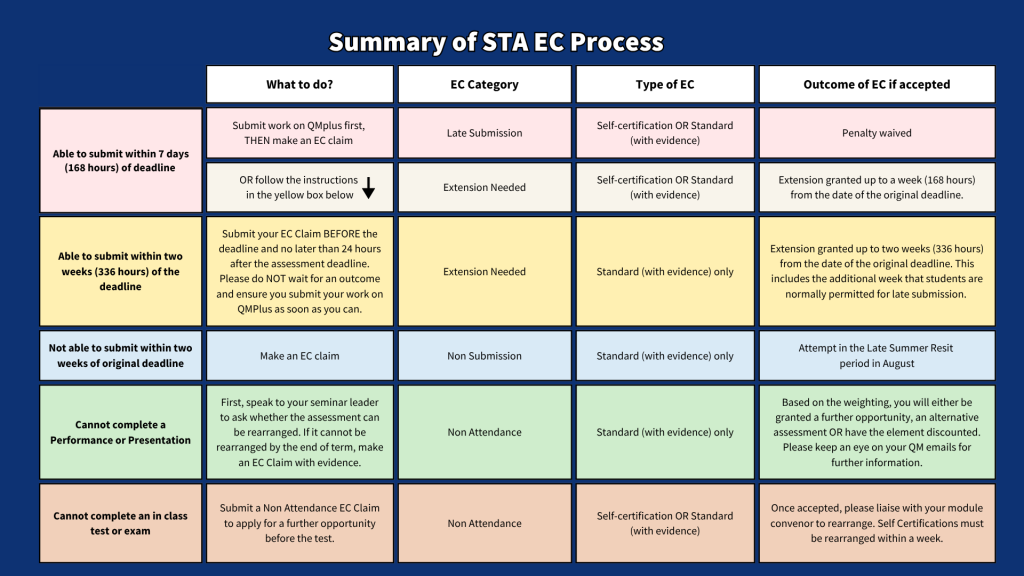
Please see the Extenuating Circumstances Guide for Students, on the Student Wellbeing Hub.
According to QMUL regulations, extenuating circumstances are:
‘Circumstances that are outside a student’s control which may have a negative impact on a student’s ability to undertake or complete any assessment so as to cast doubt on the likely validity of the assessment as a measure of the student’s achievement.’
The ‘circumstances’ mentioned in the definition above are usually personal or health problems. Health problems include your emotional wellbeing and mental health, as well as your physical health. However, please note that as the Advice and Counselling booklet on Extenuating Circumstances states:
Extenuating circumstances do not include events such as:
❌ Computer problems (including connectivity issues)
❌ Planned holidays
❌ Conflicting deadlines
❌ Running out of time
❌ Difficulty in obtaining books from the library
❌ Transport delays
❌ Work commitments.
❌ Submitting an incorrect version of an assessment.
❌ Academic workload issues
❌ Observance of a religious festival
Personal or health problems are only ‘extenuating circumstances’ if they are unforeseen and outside your control and are likely to have a negative impact on your ability to undertake or complete academic assessments such as exams or coursework. Flare ups of pre-existing conditions are grounds for extenuating circumstances but having a diagnosis of a condition is not.
See the section on “What if I have ongoing health or other problems?” in the Advice and Counselling booklet, which states that the extenuating circumstances process is designed to help students who have an ‘acute episode’ of difficulty.
The University can only consider extenuating circumstances that directly affect the validity of an assessment and are beyond the student's control. We assess actual achievement, not potential. Issues like missing teaching due to illness do not qualify unless they impact the assessment itself.
QMUL follows a strict ‘fit to sit’ policy: if you submit or attend an assessment, you are declaring yourself fit. Claims made after receiving results will not normally be accepted.
Extenuating Circumstances During Term Time
Extensions to Assessed Coursework Deadlines
If you are unable to meet an assessed coursework deadline owing to extenuating circumstances you may submit a claim to apply for an extension. This should be before the assessment deadline; claims submitted more than 24 hours after the assessment deadline may be rejected. This applies even if a deadline falls at the very beginning of a semester or during holidays. The same rule applies if your assessment is an "in-class" test during Semester One or Two.
For "in-class tests", an extension, should your claim be accepted, would mean an opportunity to sit the original test at the earliest opportunity after the original sitting. Once your claim is accepted, you must liaise directly with your seminar leader to rearrange this. If you are unable to complete this by the specified date, you will need to submit a Non-Attendance EC claim (with evidence) to request another opportunity in the Late Summer Resit period.
How to Make a Claim During Term Time
You will need to submit your claim using the online form in MySIS. Please ensure you familiarise yourself with the STA EC process before submitting a claim as this may differ from other Schools. If you wish to discuss your claim before or after submitting it, you should contact your STA Student Support Officer at sta-studentsupport@qmul.ac.uk.
Please remember:
- EC claims for extensions or missed class tests must be submitted via MySIS no earlier than 1 week before or no later than 24 hours after the assessment deadline.
- Coursework deadline extensions are usually set one week from the original deadline, with a valid claim.
- Class tests with a valid claim for 'non-submission', depending on how much these are worth, can be rearranged within the week or by the end of the term, or (depending on the weighting of the assessment) sometimes discarded.
- If you have had an extension, but still cannot meet the extended deadline, you will need to submit a new claim to request a further opportunity to complete the affected assessment during the next available resit period. Please note that having a resit may delay your progression or classification.
- If you have submitted a piece of coursework up to seven days late, you can make a claim for 'late submission' to ask for late penalties to be removed.
- If you are more than 7 days late submitting your coursework, you cannot submit your work as normal. You would need to make a claim for 'non-submission' and ask for a First Sit to be submitted in the Summer (see above).
- There can be no 'late submission' claims for class tests nor exams.
You must complete all parts of the form and submit it before the assessment deadline; claims submitted more than 24 hours after the assessment deadline may be declined.
There are two kinds of claim:
Standard Claim
You must upload appropriate documentary evidence (such as a medical certificate or police report/crime number) with a Standard EC Claim before submitting the claim. The evidence needs to cover the period of the assignment deadline or leading up to it. Standard Claims without evidence will not be considered. There is no limit on the number of Standard Claims that you can submit.
Self-Certification
There are some situations that fit the definition of ECs, but where it can be difficult or impossible to obtain evidence, for example, very short illness, family or accommodation crisis etc. In these situations, you can choose to make an EC claim with Self-Certification. You can only do this twice per academic year so please use these carefully. Your statement still needs to show how the situation meets the above EC criteria and is having a detrimental effect on your studies.
Self-Certification Restrictions:
- Self-certification covers up to 7 days only. Longer periods require a Standard Claim with evidence.
- You can’t use two self-certifications back-to-back to cover more than 7 days.
- Only one self-certification per assessment is allowed. If you miss the new deadline, you must submit a Standard Claim.
All claims are reviewed by the School and may be accepted or rejected.
Choose the Right Assignment
In the EC form, you choose the module and then the assessment. Be sure you choose the right ones!
For modules that have several small assessments, they often bunch them into one umbrella term, called 'portfolio' or 'continuous assessment' or '10 weekly quizzes' etc. If you need to make an EC claim for one of these, you need to choose the umbrella assessment and then specify the name or type of the specific assessment in the "Additional Information" field.
Choose the right "impact":
- Need Extension – submit this before the coursework deadline (or up to 24 hours after) if you need an extension for a piece of coursework that you have not submitted.
- Late Submission – select this option if you have already submitted your coursework late within 7 days and are asking for late penalties to be removed- (Note: this cannot be used for exams or class tests.)
- Non-submission - use this if you missed the submission deadline and did not submit late (e.g. when it’s too late to get an extension and you need another opportunity to submit your coursework). Self Certifications not permitted for this impact.
- Non-attendance - use this if you miss an exam or in-class test, to ask for another opportunity to sit it. Self-Certifications not permitted for this impact.
What Happens Next?
If you applied for an extension, please submit the work as soon as you can – do not wait to hear about the outcome of your claim.
EC claims are normally processed or queried within 3 - 5 working days of submission but may take longer in peak periods. You will be notified about the outcome of your EC claim via email so please keep an eye on your QM emails and carefully read the panel comments for further instructions and important information. Failure to do so can have a significant impact on your overall grade so please be vigilant.
Remember that, unless an extension has been agreed, a late assessment will be penalised by a deduction of 5 marks for each 24 hours of lateness, or any part thereof, for up to 7 days, and receive a mark of zero if submitted more than 7 days late. If you do not meet the extended deadline, these late penalties will apply. If you are still unable to submit the assessment, you will need to make a new Standard claim. The Committee will then consider whether to accept the claim.
Extenuating Circumstances During the Examination Term
Missed Exams or Non-Submitted Coursework
If you do not feel you are well enough to attend an examination, then you should not attend but must submit a claim for extenuating circumstances along with a doctor's note as evidence of your illness (Self Certification claims cannot be considered for exams). The ‘fit to sit’ rule means that if you submit an examination then you will be deemed to have declared yourself well enough to sit it, and as a result any extenuating circumstances claim will not be considered.
If you are taken ill during a timetabled examination, you should submit an extenuating circumstances claim with documentary evidence in the normal manner. In these cases, claims will only be accepted if you were fit to sit on entering the examination venue but – for unforeseen reasons – became ill during the examination. Any work you completed prior to leaving the venue shall be null and void.
Please note that extenuating circumstances in the examination term do not include:
❌ Having multiple examinations in close succession
❌ Misreading timetables
❌ Forgetting to set alarm clocks
❌ Computer failure
❌ Employment commitments
❌ Misjudging the time needed to revise.
You are expected to manage your own time effectively.
How to Make a Claim During the Examination Term for Missed Exams or Non-Submission of Coursework Throughout the Year
You will need to submit your claim using the Extenuating Circumstances form on MySIS. If you wish to discuss your claim before or after submitting it, you should contact your seminar leader and the STA Student Support Team by emailing sta-studentsupport@qmul.ac.uk or via the STA Reception in room 1.40 on the first floor of the ArtsOne building.
You will need to complete all parts of the form and submit it - including appropriate documentary evidence (such as a medical certificate or police report) – as soon as possible after the examination and before the final deadline.
What Happens Next?
All claims for missed coursework or exams are considered by the Extenuating Circumstances Committee of the School Board of Examiners. All claims for extenuating circumstances are kept confidential, and the proceedings of this Committee are also confidential. Details of individual claims will not normally be discussed at the full Examination Board meeting. The School will inform you of the result of your application after the Examination Boards have met.
EC claims deadlines
Extenuating Circumstances deadlines in 2025/26 for assessments/resits due in
- Semester 1 Monday 26 January 2026
- Semester 2, including exams and Spring 2026 resits Monday 18 May 2026
- Semester 3 (Foundation Programmes only) Monday 27 July 2026
- Late Summer Resit period (Undergraduate and Foundation Programmes only) Monday 17 August 2026
- Late Summer Resit period (Postgraduate Programmes only) Monday 24 August 2026
Further Information on Extenuating Circumstances is available here:
Advice and Counselling booklet on Extenuating Circumstances
We can't do anything if you don't tell us, you have a problem
It is not possible to make a retrospective claim for extenuating circumstances, specifically once you know your results. Therefore, claims submitted after the deadline will not be considered by the examination board.
At some point you might fall ill and need to see a doctor. When that happens, it can be very difficult to get back 'home' to your family GP if you are living in London. So if/when you move to London, you need to register with a GP.
You can find advice about where to go and how to do it on the Student Health Service website: https://www.studenthealth.qmul.ac.uk/
The Student Health Service
(SHS) is a free National Health Service (NHS) providing a wide range of services. Students living in QMUL accommodation at Mile End or Whitechapel and students living in the borough of Tower Hamlets (E1, E2, E3 and E14) are encouraged to register with the SHS (located on campus in the Geography Building, Mile End (number 28 on map). You can see a doctor or nurse there every weekday during term time. If you cannot register with the SHS, you can find your nearest doctor through the NHS website. QMUL students who are not registered patients may be able to use the service in certain circumstances. Please, visit SHS for further information.
If your illness causes you to miss a deadline or a test, you need to make a claim for Extenuating Circumstances (see previous chapter).

ADVICE AND COUNSELLING SERVICE (ACS)
The Advice and Counselling Service offers a range of free and confidential professional services to all Queen Mary students.
They have helpful advice and guidance for financial, immigration and other practical issues as well as emotional support on our website (welfare.qmul.ac.uk). You will also find information there about their services and contact details.
Financial, Immigration, and Welfare Advice
Their Welfare Advisers can advise you on solutions and options relating to financial, immigration, practical legal and welfare issues. They can advise you about your rights and entitlements to different sources of funding and welfare support, and also offer an advocacy service if you need professional representation to remedy your difficulties e.g. if you need help dealing with Student Finance England or the UK Home Office. They provide specialist advice and support on all aspects of student finance (loans, grants, bursaries), hardship funds and, welfare benefits and dealing with debt. We can help you plan your budget and find out how to reduce your spending.
If you are an international student they can advise you on your immigration rights. They can advocate on your behalf if you need help resolving an issue, for example with Student Finance England or the UK Home Office.They also offer preventative advice, on issues such as planning a budget and maximising your income from a range of sources, to help you avoid problems emerging during your studies.
They offer dedicated support for students who no longer have contact with their family (estranged), and students who have experience of local authority care, and students from a refugee background. They also provide support for students experiencing domestic abuse or forced marriage.
They provide confidential advice on all student and Tier 4 related immigration issues. The Welfare Advisers in the Advice and Counselling Service are the staff at Queen Mary who are authorised by the UK government to offer immigration advice to our students.
Counselling
Life can seem like a struggle at times, and it is normal to sometimes feel a bit low or anxious. Sometimes, though, emotional and psychological issues can become too challenging, and may have a negative effect on your studies and well-being. Their Counsellors can help you to make sense of difficult experiences and feelings by providing.The first step is meeting confidentially with one of our Counsellors to discuss what type of support might be most useful to you. This might be short term counselling, group therapy, cognitive behavioural therapy or a referral for longer term support or specialist services outside Queen Mary / in the NHS. For many students, just one or two sessions can really help. Their Counsellors are all highly experienced in working with students, and all types of issues.
Contacting the Advice and Counselling Service
For more information about available services and contact details please visit the Advice and Counselling Service’s website: www.welfare.qmul.ac.uk
MENTAL HEALTH ON CAMPUS
QMUL Wellbeing Hub webpages have all the information about wellbeing in one place, so that's the first place to look.
Mental health issues, like depression and anxiety, are common and real and nothing to be ashamed of. If you are experiencing difficulties, and it is not an acute crisis, please get in touch with your Advisor as the first point of contact. They can help you to contact the Advice and Counselling Services (see Section 9.3).
If you are experiencing extreme difficulty, please contact: https://www.qmul.ac.uk/welfare/help-in-a-crisis/
External Support Networks:
Togetherall: An anonymous, peer-to-peer service. Online community designed to: Improve your mental health, Get Peer Support, Access MH Threads:
https://togetherall.com/en-gb/
Samaritans: An anonymous listening service operating 24/7. Confidential, non-judgemental.
https://www.samaritans.org/how-we-can-help/contact-samaritan/
Call: 116 123
Nightline: An anonymous listening service running through the night, during term time. Run for students by students, confidential and non-judgmental.
PERSONAL HARASSMENT
Queen Mary is committed to creating an environment for work and study where staff and students are treated with dignity and respect. We have no place for bullying, harassment and hate. We recognise that these behaviours can take many forms. Any allegation of harassment, hate crime, bullying or victimisation will be treated seriously, regardless of the seniority of those involved, and anyone found to have behaved unacceptably may be the subject of disciplinary action subject to the processes detailed in the relevant Queen Mary policies.
All members of Queen Mary have a collective responsibility to: encourage a culture of dignity and respect; to treat others fairly, with courtesy and consideration; and to challenge inappropriate behaviour when it is safe to do so.
The University has a comprehensive policy on harassment and recognises any type of behaviour perceived as harassment on grounds of sex, sexual orientation, ethnic or national origin, religion, political conviction, disability or age. Harassment of students is a disciplinary offence and is always treated very seriously.
Resources:
Consent Matters is an online training course to learn about giving and receiving consent in relationships. All students are required to complete the course.
Report and Support is the secure online platform for anyone at Queen Mary to report harassment, gender-based violence or hate crime, and find out about support options. If you have experienced or witnessed any form of bullying, harassment, violence or hate crime, please use the link to file a report (anonymously or with contact details.)
FINANCIAL SUPPORT AT QUEEN MARY
For all student finance concerns or questions, you should contact AskQM
This includes questions about: Tuition Fees, Student Loans, Bursaries, Grants, Scholarships and the Queen Mary Financial Assistance Fund.
You can also find information on the main Registry Services Page.
If you find yourself in financial difficulties the Advice and Counselling Services can provide help and guidance.
INTERRUPTION OR WITHDRAWAL OF STUDIES
If, for personal reasons, you decide that you would like to take a break from your programme (called a period of interruption), or withdraw from your studies, then you must do so officially so that your QM records can be updated. It may be possible for you to interrupt your studies after you have completed a year of your programme (at the beginning of the next academic year), or at the end of a semester.
- Students are allowed to Interrupt for up to a period of two years (either consecutively or at different points in the degree programme.)
- If you Withdraw, your enrolment is terminated permanently.
There can be many reasons for Interruption of Studies. Some common examples are:
- illness that prevents you from attending a significant portion of your classes
- unsure of course- thinking of changing subjects, but not wishing to lose your place at uni
- financial burden
- family responsibility
Some of the same reasons may also lead to Withdrawal.
In the first instance, discuss your situation with your Advisor. You will then need to contact STA Student Support ( sta-studentsupport@qmul.ac.uk) to further discuss your decision to interrupt or withdraw and to complete the online form via MySIS.
As part of your decision-making process, please consult the Advice and Counselling (ACS) pages about tuition fee and potential visa implications of interruption and withdrawal.
The deadline to submit your interruption form:
Please be aware that most programmes have two assessment periods – one in January following Semester A teaching and one in May following Semester B teaching. The deadline for submission of the interruption form for most programmes is the day before the start of these assessment periods.
Further points to consider:
- After taking a period of interruption, you must resume your programme where you left off. For example, if you interrupted after completing your first year, after taking a year out, you would resume your second year the following September.
- Remember that withdrawing from your programme is a decision that should be taken with serious consideration, and alongside the advice of staff in the School (such as your Advisor). Once you withdraw from your programme, it isn't possible to simply 're-join' or pick up again where you left off. Withdrawing from your programme means you no longer have any intention of continuing on your programme at all.
- Don't just 'drop out' or stop attending classes. This could have serious financial consequences.
Appeals and ComplaintsAppeals Before submitting an appeal please speak to you Advisor or contact the School via AskQM about the decision you wish to appeal. In many cases, issues can be resolved without the need for an official appeal. You should be able to request feedback on your marks or degree classification from the module convenor or Advisor as appropriate. If you wish to submit an appeal then you must submit the request within 14 days of the notification of the decision you want to challenge. Information about how to appeal and the appeal form can be found on the QMUL website. Please note that appeals against academic judgment (e.g. marks) are not permitted.
Complaints If you wish to make a complaint, please contact the School via AskQM in the first instance. We will then be able to refer your complaint to the appropriate person (for example, the Head of Department) and will be able to let you know what is happening with your complaint. In many cases, complaints can be resolved informally without need for a formal complaint. If your issue it not resolved through the informal process then you will need to complete the Stage 1 complaint form and submit this to the School for investigation under the Student Complaints Policy. |
Appeals
An academic appeal is a request to review a decision about progression, assessment or award. Before you submit a Formal Appeal, please speak to you advisor or contact the School via AskQM about the decision you wish to appeal. In many cases, issues can be resolved without the need for an official appeal. You should be able to request feedback on your marks or degree classification from the module convenor or advisor, as appropriate.
If you wish to submit an appeal then you must complete the appeal form within 14 days of the notification of the decision you want to challenge. Please note that appeals against academic judgment (e.g. marks) are not permitted.
Further information about the grounds for appeal and how to submit a Formal Appeal can be found on the Queen Mary website: http://www.arcs.qmul.ac.uk/students/student-appeals/appeals/index.html
Student representation and feedback
Your views are important to STA and Queen Mary. There are a variety of ways in which you can tell us what you think and share your ideas for improvements. Student representatives, elected by fellow students, also speak on behalf of the student body at the School, Faculty and QMUL-wide level via various committees, groups and meetings.
Feedback can be discussed at our STA Student Voice Committee meetings or given via Student surveys. You can find more information at my.qmul.ac.uk/your-voice/feedback
For more information about the role, please see the Student Union page: Student Voice Committees (SVCs)
Student voice committees (SVCs)
Student voice committees (SVCs) are an important channel for students to air their views, criticisms and suggestions for improvements, and a wide range of issues regarding modules and teaching is covered each year. All reasonable suggestions are carefully considered by the department(s) concerned. Issues raised are reported to the School Education Committee, where appropriate, with other matters being referred to the Head of School. Students are encouraged to make full use of this forum. You can read more on the Queen Mary feedback pages and the QMSU representation pages.
Terms of reference
The SVCs exist to consider and discuss matters relating to:
- the content and organisation of programmes of study and any proposed changes;
- the provision of academic facilities and general departmental/ School/ College facilities;Departmental/ School social activities;
- provision for student welfare
- arrangements for induction and study skills provision;
- Local monitoring of academic standards through, for example, consideration of annual programme reviews on undergraduate and postgraduate teaching, external examiners' reports, first destination statistics and results of student experience surveys;
- election of student representatives to Faculty/ School Boards and College committees with assistance from the Students' Union;
- any other topics on which the SVC wishes to express a view.
Membership
In STA, Directors of Student Support and Engagement co-run the Student Voice Committees along with one student course representative.
Meetings are held twice per term, and all the Student Reps are invited to voice their views and concerns after gathering comments from the groups of students they represent. The School SVC is attended by key members of staff, in order to be able to answer as many questions/points directly and immediately as possible.
Membership includes:
- One or more undergraduate student from each year (first, second and final)
- One or more taught postgraduate student
- One or more foundations students (IFY, PMP)
- Directors of Education
- Directors of Student Support and Engagement
- STA Student Engagement Manager
- a representative from the STA Student Support Team
Election of student members
The Students' Union hold elections for Course Representatives in September and October. The Students Union provide full training to those who are elected. Students will be invited to nominate themselves each year to represent their subject area and year. Once elected, a student Course Representative remains in post until they graduate or they step down. This allows students to gain experience and pass it on to new reps, as Senior Representatives.
If you are interested in becoming a Student Course Representative, go to the Student Union Hub and ask about it, or have a look at their website www.qmsu.org/yourvoice
Student surveys
Your views are important to the School of the Arts and Queen Mary. There are a variety of ways in which you can tell us what you think and share your ideas for improvements.
Module Experience Surveys
In the last few weeks of semester you will receive an email with link to complete a Module Experience Survey for each module. This is your chance to anonymously rate and comment on the module, its content, and how it was taught. Your teachers may give you time in class to complete your survey, but you can complete it at any time
All responses are anonymous. Once the survey has closed the data is collated and reports are sent back to the School, with a breakdown of the average response on each rating question, and with all the written comments included, but without any names or numbers attached. These are then seen by the module organisers so that they can use the feedback to make improvements to the module for next time. Any very poor ratings are flagged up at Department and School Level, so that any problems can be discussed at Department meeting or at the STA Education Committee and actions can be taken.
Survey etiquette. Remember that what you enter on your module experience surveys is anonymous. There are some guidelines you should bear in mind:-
- Outline as clearly as possible what you thought was best about the module and teaching, and how the module could be improved/developed, along with any other comments you have;
- Don't use language which is inappropriate, offensive or abusive. Forms containing such language will be immediately disregarded from the evaluation process.
National Student Survey (NSS)
All final-year undergraduate students at UK institutions take part in the National Student Survey (NSS). The NSS is a nationally recognised annual survey of mostly final-year undergraduates in the UK. The survey gives you an opportunity to give your opinions on what you liked about your time at Queen Mary as well as things that you feel could have been improved.
If you are a finalist, you will usually be contacted by email early in the spring term. Please do complete the NSS, and fill it in honestly.
The NSS results are made publicly available to help prospective students make informed decisions of where and what to study. Queen Mary and the Students’ Union will also use the data to identify areas of strengths and weaknesses to help effect change and bring about enhancements to improve the student experience for future generations of students.
Postgraduate Taught Experience Survey (PTES)
The Postgraduate Taught Experience Survey (PTES) enables higher education institution to gather important information about the experience of any taught postgraduate student on a Masters, Postgraduate Certificate or Diploma course. PTES also considers students’ motivations for taking their programme and – where relevant – their experience of undertaking a dissertation or major project.
Learn a Language
Second and final year students have the exciting opportunity to apply to take a language module either as part of their programme (i.e. for credit) or in addition to their programme (i.e. as a non-credit bearing module). For more information, including what modules are available and how to apply please visit the Language Centre web pages.Non-credit bearing modules are normally self-funded, but language module fees may be funded by the School of the Arts in some cases. Please indicate on your online application form – see link above - if you’d like to be considered for funding. The number of funded places available will depend on the overall School funds dedicated to Language Scholarships for the academic year in question.
Please note that first year students are not eligible for funded places on language modules unless it is part of their programme.
Equality, diversity and inclusion in STA
The School of the Arts at QMUL strives to be an inclusive work environment, a community committed to ensuring equality of rights, recognition and responsibilities for all, irrespective of ability/disability, sexual orientation, racial background, social background, age, sex, gender, marital status, maternity status and religion or belief and challenging ableism, homophobia, racism, sexism, xenophobia, and discrimination based on religion, class or age.
To foster inclusivity STA will:
- Call out discrimination of all kinds wherever and whenever we see it
- Listen to one another, support and hold up one another
- Express our commitment to social justice publicly and openly
- Recognise and name barriers to access when we experience and witness them
- Recognise that we do not all experience this space equally
- Work on making this space one which is sustaining for all
The STA EDI Committee will:
- Treat each other with respect, value the input of everyone irrespective of grade, role or experience; ensure no one dominates.
- Advise the School on all areas of equality, diversity and inclusion work in relation to staff and students.
- Provide forums for staff and students to be safe in their discussion of discrimination that has been experienced and witnessed
- Engage students and staff with maintaining and developing a culture that supports a good work life balance.
- Share and disseminate good practices relating to progressing equality and diversity across the School.
- Monitor and review training and mentoring practices across the School.
- Review current and future School equality charter awards, to prepare and submit applications for renewal as required.
- Seek to raise the level of awareness and engagement of staff and students in equalities matters and encourage their active participation in the principles of the Equality Act and its implementation.
- Work with the Faculty and wider University structures to support members of our School in ways that are inclusive and enabling.
- Start and end on time; come prepared and contribute; respect confidentiality—when sensitive matters are shared, they should stay in the room.
IT and language learning facilities
IT services
Our services to support students range from email and internet access, to state-of-the-art teaching and learning facilities and high performance computing in support of research. There are a number of rooms around the campus that contain computers which students can use. You sign in using your QMUL username and password. In general, any computer you use on campus will have all the applications that you need for your course available to you.
Your IT Account: Details of your QMUL username and password will be emailed to your personal address before you enrol.
The IT Service (virtual) Desk is the first point of contact for all IT help, support and advice. You can Live Chat with the Service Desk 24/7 www.its.qmul.ac.uk/about/contact, call on 020 7882 8888 or raise a ticket via the Self Service portal servicedesk.qmul.ac.uk/esc.
Should you require in-person support then please contact us via Live Chat and we can book you in. Our opening hours are Monday to Friday, 7am-7pm.
Find an available PC on campus: an interactive map showing which rooms have empty seats availability.stu.qmul.ac.uk
Microsoft 365 training for students: you can find videos and training guides for all the Microsoft 365 apps and services that Queen Mary students have access to here
Print, Copy, Scan: There are printers located across campus to use, with all devices offering both copying and scanning facilities alongside printing. Wireless printing services are also available and more information can be found on the ITS webpage. The cost of printing and photocopying is automatically linked to your MyPrint account, which is linked to your student ID card. You are charged for printing and copying by clicks (1 click = 1 side of paper). The cost of a single side is 4p but drops to 3.5p when you print double-sided. All students will receive £10 each year through your MyPrint account to use for printing and copying.
The CopyShop: A quick, professional and cost-effective photocopying and printing service. We can print a range of items for you, including: Theses/Dissertations, Lecture notes, Posters and much more.
Book Scanning Service: The CopyShop offers students a professional scanning service. If you wish to retain a section of a publication for study use, the CopyShop produce a clear image without fingers tips, black areas and poor results for you.
We can also scan materials you wish to include in your research materials in the correct format you need, for example Research Posters for William Harvey Day….no more fuzzy images.
Wi-Fi: The wireless network you use to connect your devices is eduroam. Halls of residence are fully networked with Wi-Fi and a wired socket in each study bedroom. Access to e-mail, QMplus the online learning environment and other services relevant to your study at QMUL is available from the Internet as a whole.
Mobile app: QMUL’s mobile app is available as a native app for Android (version 2.3.3 or higher) and iOS (version 6.0 and above) devices. The app allows you to do a number of things on the move, including: check your course timetables, log into QMplus and your QMUL email, search for and renew library books directly from your phone
Language learning facilities
The Multimedia Language Resource Centre in the Bancroft Building is timetabled for class-based sessions and may be used for self-access study when not in use for teaching. There are satellite-viewing facilities for foreign-language television channels.
Careers and Enterprise
Looking for part-time work or an internship? Need help with your CV or a job interview? Want to find out about your options when you graduate? Thinking about starting a business?
The QM Careers and Enterprise Team provides a range of services that enable you to develop your employability skills, access work experience and graduate job opportunities, network with employers and decide on your next steps after graduation.
You are able to participate in a diverse careers programme. This might include in-curriculum lectures, lunchtime workshops, professional career options panels, 1-to-1 careers guidance, application feedback appointments and mock interviews. This is supported by a wealth of careers information online.
There are employer-led events on campus a year, from fairs to skills workshops. These offer you the chance to network with recruiters and get training on self-presentation skills for the recruitment process. Careers and Enterprise also provide a range of paid work experience opportunities that give you understanding about different sectors and employers.
For those who are aspiring entrepreneurs and social entrepreneurs, the enterprise programme supports students in setting up their own businesses via initiatives such as seed funding.
You can can find out more about the services offered by Careers and Enterprise and book appointments via the website: https://www.qmul.ac.uk/careers/
Student societies
Creating or joining a society of like-minded fellow students can be a richly rewarding experience. Have a look at the list on the website and find something that interests you, or if you don't see what you're looking for you can create you own new society and recruit members.
The Students' Union subsidises student-run societies and the School welcomes its students setting up societies to organise events, such as parties, visits to relevant exhibitions, plays, films etc. relating to their subject areas.
Use the link above to go to the Student Union's Societies website, or go to www.qmsu.org/clubs-socs to find out more.
Music at Queen Mary
Music is central to cultural provision at Queen Mary. Music at QMUL can help if you are interested in applying for music scholarships, joining an ensemble, taking up tuition or simply attending one of the many musical events you can check the website and contact music@qmul.ac.uk.
The teams main responsibilities are:
Housing Services, based in the Housing Hub, Feilden House, Westfield Way at Mile End, manage halls applications, room allocations, room transfer requests, summer accommodation, residential fees as well as providing a comprehensive alternative housing service.
Contact Housing Services on: housingservices@qmul.ac.uk
Residential Services, based at the Residences Reception, France House, Westfield Way at Mile End, look after you once you have moved into Queen Mary Halls and has three key areas you will interact with during your stay. Residential Services is made up of 3 teams; Residential Operations, Residential Life and Residential Welfare and Support.
Contact Residential Services on: residentialservices@qmul.ac.uk
If you are a resident in College accommodation you should consult the Residents’ Handbook for comprehensive information on all hall related issues, and contact details for the relevant section of Residential Services